The artist’s talents were well elaborated in his most recent solo exhibition Monuments for D. Flavin at Roebling Hall in Brooklyn, New York.1 Navarro’s formal and conceptual starting points for his five fluorescent sculptural pieces were Dan Flavin’s late 1960s untitled series of white fluorescent light sculptures that Flavin dedicated to the Russian artist Vladimir Tatlin (1885-1953). In the mid-1960s, after completing that series of wall sculptures (many of which are in the DIA Foundation collection), Flavin wrote on the ‘monuments’: “Thus far, I have made a considered attempt to poise silent electric light in crucial concert point to point, line by line and otherwise in the box that is a room. This dramatic decoration has been founded in the young tradition of a plastic revolution, which gripped Russian art only forty years ago. My joy is to try to build from that ‘incomplete’ experience as I see fit. [The work] in cool white fluorescent light memorializes Vladimir Tatlin, the great revolutionary, who dreamed of art as science. It stands, a vibrantly aspiring order, in lieu of his glider, which never left the ground.”
Flavin thus acknowledged Tatlin’s revolutionary role as an artist whose utopian dream rested with the Monument to Third Revolution, a structure that was never built! In the same way that Flavin looked back some forty years on Tatlin’s contributions that provided ideas for his new series of sculptures made from commercial lighting fixtures, Navarro, too, looked back on Flavin’s inheritance and radical innovation and stated some of his own objectives in his catalog brochure when he quoted Flavin’s remarks on Tatlin’s ‘monuments.’ With a deft mixture of respect and irony, Navarro wrote a brief text titled “Monuments for D. Flavin” for his own exhibition. In that text, the Chilean artist noted that Flavin’s “dramatic decoration has been founded in the young tradition of the plastic revolution that gripped American art only forty years ago.” Navarro added that his joy comes from trying to build from Flavin’s incomplete experience.
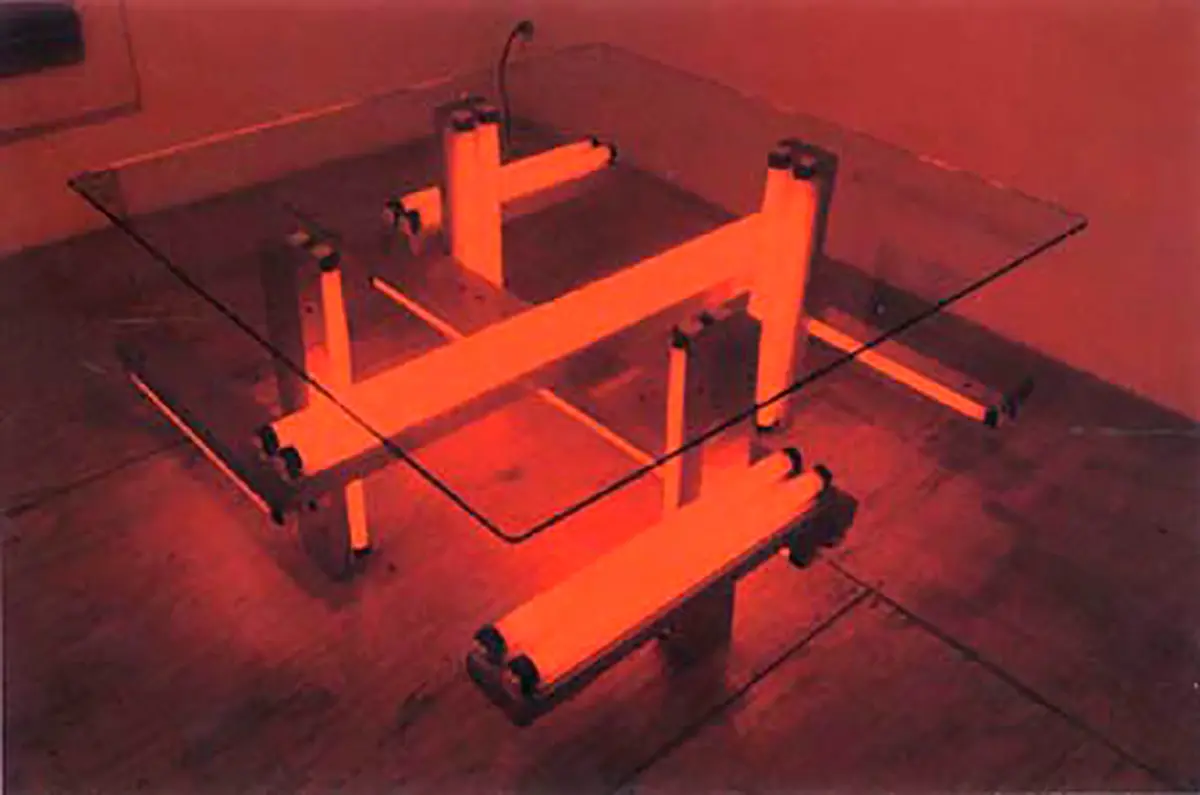
In attempting to build on Flavin’s experiences, or differently stated, investigations, Navarro constructed five very impressive large-scale sculptural objects in the form of a shopping cart (Homeless Lamp), an illusionistic reflecting pool (Black Hole of Light); a combination cocktail bar and gallery bookshelf (Yellow Bar); a chair based on Gerrit Rietveld’s ‘Red-Blue’ chair (Blue Electric Chair); and a coffee table (Joy Division). Each sculpture was made of fluorescent light fixtures with different colored covers to produce the colors purple, green yellow, blue, or red. Despite the explicit references to the formal vocabulary of Flavin’s fluorescent lights, the viewer is impressed by the immaculate handcrafting of the light fixtures, the captivating colors, and the intriguing titles. A closer examination of the objects reveals a more immediate relationship to material reality than might at first meet the eye. Joy Division, for example, is designed ostensibly as a large coffee table with a base structure in the form of a swastika. Navarro, who enjoys weaving diverse pop cultural references into new narratives, appropriated the title of an English punk rock band (Joy Division) that began singing as a group in the late 1970s. Through the years, Navarro came to know one of their popular songs, No Love Lost, which made reference to Nazi concentration camp brothels. Knowledge of the camp brothels became the conceptual starting point for the artist’s incorporation of the Nazi insignia, an icon that raises eyebrows wherever it appears. Navarro’s reference to that piece of history is but a fragment of a larger ongoing historical picture in which some form of abuse emanates from the rank, unbridled behavior of the victimizers. Navarro’s use of that insignia, stemming as it does from the sounds of the Joy Division, also reminds us that weighty historical lessons are often passed on to younger generations in the popular form of a rock band’s lyrics.
Navarro turned to another modernist artist for ideas for his Blue Electric Chair. Rietveld’s famous Red-Blue chair (c.1923) is composed of horizontal and vertical rectilinear planes that overlap at the point of intersection, thus blurring the volume of the chair and its surrounding space. While the general shape of the modernist chair is reflected in the linear planes of the blue and white fluorescent lights of the contemporary work, the actual function of the electric chair is proposed by its title. By referring to a modernist chair, from the avant-garde movement De Stijl, Navarro establishes an alternative narrative for his blue and white fluorescent sculpture, charged—no pun intended—with less utopian ideals than those that influenced the earlier Dutch architect and furniture designer who pioneered a new territory for his designs.
The exhibition at Roebling Hall holds much promise for this emerging artist who has produced a very compelling body of thought-provoking sculpture during the past few years. This new work is a very successful attempt to advance previous investigations that have changed the direction of artistic production in distinctive historical moments.
NOTE
1. The exhibition was on view from May 21 through June 21, 2004.
JULIA P. HERZBERG