
“Contraplanos refers to a film technique that enriches the narrative. Also called a counter field, is the move from one shot to another shot of the same scene from an opposite point of view. The title of each work expresses the concept of a series of buildings ironically lacking any narrative, all of which can be entered from different and contradictory planes."
Romano’s works are objects that join together pictorial and sculptoric elements. They seem closer to realism than to abstraction, even though they don’t allude to any aspect of reality. These objects reaffirm the materiality of their physical components, and the inward- and outward-projections created by planes attached to the wall. The artist points out that these are not paintings. They do not recreate spatial depth through the juxtaposition of color fields, nor do they tend to bring out signs against the surface.
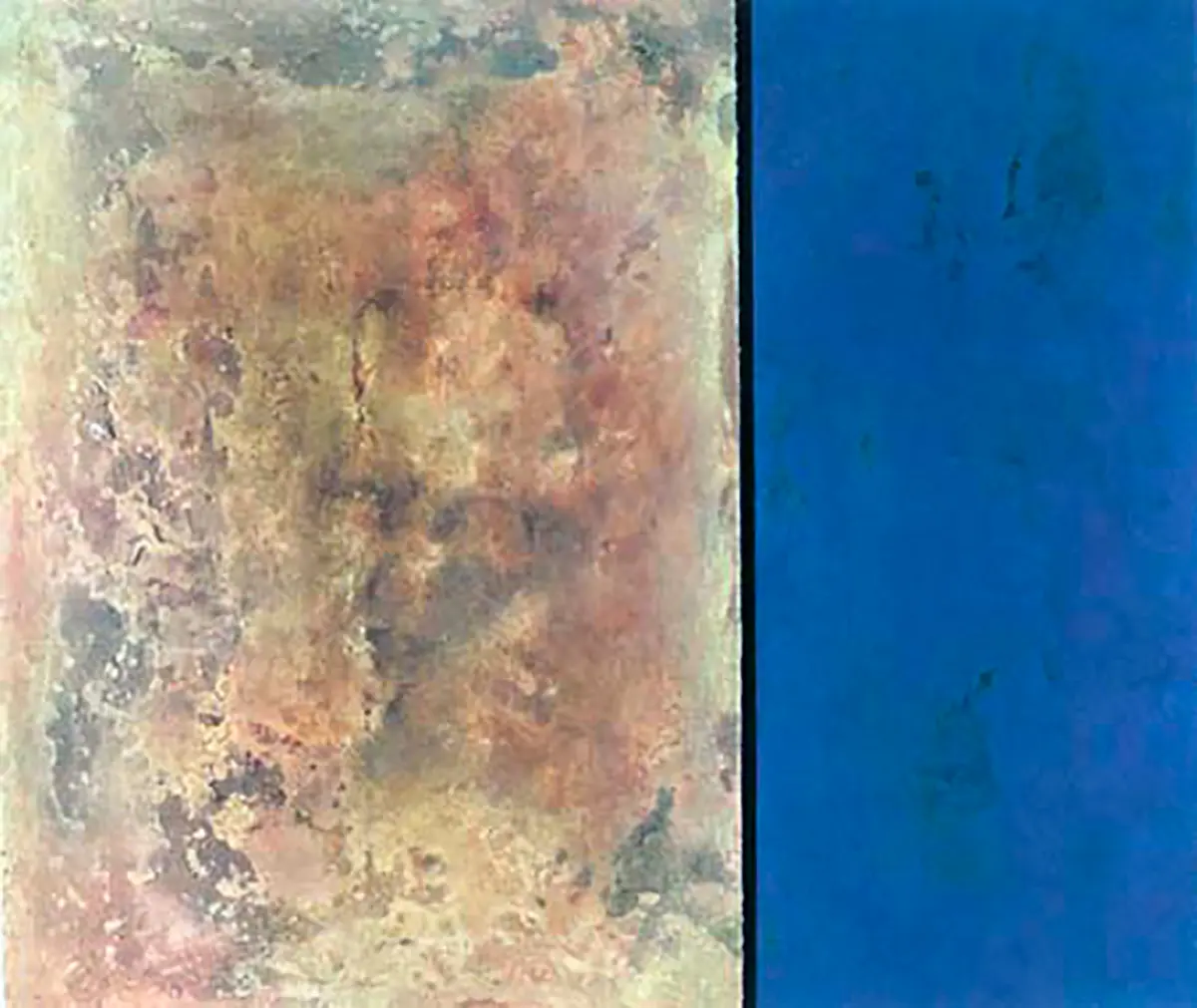
Nevertheless, most of these 36 x 45 in pieces are in flat formats and intense contrasting colors, like a large part of abstract painting. Each piece is divided into two irregular panels joined at a painted “incision” or canal. The surfaces of the canvases that form these panels are covered in layers of sand, glue, and pigment. Romano doesn’t think of them as representations of textures, but as “the closest thing to the textures themselves.” His contraplanos are flat objects that can be looked at from different angles, including the sides; these are not borders or frames but narrow planes. Romano’s abstract work takes distance from Pollock’s biographic gesture and Rothko's will to transcendence, coming closer to proposals such as Jeremy Gilbert Rolfe’s, where abstraction means surface, point-of-view shifts, and materiality.
After a process of experimentation and conceptual search, Romano has inscribed himself in the interplay of absolute structure and the fluidity of the blotch. On the basis of an investigation motivated by the works he presented at Puerto Rico’s Museo de Arte Contemporáneo in 2002, about collage and two-dimensional surfaces, he renews abstraction validating the dissolution of the borders between painting and sculpture. His contraplanos are no more than a schiacciatto of inward and outward projections with a single focus of interest: the surface. Wrinkly, sandy, with sometimes imperceptible bumps, the surface captures the attention of the viewer, who is compelled not just to look at the object but also to touch it. Nevertheless, the visual element is not set aside in favor of the sculptural element; each plane or panel is an intense color surface that contrasts with its couple and the incision that separates them.
There is a structural contradiction implicit in Romano’s non-representational proposal: the visual element threatens to destabilize the work as an object. The planes of sandy surfaces reaffirm the object’s materiality, while their intense and vibrant chromatism drives us to seek a pictorial space that negates the surface. It is in this contradiction that the work’s conceptual strength resides. Romano has said: “Without external referents, the canvas is nothing but a canvas, wood is no more than wood, matter and color only represent themselves.” However, the associations with the pictorial do not disappear. Two-dimensional format and color contrasts make us, initially, relate these ‘objects’ to painting. However, the question arises about the incision. This element, despite being painted, breaks the sequence of the traditional format, creating an “in” that reasserts the separation of the two planes. The incision is a low-relief that obstructs the imaginary location of a horizontal parallel, in the lower part of the object, in order to project them and build a perspective. Romano has also said that this element does not have the purpose of separating or uniting two parts of a diptych; what it does is allow the viewer to move “in,” or to see the work from different planes and points of view.
It would seem that each contraplano can be read in two opposite ways, depending on the artistic conventions that dominate the viewer as he or she formulates questions about the piece. The chameleon-like essence of Romano’s work refers to the debate about the death of painting, and it inscribes itself in the topic of the nature of images. About the latter, the nature of images, the practice, criticism, and philosophy of art have expounded amply. In his picture theory, W.J.T. Mitchell elaborates a typology that includes puzzle images, meta-images, dialectical images, and talking images. Meta-images are those that motivate a reflection on the nature of all images. Jaime Romano’s contraplanos can be classified as that. They express a theory of what a work of art can be. Romano’s work could be an argument and at the same an example of the objectivity of matter that crystallizes in attention to the mutability of artistic language. The abandonment of the logic of traditional work in painting and the impossibility of restoring the unity of modern painting guarantees the unlimited number of artistic combinations in the postmodern era.
The show is complemented by a catalog with the same title, Contraplanos.
INGRID MARÍA JIMÉNEZ MARTÍNEZ