Upon entering this exhibition, the large number of sculptures and their symbolic charge seem overwhelming. Works such as Tapestry in Black and Red and Large Black Tapestry, which are made up of numerous vertical units, follow the trend of her earlier works in spite of the fact that they no longer display the brilliant colors that played such an important role in the past. According to the artist, who has lived in the United States, Israel, and Panama, her recent work reflects what she considers a dark period in the history of humanity, with its terrorist attacks, wars in the Middle East, and hatred between ethnic groups. Not only has she darkened her colors, but the assemblages are now mounted on the wall in such a way that they no longer move freely nor allow the viewer to walk through them. Rather, they must be “read” from left to right. In many of the assemblages, a metal bar attached to the wall supports the pieces, including the vertical sticks and boards carved into rectangular forms. Although they share a single unseen horizontal axis that imposes a static position, the pieces invade the space above and below that central line at varying heights and distances. The sticks show the natural bulk where branches once emerged, while the more two-dimensional chunks of wood reveal their origin as industrially cut planks, which the artist then transforms.
One of the most striking works in the show is Tapestry with Heart in which an exquisite balance of forms is complemented by undulating blocks of wood that are superimposed onto the basic shapes, enriching and enlivening the ensemble, which the artist crowns with a heart of battered metal. Dreams of Black Hair, which echoes the Tapestries, is equally impressive, although in this case, the poles hang from fine wires attached to metal loops driven into the wall. There is a lyrical feeling and visual movement in the way these carved pieces—some with curved edges—play with the irregular borders of the other forms.
In addition to the assemblages, there are several sculptures of single vertical units that contribute to clarifying the message of this exhibition. Woman No. 2 is a wooden piece, the top of which is split in two. The perimeter is totally covered with angular nails that give the sculpture a look reminiscent of the stinging surface of a black, poisonous caterpillar. Woman No. 5261230 has a chunk of wood for a head, three sets of eyes, tears, a number engraved on a metal band, a pubis of protuberant nails, and a hole in its wooden shaft. The number is particularly meaningful and disturbing within the context of Milson’s Jewish faith. In the works she named Bodies, Milson incorporates a mirror, or a collar and chain in the space usually occupied by the head; on the lower edges of the phallic forms, she places tiny feet of lead that hang from the wood as if suspended in the air.
The metaphors are greater and the language simpler in sculptures such as Vagina Fetish No. 1, in which a thin vertical plank with straight edges has a narrow, cutaway middle, an empty space that allows a view of the background wall. Seen from the side, the piece is all curves and femininity. From its lowest point hang two lead tears, which together resemble genital labia. The meaning of Twins, made up of two thick bristle brushes, painted black, under which hang two pairs of leaden tears, is even more explicit.
The tiny metal symbols that the artist includes in some of her new sculptures stem from her interest in the small lead figures called “miracles” which are sold in Panama, especially in Portobelo, where the followers of the Black Christ buy them in gratitude for answered prayers. Although the tears in this exhibition were made by Milson herself by hammering lumps of lead, the miniature eyes, breasts, legs, and feet are found objects that she incorporates into her works with great mystery and much humor. Miracles, which a carved narrow, horizontal, wooden pole perforated with small circular openings through which one can see the tiny, hanging “miracles” provides a good example. In Orphan, a single horizontal wooden bar provides the anchor for a long line of tears hanging from thin wires, and one single cast iron fishing boat refers not only to the hard life of the inhabitants of Panama’s Atlantic coast but also to the sense of solitude that characterizes many of the sculptures in this exhibition.
This show reveals a step in a new direction for Milson. Beyond finding objects, now she casts them in bronze, iron, or aluminum, to create objects that she later makes part of her compositions. In several assemblages, she includes little cast iron fishing boats, related in size to the above-mentioned “miracles.” Larger scale casting is apparent in the iron doll faces that appear chained to the wood in Childhood; as part of a delivery in Birth Box; or in disturbing repetition in the piece entitled Familiar Face. The next step for Milson—who says she never played with dolls as a child—was to reproduce the full body of a doll in metal; this reproduction is present several times in this exhibition, albeit always broken up in parts.
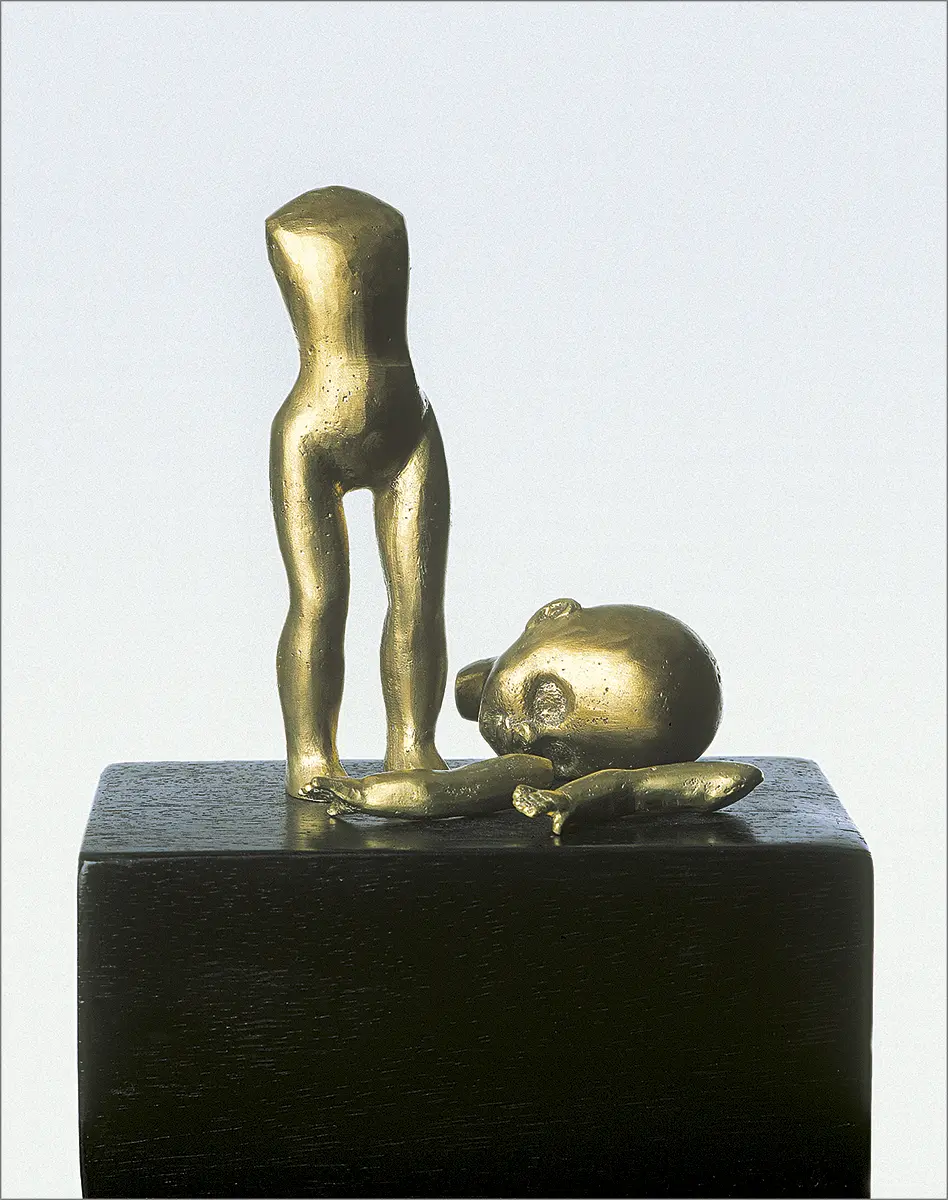
For Ona, a work in bronze dedicated to a psychoanalyst friend—who, according to the artist, “puts people together again”—shows a doll’s body and legs, and to one side, her arms and head. The head, which is disproportionately large for the body, seems to reflect the idea of a brain overloaded with thoughts and concerns. In Birth Box No.2, the baby doll’s body hangs under a wooden box where one presumes her head still is. Cast aluminum dolls are also included in the pieces Box of New Miracles and So Others Don’t Cry. In the first of these, four doll bodies hang separated from their heads in a nightmarish window; in the second, the heads are like balls on which three playful, headless dolls try to balance. In Doll, the figure’s childlike body has a head, but it appears surrounded by a halo of nail tips in a clear reference to sainthood and feminine sacrifice. The arms, which rest on the pedestal, are connected to the body by thin chains that allow the viewer to “play” with the figure. Finally, Milson included in this exhibit My Head is Your Head, with a title that echoes the popular Latin American phrase “My home is your home”. In this piece, two highly polished, shiny aluminum heads seem to encourage manipulation, in a sensual and ironic game.
In Nocturnes, Lezlie Milson bravely moves away from the decorative colors of her earlier work to show us a strong and dramatic world that reflects both her convictions and the effect of the outside world on her psyche. Confronting technical challenges, the artist presents sculptures that are characterized by an intense physical presence. Her Nocturnes avoid complacency in order to express—in a not-too-subtle way—issues of gender and humanity, to which the viewer can relate or react, from the first visual impression to the innermost thought.
MÓNICA KUPFER