The mystery, if we can call it that, resided in the origin or the provenance of those gestures, in the hand of an uneducated woman, completely isolated from information about art such as that provided by academia or manipulated by the so-called artistic field. Not having a résumé or the appropriate reference created for her the problem of facing, without a known lineage, such a conventional, secretly intolerant, hierarchical environment as the art world, especially at a time when the image created by a gallery or by an artist’s agent in the media often ends up being the defining element, the work relegated to the background.
And to pigeonhole the whole affair as naïf would have been the easiest and most comfortable thing, as Art History would then place her in the chapter devoted to popular artists, the childish ones, to avoid any disturbance caused by the consideration of complex situations. This underhanded discrimination has existed in all official cultures. Paul Virilio points it out: “Precisely regarding the disappearance, the decadence, let's wonder about the elision of Naive painters, of Vivi, of Bauchant, not to speak again of Rousseau and the war, his masterwork that inspired Picasso’s Guernica.”
A transparent life, we say, is not interesting to the establishment, since what is in play is also the power exercised on knowledge. And those who escape such pedagogies cannot be considered “artists.” Why such a Freudian forgetting, Virilio continues, that discrete erasure of those who do not aspire to an educated, academic, or avant-garde art? Must we believe that that tendency in art, naiveté, stopped suddenly because it was too painful, surely, like Raul Duffy, the Libertine wit?”
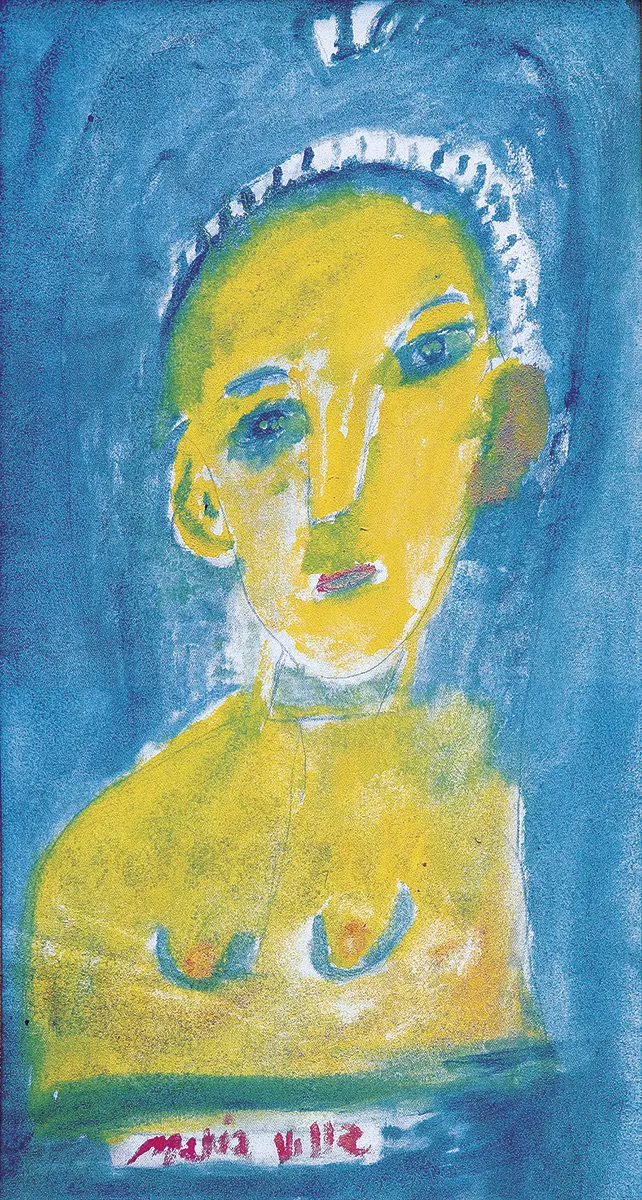
To turn Noé León into a primitivist was the most comfortable option. The fabrication of an image for the media has turned the artist into a ghost of himself. What to do with an old woman who does not possess such an image. We can measure here one palpable fact: there is no longer a gaze in the sense in which Jhon Berger uses the term. The mediated gaze is one-dimensional, as it only sees that which prior information has provided. Should we locate María Villa in the history of our art? A résumé is given only to those whose past is recognized.
At the municipal level, the anecdote of her life seems to be more important than a critical view of her body of work. A body of work that does not derive from prior axioms and is not affirmed through schemata, as the academic progression of any recognized artist who lives “to exhibit.” María Villa is not a folklorist, nor is she a regionalist—two more categories she confronts—, which further confounds ideas about her. She apprehends what she sees, and transfigures it. Bad nineteenth-century paintings, were rescued in their color and placed under other, more human considerations in popular imaginaries.
This show drives us toward a further question, one about the whereabouts of the thousands of small and medium-sized paintings she made during the last ten years of her life. A body of work that escapes from museums, from local iconographies, and which carries only its own truth, precisely because its expression does not respond to an agonistic feeling as in Nolde, but a particular way of looking at the world from color. And here a color that escapes the merely local, the possible obscenity of becoming the product of personal pain, of isolation; it is the presence of a subterranean joy, the joy of she who paints.
And she who paints in this case is someone who is or is not, to put it in Focillon’s words, the hand that paints, which in turn almost never obeys the tyranny of so-called intelligence or of a deformed sensibility. The hand, as manifested by the painter at Lascaux, is illiterate, and that is why it renews the freshness of the first gaze, that is why it flows from regions that have remained beyond the analysis of psychiatrists.
María Villa was not a person of humble means, but a person for whom humility was a necessary condition. Then, is she a painter, or a case? Was painting her way of communicating with the world? This sounds too much like rhetoric, because painting is not, and cannot be, “communication.” But it is true that many try to become painters and with that purpose study for many years, while María Villa was born a painter and died a painter, and this is what can drive traditional critics to error, to not know that, as Virilio points out, there is a line of painter who simply didn’t aspire to anything other than painting, without paying attention to hierarchies, to academies, from the perspective of a gaze that is not determined by any opacity, that of Art History, that of information.
DARÍO RUIZ GÓMEZ