
Marta Chilindron’s second solo exhibition at the Cecilia de Torres Gallery confirmed that the formal language of geometric abstraction has by no means been exhausted in contemporary art. This show added to the growing list of recent exhibitions, including MoMA at el Museo and Beyond Geometry: Experiments in Form, 1940s-1970s at the Los Angeles County Museum of Art, which highlight the important contributions of South American abstractionists to the history of art. The sparse exhibition of Chilindron’s work featured numerous acrylic constructions of varying colors and dimensions. At once playful and sophisticated, the sculptures are literally endowed with layers of meaning.
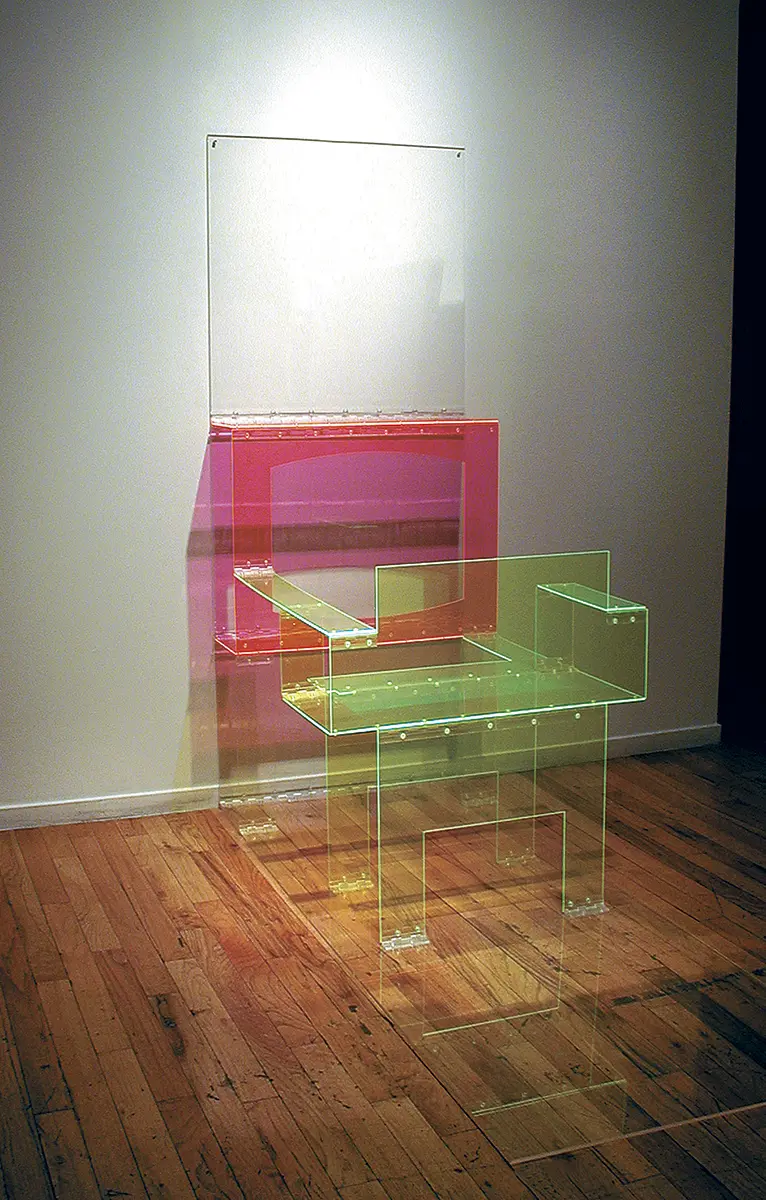
Three of the sculptures inhabit the interstices between representation and abstraction, as referenced in their titles: WC, Table and Chair, and TV and Chair. Like Lygia Clark’s Bichos, these works demand the spectator’s interaction to come alive. Initially, they appear to be multiple layers of acrylic compressed against the wall, but as one draws the layers back, two dimensions give way to three, and sculpture is born. The constructions are a tongue-in-cheek reference to the Soviet productivists of the 1920s, particularly Aleksandr Rodchenko, who attempted to bridge the gap between art and life by creating functional objects with a minimum of materials. By contrast, Chilindron’s constructions are utterly useless. WC evokes a toilet in appearance only, while the flimsy Table and Chair are made to appear on the verge of collapse. In the more recent TV and Chair (2004), color comes into play. The yellow chair and pink television are no more functional than the objects in the earlier works, but their neon colors accord them a different sort of visual interest, calling to mind the light bulb constructions of the minimalist sculptor Dan Flavin, who also engaged with Russian Constructivism.
Indeed, the specter of minimalism is also present in Chilindron’s purely abstract works, particularly in the vinyl Cube Maquette. This small-scale construction features an orange cube on a flat transparent base. It is brought into being by the spectator, who must pull apart the layers of the base to create the cube. Here, the artist subverts the relationship between subject and object found in minimalist sculptures, which typically intimidate the viewer with their physical presence, by placing the spectator in complete control. This effect is further heightened by means of the cube’s small scale and supple material. Construction Female and Construction Male operate in a similar manner. Like a child’s pop-up book, they depend on the viewer’s engagement and create unexpected results. The pieces are the epitome of simplicity, consisting only of planes of clear and orange-colored vinyl which bring to life the artist’s philosophy, “Every form exists in the second and the third dimension and in a place between them. They occupy real space and real-time (the fourth dimension).”1
Two larger-scale free-standing sculptures in acrylic, Yellow Circle and Black Triangle, are the most static of all the works in the exhibition. Perhaps as a means to demystify these objects and more actively engage the spectator, the artist also included their vinyl maquettes. The small-scale versions consist of single planes of vinyl folded into three-dimensional shapes. The larger works, however, are more complex and require hinges and screws to hold them together. The effect of each, however, is altogether different, for Yellow Circle is as ethereal as Black Triangle is dense. The translucent Yellow Circle creates a luminous glow that gives the sculpture the impression of floating on air, whereas the Black Triangle is firmly grounded, its triangular legs pointing downwards to an ominous shadow below it. The latter appears out of place in the exhibition which otherwise seems to celebrate transparency, both literally and figuratively. In this respect, the deceptively simple Wall Triangle was perhaps the most emblematic piece in the show. It is an isosceles triangle divided into five segments of varying widths that proportionally correspond to the golden section. The relief is activated by peeling apart its multiple layers and the triangle transforms itself into an intricate three-dimensional object, like a staircase leading upwards. For all the humor and light-heartedness in the exhibition, this piece seems to argue for the redemptive power of art.
NOTE
1. Marta Chilindron quoted in http://www.dotgalerie.com/artists/pages/chilindron_m/index.html.
TATIANA FLORES