
An admirer of Elvis Presley, Roberto Carlos, James Dean, and Marylyn Monroe, Colares lived in a time when icons emerged profusely from rock’n roll and Hollywood movies. He belonged to a generation of important Brazilian artists who were to finish their careers in the 1980s, among them Hélio Oiticica (1937-1980,) Glauber Rocha (1939-1981), and Lygia Clark (1920-1988).
Judging by the fate of the work of his companions, only a kind of marginality can explain the fact that it is only now that the first individual show of Colares’ oeuvre is being held in São Paulo, almost twenty years after his death.
A brief panoramic of the artist’s career at María Antonia University Center, with 15 pieces dated between 1968 and 1985, testimony of the fact that his production, albeit brief and marked by intervals, synthesizes with singularity the main artistic trends of the period, without affiliating exclusively with any one of them. From neo-concretism in the 1950s to the new figuration of the 1960s, from Pop Art to minimalism.
Colares’s references are, then, prior to the movements of the second half of the century, harking back to Piet Mondrian; Neoplasticism. The show, curated by Lorezo Mammi, director of the Center, included one of the works the Brazilian artist dedicated, in 1972, to the Dutch master: Mondrian, I Will Never Understand This Guy, Like Nobody Ever Understood Him. This collage comprises two reproductions —a postcard and a drawing by Colares— of the orthogonal stripes in a painting by Mondrian.
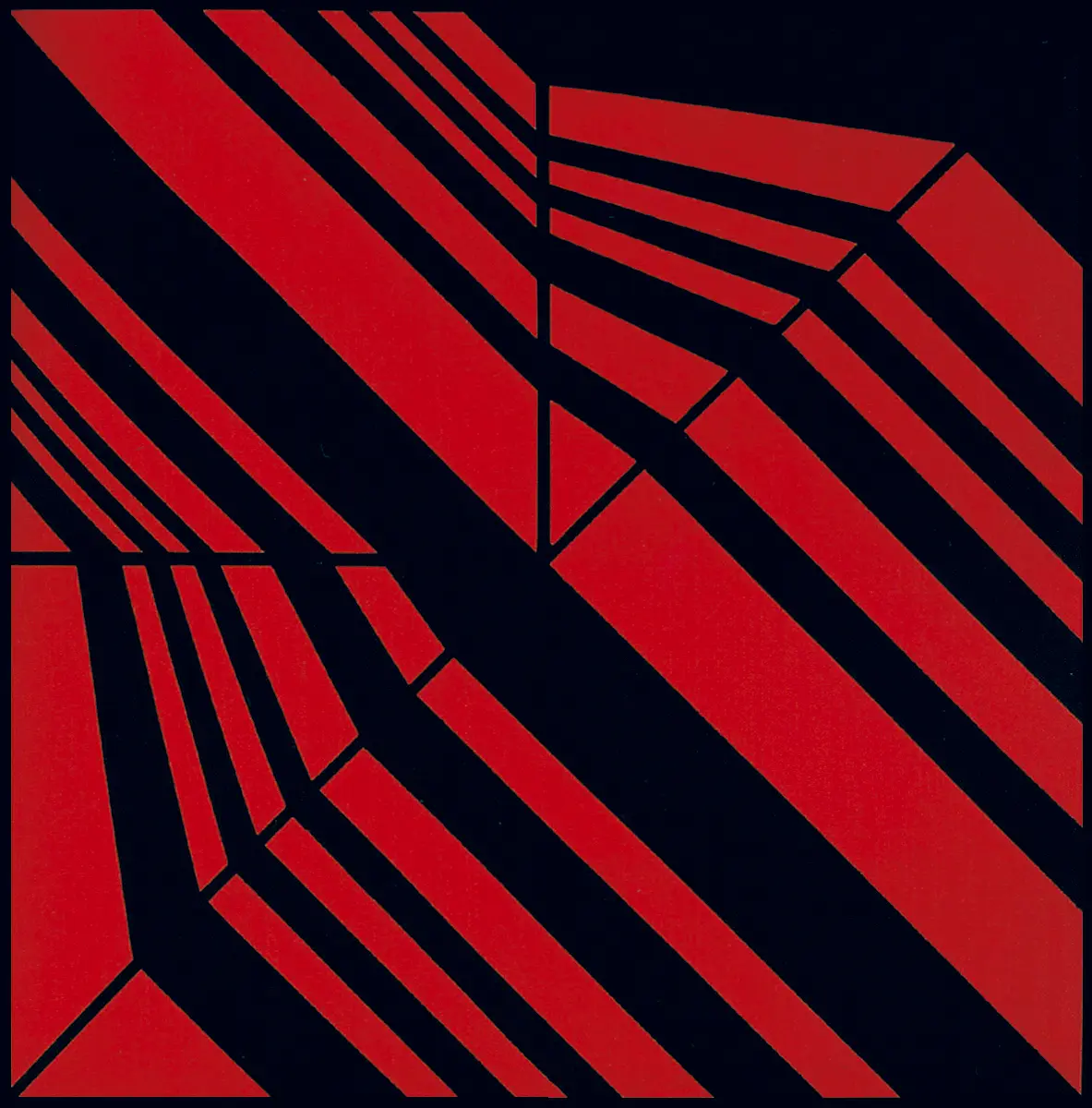
The show also gathered three paintings from the series that gave Colares his first awards in art salons, created using varnish on wood, on the theme of the bands and numbers in Brazil’s colorful public transportation buses. In these works Colares takes Concrete Art’s rigid and regular structures and sets them off balance, appropriating urban reality through cinematic geometry.
The artist reconstructs the speed of vehicles in the act of passing each other, in the organization of space into simultaneous planes, with different frames of action that indicate the passage of time. His paintings comprise a series of perspectives of the trajectory followed by the buses, in opposite routes, back and forth, on a single surface.
Influenced by the narrative of comic books and film editing, Colares subverts the faceted body of Futurism that reproduces each instant of the gesture in a single image, to institute a dynamism capable of preserving the wholeness of the cars in the different registers of their shifts in direction.
In the painting Ponto de mudança – ocorrência em uma trajetória, for instance, instead of recomposing or restoring the fragmentation of different moments in a bus’ acceleration, the artist disperses different parts of the vehicle into nine frames, in a composition of kaleidoscopic effect.
The static representation of a moving automobile is thrust into three-dimensional space in an untitled 1969 serigraph on a bent aluminum sheet. The support’s folds protrude from the wall, with different points of view of the bus’ front and side, so that, by waking at a 180-degree angle, the viewer perceives the variations in the dynamic of a body in motion. The work has proportions (100 x 232 cm) that are inspired by outdoor billboards and panels, precisely so that it can be seen during the course of the trajectory.
The multi-nationality of this piece located between painting and sculpture is transferred to a book format in Gibis,1 of 1970. The show included five original gibis, displayed in cases, and four replicas that could be manipulated by visitors. The pieces were bound with multicolor paper cut-outs, which made it possible to organize sequences of color planes as one leafed through the pages, thus creating another way of integrating time and space that no longer belongs to the universe of painting or sculpture.
Finally, the show presented a reproduction of Hélio Oiticica’s poem/painting Chamada Telefônica (1970), about a phone call Oiticica got in New York from Raymundo Colares, who was in Rio de Janeiro. During their conversation, Colares told Oiticica that he no longer paid attention to Mondrian, Marcel Duchamp, Andy Warhol, or even Oiticica, On the contrary, he wanted an exhibition “based on James Dean, Elizabeth Taylor, and Elvis Presley.” Such aspiration could only be coming from someone who understood the power of the image in entertainment, the cult of celebrity, the incitement to consume, and the shift of human perception in the modern world as nobody understood them before.
NOTE
1. A graphic magazine for young readers.
JOSÉ AUGUSTO RIBEIRO