This spring orthodontist-art collector Arturo Mosquera lent his dental offices to a display of several of the Torres Llorca works he owns; the pleasure of the show was double and doubly mixed, owing not only to Torres Llorca’s nettlesome powers but also to the nature of Dr. Mosquera’s curious exhibition project. It always seems as if the doctor is running a very serious alternative gallery while attending to adolescent overbites, and at times, especially during the convivial mojito-and-croqueta openings, the incongruous art-crowd burbling overwhelms the dentistry.
This disconnect between rarefied navel-gazing and nuts-and-bolts teeth-straightening was never more evident than during Torres Llorca’s show. There were seven fairly recent works from the last four years mounted in the office’s various rooms. On the walls of the long, narrow waiting area above the chairs where young patients nervously wait their turns and their accompanying moms fight boredom, was a new, abbreviated version of the Torres Llorca classic, So Quiet in Here. So Quiet in Here first appeared at El Museo del Barrio in New York in 1998 and again at Miami’s Locust Projects a few years later. It is little more than a line of candid snapshots of the most mundane details of the artist’s life: a stovetop with a coffee maker; clouds banking gloriously in a south Florida sky; the front porch of a worse-for-wear, gable-roofed Miami house; a few of the artist’s never-shown works. Torres Llorca overlaid each photograph with tracing paper, further smudging the scene’s inscrutable purpose, and applied schematic drawings or text. This show’s edition is very concise, with a lot more visual punning. In one piece, a sketch of a hand-signing sign language is in the foreground; beneath it is the snapshot of a real human hand reaching toward a wall sculpture of a hand covered with text. Torres Llorca uses many repeated images here—flashlights probing the dark, hands flashing various signs—which lends the piece a snappy, quick-cut rhythm. Nonetheless, the snippets of text have their usual dolorous tone: “In a house / with no door /... in a room / with no windows / I make myself / a mask.”
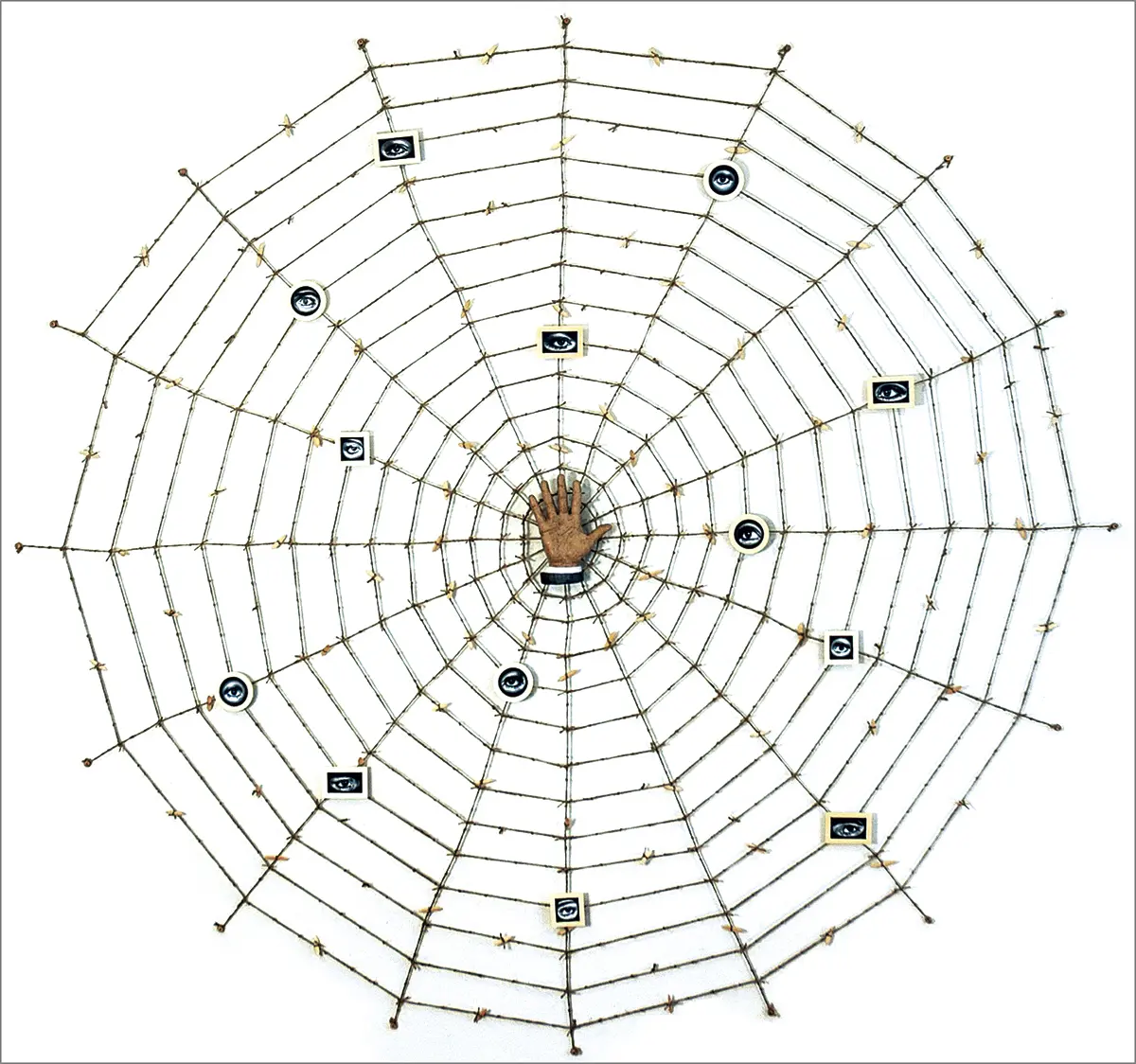
Dr. Mosquera’s treatment room has four reclining chairs arrayed around a central stand for his equipment, and there was at least one Torres Llorca work on each of the walls. An adjacent alcove contained a large painting. At various times in the past, this work theater has resembled a bursting Kunsthalle with a generous hodgepodge of the doctor’s predilections on view. But for this exhibition, it was limited almost exclusively to Torres Llorca’s consummately restrained, broodingly cerebral relics. The most dramatic and effective works were two sculptural ones, including Nobody Listens (2002), a great spider web with an ear at its vortex. Little, trussed-up human figures hang here and there on the ropey web like so many caught flies and the ear, sitting alertly, is festooned with tiny type cut from newspapers.
This business of words as a kind of skin or dressing is a recurring motif with Torres Llorca, and it is but one of the many provocative mysteries that surround his work. Are we to presume that language shapes all that we see and hear? Or, conversely, that it is a kind of filter or scrim and that our busybody intellects prevent us from seeing the world’s true form? The mediation of perceptions and emotions is a recurrent theme throughout Torres Llorca’s oeuvre—the distorting lens of television and other mass media is a favorite topic—and often involves the artist, himself, stretching the truth.
Of course, this may be one of his points: making things up is what artists do.
He manages these inventions and polemical thrusts in a light-handed way. The other sculpture, Keep Your Ear to the Ground (2002), consists of a small shelf, unfinished except for a neat molding, attached to the wall near one of the reclining chairs; four heads rest atop the shelf and a nearby blackboard is inscribed with the title. Three of the heads are lined up facing in one direction, and two of these wear vicious-looking weapons: a knife on one, a sledgehammer leaning against another. The fourth head stares back at the other three with an ear attached to his forehead. Does Torres Llorca mean to show language as blunt and sharp instruments whose true meanings one divine—or, perhaps, misinterprets—only through careful listening? Most of the heads are variously colored as if masked, to further imply disguise or deception.
Across the room, My TV Said That I Am Not Good Enough (2002) is quite explicit about the idea of human inadequacy in the glare of mass media, or so the title suggests. It is a four-part painting featuring a man and woman—or, better said, a boy and girl—wearing mid-1950s American styles: oxford shoes, pleated skirt, bobby socks, and pompadour. The figures—a woman in the tableau to the left, a man in the one to the right, an embracing couple above them, and an imageless black canvas acting as a fulcrum between man and woman, and individuals and the couple—float iconically in striped, pastel atmospheres like the flat, bland symbols of the bourgeois eagerness on which they’re based. Out of context, they are all longing and free-floating anxiety, wearing their distress like their coats and sweaters. As if these figures are not oppressed enough, Torres Llorca has a ghostly object hovering near each one: a house by the woman, a ladder by the man, and a table by the couple.
The proximity of paintings and sculptures in Dr. Mosquera’s office highlights a distinction between the two; or, let us say, a tendency Torres Llorca sometimes shows to give the game away. His sculptures, at their best, are tiny, minimalist theaters of a rather savage sense of how our humanity betrays us, of our puniness before the trespasses of the greater world and the petty sabotage we enact upon ourselves daily. And he does it by hardly saying a thing.
The paintings, in comparison, come across like simple declarations that are sometimes overstated, though not in the satisfying, secret way of some of his projects. In My TV Said That I Am Not Good Enough, it’s all out in the open: the overwrought girl and her house dream; the hopeful boy and his place to climb; the title itself. These words and images violate those taut, taunting principles Torres Llorca employs so well. Like, less is best, or leave them panting for more.
JOEL WEINSTEIN