
To see is to know? Not always, particularly not when what we are seeing is too close to us. In that moment, when the eye loses its ability to send information to the mind, images become blurred. Seeing is recognizing, and we often recognize only a fraction of what we see.
Santiago Borja is interested in the phenomenon of vision. In a series of photographs shown at the Museo de Arte Moderno, the artist presented the blue flames of a gas stove. The varying degrees of light against the darkness are color cells against a black background. The image calls attention to the problem of our vision of light. What is the role of the eye in the gaze? The camera eye transforms light impulses into signals that travel to the brain.
For his exhibition at the Museo del Chopo, titled Aluminio (Ojo por ojo,) Borja has focused on the precise, almost scientific reproduction of corneas. Cut up schematically on an aluminum sheet, the eyes appear in the side view as sophisticated lenses. The show is complemented by two large-format paintings, based on a photograph showing the spherical structure traversed by thousands of blood vessels and nerves. An intense light crosses through an eye with the retina on the opposite side, a retina we can’t see just as it can’t see us. Santiago alludes to the eye seeing an eye, with an optic mechanism that works to perfection.
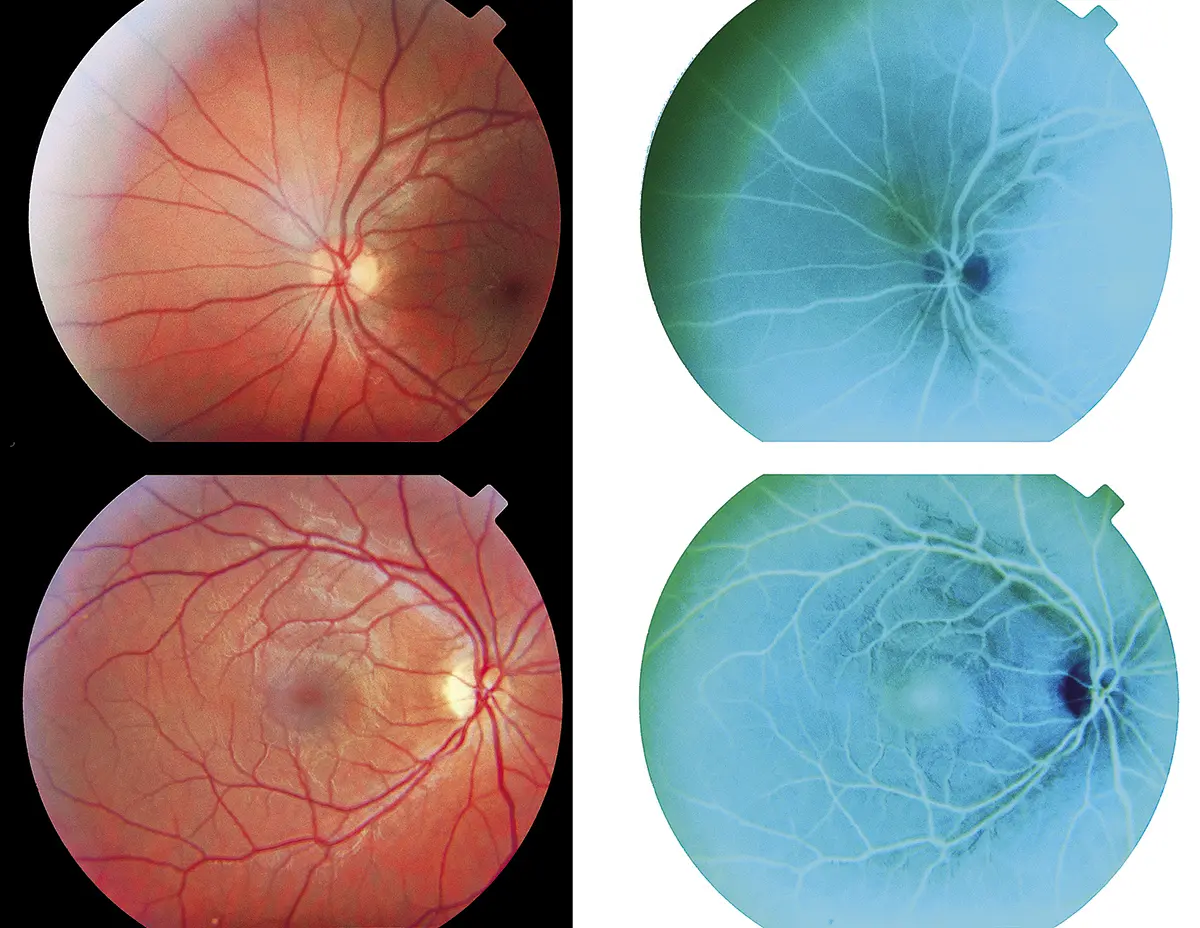
Scientific photography is proof of the relationship between reality and visuality. Each scientific image constitutes an unobjectionable argument. To understand the idea that inspires these high-tech images we need to refer to Borja’s earlier painting. These are painted from ink-drawn calligraphy, which does not represent any familiar shapes. Borja creates white paintings with marks that grow on one another, generating the impression of spaces similar to colored bone structures.
Part of the current exhibition comprises drawings of the kind used for his paintings, etched on aluminum sheets. Colorless and with a texture similar to that of an aquatint plaque, these works appeal to our sense of form and visuality, and there is something in them that appeals to touch. As in his relieves of corneas, Santiago is pointing here to the sense of touch as a complementary sense. The meaning of his work is related to synesthesia, the ability to perceive through all senses simultaneously.
The issue of sensorial perception has been in fashion in recent years. Given the emergence of new means of representation in the visual arts, there has developed a need to explore in depth how are the impulses captured by our senses translated into images in the mind. Even a novel like The Girl With the Pearl Earring, written by Tracy Chevalier with inspiration from Johannes Vermeer's famous painting, deals with the issues of vision and color with such clarity and simplicity as to gain a mass audience. How is it that we perceive the image-filled world that surrounds us? This is a central question for the current generation of artists. The rapprochement between art and science, physiology, and the psychology of perception is the field where both the speculation and the answers are to be found.
Santiago Borja poses the problem with clarity of mind that is unusual among artists of his generation. In principle, he has started to take images from one medium to another in order to examine their semantics. The transfer of calligraphic drawings to painting, through a projection, brings to mind the use of camera obscura in the Seventeenth Century to facilitate the translation of three-dimensional reality into two-dimensional space.
For Santiago Borja, since the invention of painting visual artists have faced a reality that escapes faithful representation. His strategy as an artist has been to bet on a reality that, although it is visual, rejects easy conceptualization. This is why his paintings, like his prints on metal, are misleading. They are represented as objects that do not refer to reality and seem symbolic, but we can’t truly recognize them. They are drawings of a platonic ideal, not reflections of real objects.
With the introduction of video and digital photography, which combine instantaneous vision with an infinite capacity to manipulate time, the objectivity of vision has come into serious question. If Vermeer or Velázquez were able to paint with greater objectivity through the use of camera obscura, today artists face the feeling that all tangible reality is constructed and reconstructed ad infinitum through technological mechanisms. This brings us to ask what is it that the eye is really able to see, and to what degree reality itself is constructed through the extensions of our senses, such as cameras, telescopes, and products of technology.
It is significant that Santiago Borja chose to represent the ocular globes against two backgrounds, one white and the other black; his intention is to refer to the role of photographic paper in the phenomenon of vision. The eye seen in negative and positive (white and black, respectively) makes us think of photography and its influence on painting. The connection between eyes and painting summarizes, in part, Borja’s interests, complementing his photographs of light and his aluminum relieves of retinas, which point towards the technology of vision.
We live in a world that is saturated with images forming a parallel, virtual reality dominated by image and sound. In this context, as saturated as it is uncontrollable, Santiago Borja’s painting becomes a reflection of the essence of seeing and of visual knowledge.
JOSÉ MANUEL SPRINGER