
Silvia Gruner’s Instinto (Instinct), 2002, is a bridge between the work where she researched the themes of psychoanalysis and the politics of identity and her most recent work in which the subject’s relationship to the other is posited in terms of desire. Instinto asks us about the meaning of desire and love. Are they cultural constructions or part of human nature? In Instinto, Gruner shows us that all our attempts to satisfy desire and to reach out to love others are impossible and transgressive efforts.
In earlier pieces, Gruner dealt with the identification and constant reinvention of the self, linked to local identity and its borders, and the body as the site for its reinvention. In her work, Gruner posited a ‘dislocated’ subject that fluctuated continually between “mexicanness,” “jewishness,” and “womanness,” indicating the impossibility of a fixed identity and showing that these categories are socio-cultural constructions.
More recently, Gruner has extrapolated the practice of identification into the subject’s ontological relationship to the other relying on psychoanalysis. This concern is evident in a video installation shown at InSite 2000, Narrow Slot (Sueño Paradójico). The artist filmed herself on a car ride between Tijuana and San Diego. En route, she is psychoanalyzed by an American male psychoanalyst in English and by a female psychoanalyst in Spanish. This piece embodies Gruner’s concern with the topological relationship between the self and the other, and the role of language in shaping identity. Gruner evidences the fact that beyond borders and nations, identity is a performative experience in permanent flux.
Instinto can be read as an exploration that takes place at the level of being, beyond the gaze into the Mexican, Jewish, female, or for that matter, into the nomadic condition. In the video, the asymmetry inherent in the relationship between the self and the other is posited in terms of Lacanian desire and jouissance. Desire is defined by Lacan as a lack of being—that is why it is necessarily linked to the other. But this is impossible since we can never know the desire of the other, nor fulfill our own desire. Jouissance is conformed by desire and pleasure, it is positivity lived by a body and it is beyond pleasure.
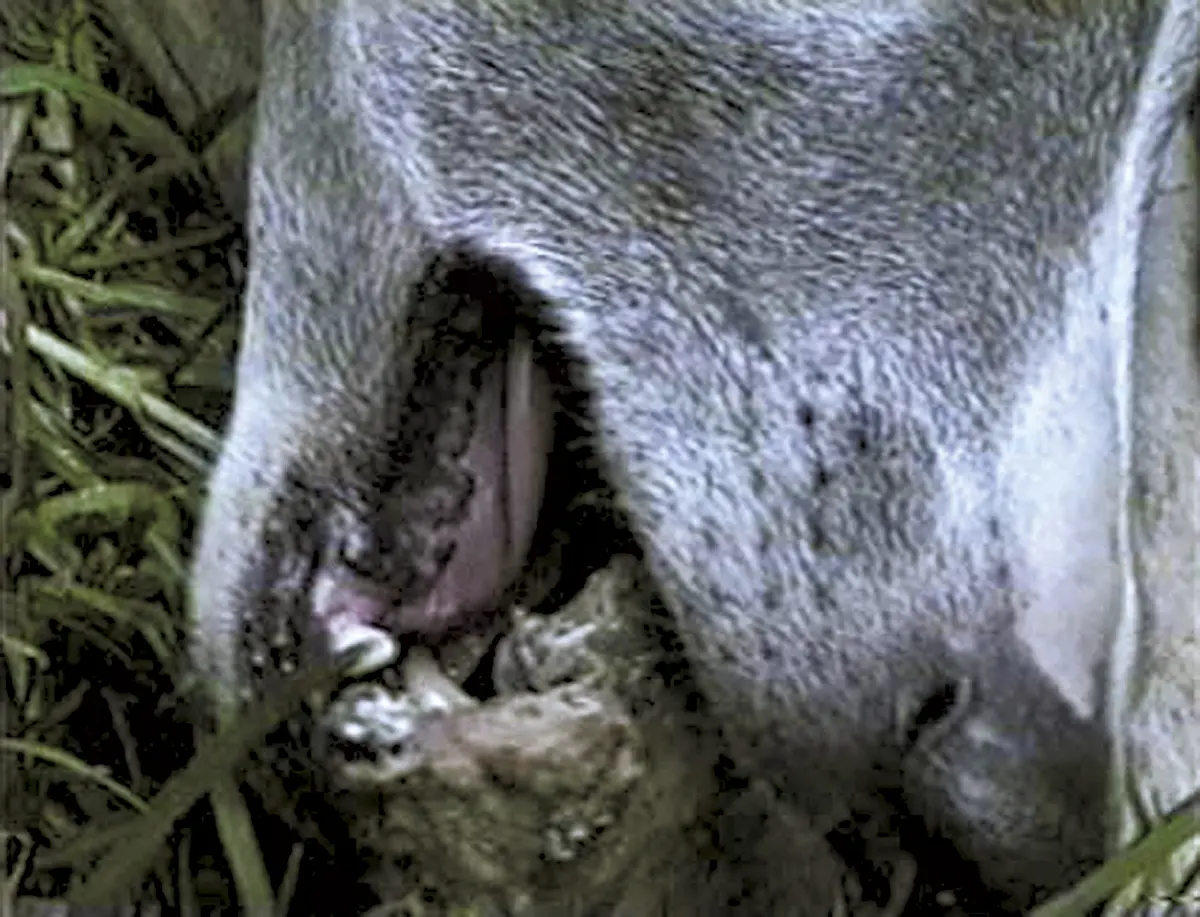
In Instinto, with a hand-held camera, the artist has filmed herself making out with an unidentified partner. This action purports the impossibility of reaching out to the other. This scene is followed by one in which Azul, Gruner’s whippet, appears gnawing on a bone—he becomes the consuming aspect of desire. Both frames are dialectically opposed and looped and display the dialectic of Lacanian jouissance as the combination of enjoyment and lust, the sense in which the body experiences itself, spending, forcing, and salivating. The fact that the actions are condemned to repeat themselves endlessly evidences the impossibility of satisfaction.
The loop structure of the video keeps the couple and Azul trapped in endless foreplay. Because making out and gnawing on a bone are condemned to infinite repetition, the work also shows the hopelessness of trying to satisfy our own desires. The logical consummation of these actions, shagging and burying the bone are impossible tasks, therefore, in Instinto, the climax is always postponed.
On another level, it can be said that the video is an event in which desire flows, not from a lack, but rather from the conjunction of two machines that become one single desiring machine. In this sense, Instinto can be linked to Francis Picabia’s drawings and paintings of celibate machines and to Marcel Duchamp’s Great Glass in which flows of desire activate machines that in the viewer’s eyes are continuously producing anti-climatic sexual activity.
These works can be related to Gruner’s 500 Kilos of Impotence (Or Possibility), a video performance at San Diego Bay in 1998: a crane pulled a necklace made out of stone that weighed 500 kilos in and out of the water. Stuck in infinite masturbation, always seeking satisfaction without achieving it, the crane also can be seen as an emblem of jouissance.
In Instinto, desire, and love become repetitive acts of both consumption and arousal. The relationship with the other is reduced to flows of desire, to the consuming aspect of jouissance: love is gnawing onto the other, and desiring the other becomes a transgressive act. If desire and love are impossible, transgressive efforts, why do we keep looking for the buried bones?
IRMGARD EMMELHAINZ