
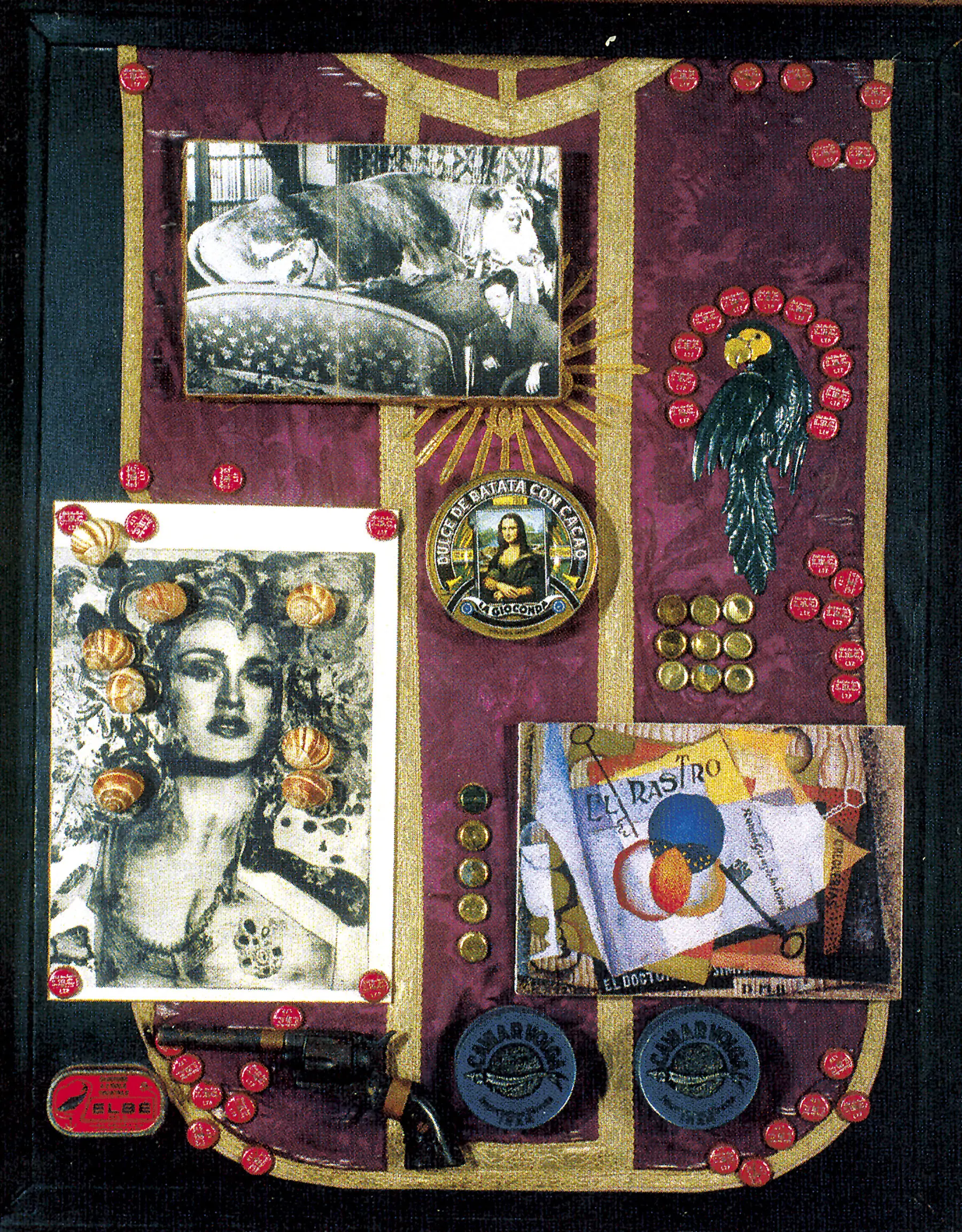
“Ambiguity is the marrow of art,” I heard Alberto Gironella (1929-1999) say many times. Gironella was one of the most relevant Mexican artists of the second half of the twentieth century and he has recently been the object of a tribute in the form of an imposing retrospective titled Alberto Gironella: Barón de Beltenebros at the Museo del Palacio de Bellas Artes in Mexico City. Ambiguity is, indeed, the communicating thread running through the 250 pieces exhibited in this vast panoramic show. Ambiguity is the leitmotif that generated paintings, collages, assemblages, and boxes that hold, behind their veiled impenetrability, an intricate network of symbols and emblems repeated obsessively throughout five decades. The astounding lucidity and ironclad obstinacy with which this artist always defended his ideas and ideals were the basis for a complex oeuvre of a very personal, not easily classifiable character, incredibly rich in concept and form. Although Gironella was a member of the so-called Generación de Ruptura (generation of the rupture), early on he opted for a solitary path, apart from the fashions and conventions of his time.
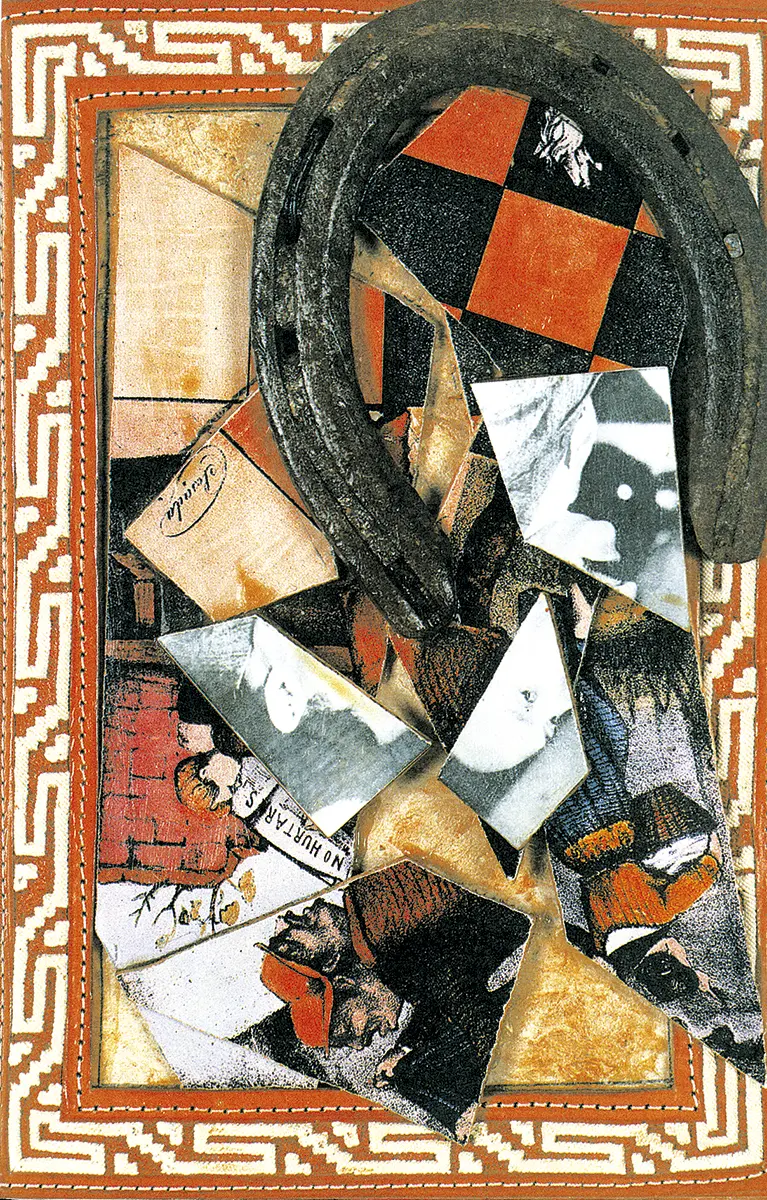
In his luminous essay "Los sueños pintados de Alberto Gironella," Octavio Paz wrote that the work of this artist “. . . is written painting, in the same way there are painted words. Alberto Gironella’s art is situated at the intersection of word and image.” Indeed, Gironella’s work was impregnated since the beginning with literary references and quotations from the most diverse writers, besides the recurrent plastic paraphrases of his favorite paintings; this singular mélange results in metaphors and poetic evocations intertwined in an art whose axis is that singular network of analogies. Many quotes from his preferred authors attest to Gironella’s passion for literature: Ramón Gómez de la Serna, López Velarde, Pierre Reverdy, Cervantes, Octavio Paz, Ernst Jünger, Malcolm Lowry, Valle-Inclán, Baudelaire, and Nietzsche, among others. As Jorge García Ponce put it, Gironella’s work is “a series of quotes of quotes of quotes.” The series of collages he created in his later years, inspired by Valle-Inclán’s Tirano Banderas and Lowry’s Under the Volcano, show the extraordinary union of the written image and its visual evocation: “While Valle-Inclán paints with words—Gironella commented—I try to write with brushes.” His work appears as a mysterious alliance of literary and pictorial allusions intermixed with the subtle filament of poetry, the common denominator of all the arts according to Xavier Villaurrutia.
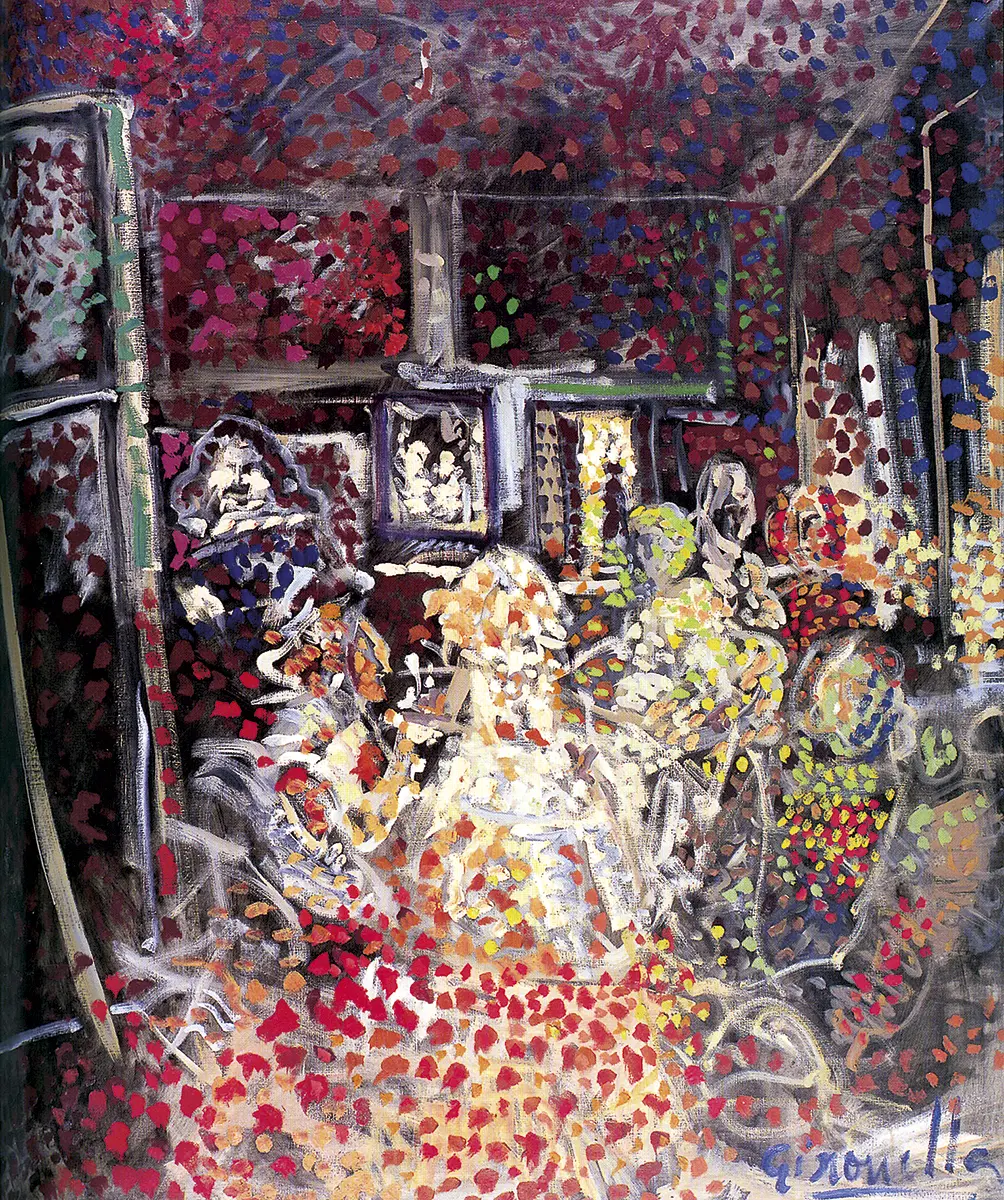
The exhibition is organized around the themes that most passion generated in Gironella and most stimulated his creative genius; his artistic origins are linked to re-readings and deconstructions of the great masters of Spanish art, such as Velázquez, Goya, Pereda, Valdés Leal, and El Greco; women and bullfighting, where the festival brings together Eros and Thanatos in a passionate embrace that fuses life and death; the tribute to his “soul mates,” the ghosts and spiritual forefathers, with whom he maintained a sense of complicity and an intellectual relationship, such as Picasso, Buñuel, Nietzsche, Gómez de la Serna, and Valle-Inclán; the series of boxes/collages illustrating Under the Volcano and Tirano Banderas; and the gallery that closes the show is devoted to his last obsession, the singer Madonna, whom he called “the convulsive beauty” and considered, more than a popular culture figure, the last of the Surrealists. A very special section is devoted to the theme of death. In this space, we found the photo-mural of a large wall from the Archivo Casasola, across from which were a death mask and a bronze cast of his hands, as well as an epitaph by Pierre Alechinsky on the plaque that accompanies the silver urn where Gironella’s ashes are kept. The paintings around this “profane altar” of sorts all allude to death. Among them, Danza de la muerte (Dance of Death, 1954) and Póstumo (Postumous, 1999) signal the beginning and end of one of his most vehement obsessions, death as an integral part of a life devoted to art and to the passions. Also included here was the video documenting his last “action”—or perhaps we can call it a performance—a few days before his death: from his hospital bed, the painter decided to cover entirely in black the portrait of an old female friend who, upon learning of Gironella’s imminent demise, had attempted to recover that unfinished work, provoking the artist’s ire. Gironella had fun recording this scene, which he considered his “last congruent act,” although some have interpreted it as evidence of his arrogance and exhibitionism; in my opinion, it rather illustrates his characteristic joking personality and the dark humor that infused his life and his work.
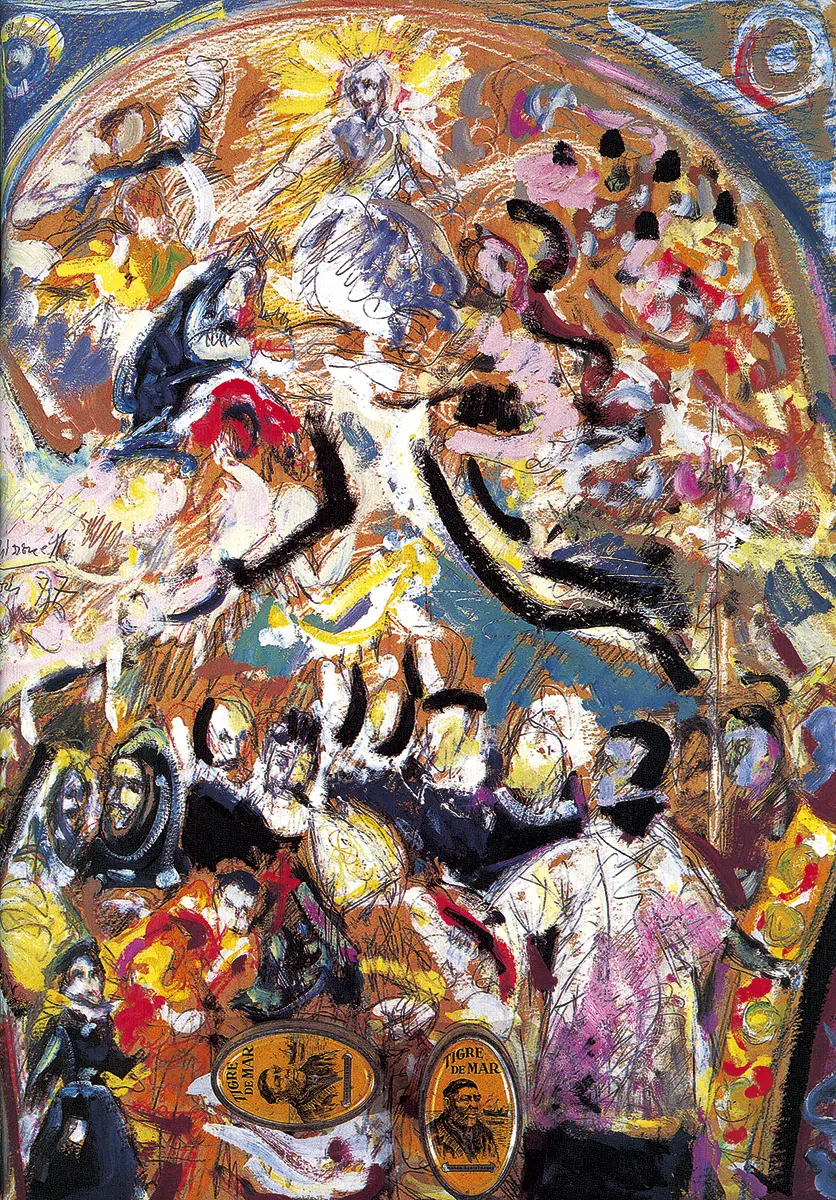
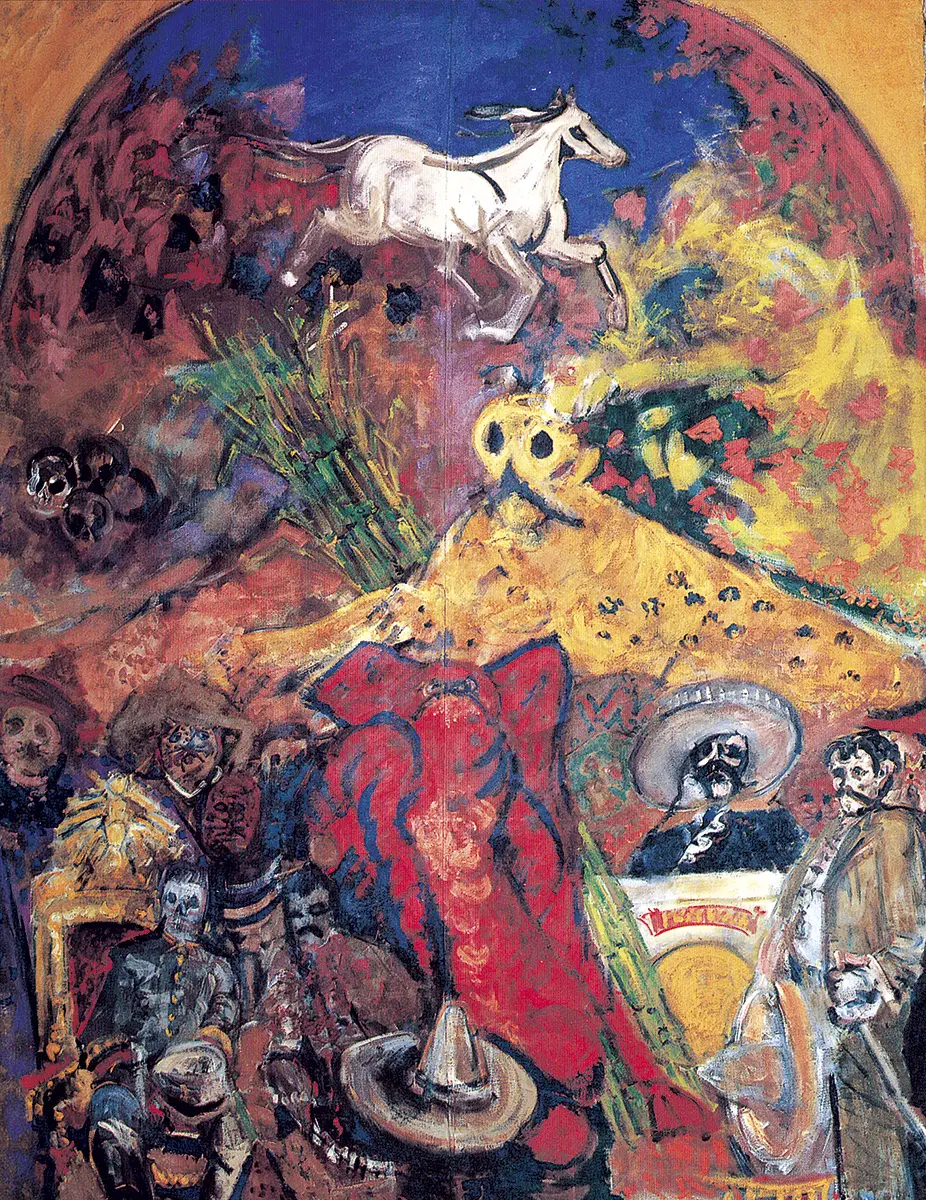
In its different periods, Gironella’s work reflects a constant interest in exploring the most varied pictorial styles. While his oeuvre was reiterative from beginning to end, he never fell prey to pleonasm; we can clearly perceive his ability to develop a powerful personal code of signs and concomitances that express his obsessions. His paintings are formidable because he was an artist in the broadest sense of the term; an erudite with deep knowledge of the history of art, one who boldly ventured into the most varied lexicons and researched and dominated numerous techniques and media. It is fascinating to find, gathered together, his repertoire in paintings that speak in different languages about interrelated themes: meninas and queens in the realist, cubist, pointillist, and expressionist manner, taken to the verge of abstraction or to their total destruction. Gironella’s desire to demystify history lays as a background: the sumptuous queen becomes a dog, and monarchy is transformed into rotten flesh, matteric rubble. For Gironella, the moral decay of Spain under the Bourbons is equivalent to the misery of the modern West. “I am the gravedigger of our times,” Gironella said and proceeded to extinguish a wounded tradition. From the ashes, another art emerged, a creation born of metamorphosis and transgression. In that sense, Gironella is not only the gravedigger of our times but also their “renewer.” Thus, El Greco’s El entierro del conde de Orgaz (Burial of the Count of Orgaz) transfigures into allegories of the death of Zapata, an icon representing the paradigm of betrayal and villainy in the circles of the powerful.
I met Gironella in 1993 when I interviewed him for the cultural supplement La Jornada Semanal, on the occasion of the boxes/collages he did as illustrations for Under the volcano. He was a man of tempestuous temperament who exercised his will and his freedom to the last consequences: his life and his work are witnesses to that. A controversial character, passionate, energetic, obsessive, rebellious, and transgressive. Adjectives are not lacking: a man who remained faithful to his ideas and coherent with his creation until the very last day of his life. His rejection of the mainstream and of all fashions added to his lack of interest in the art market and gained him many enmities, but his work speaks for itself and is an example of genius, willpower, and coherence.
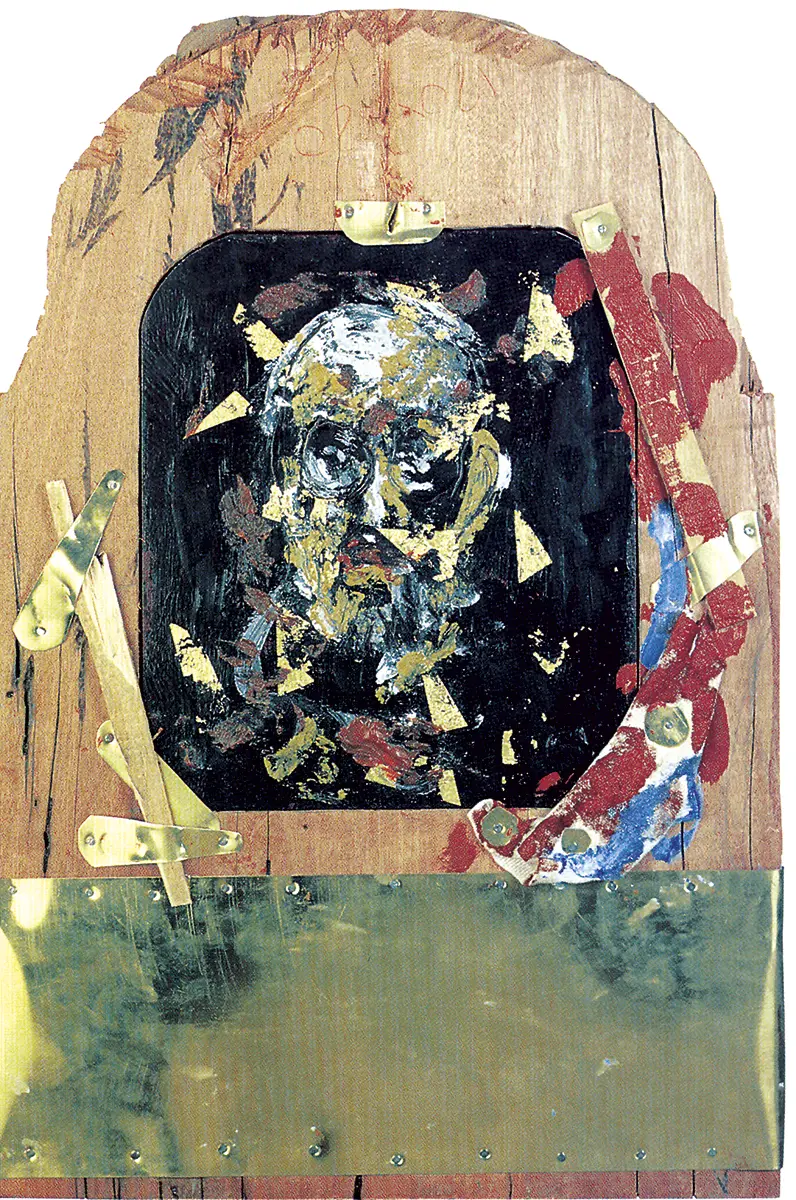
I had the opportunity to follow closely his work during his last years and interviewed him several times. Five days before his death, on August 2, 1999, I visited him at the home of his friend, José Luis Cortés in San Ángel, where he spent his final weeks. That morning I found him radiant, smoking his characteristic "Romeo y Julieta” cigar, in an excellent mood. This was the only time since the cancer that so rapidly killed him was diagnosed, he asked me to bring out the recorder, as he wanted to talk about something he thought was important. Virginia, his faithful collaborator from Valle de Bravo, was preparing the paint for him to sign his last work: a strange and disquieting self-portrait he had just finished and the mounting of which, on a block of wood with bronze applications, he had directed the day before. He seemed pleased with the piece, the first in a series that was to be, he said, “a kind of visual-cryptic memoir.” I will transcribe fragments of that conversation, which revealed the dark sense of hour and the ironic spirit Gironella retained until the last moment.
“The idea for the self-portrait came to me a few months ago when browsing through old papers and books, I found a publication with the funeral portraits in the Greek and Roman Fayum sarcophagi. Suddenly I found myself terribly interested in doing a self-portrait in encaustic, a technique I had never used. The result is this image of tremendous ambiguity. Seeing the painting in my room, a friend of my son Emiliano exclaimed: “Say, Don Alberto, aren’t you afraid of sleeping with that painting?” “No,” I answered. “Why?” “Because it is you, but... dead!”
My portrait as a dead man! That hadn’t been my intention, but he was right. Now I know death has settled in my home. But don’t get me wrong, I am happy because I have closed the circle: the only thing left is to finish some paintings, and that’s it: I finish my Pop operetta at the age of seventy very well-lived years.”
He pointed to the piles of books on the sides of his bed. His “soul mates” are with him to the end: Gómez de la Serna, Valle-Inclán, Bergamín, Baudelaire, Buñuel, López Velarde… He reaches for Gómez de la Serna’s Automoribundia and shows me a picture where I read: “The corner of fantasy in porcelain: the gloves pianistic and in love.” It is a photograph with dissimilar images, images seemingly unconnected, organized in space in the way of an improvised collage. Gironella commented:
“This image impressed me when I saw it in the first edition of this book, in 1948. That’s where all of Gironella comes from. The picture shows a corner of Ramón’s home, which was in itself a veritable collage. I have read and reread this book for fifty years, and I always come back to these images that marked me forever. Now, old and on the verge of leaving, I can see with satisfaction that I remain faithful to everything I believed in as a young man. I know I wasn’t mistaken, and I continue to work until the end, although my eyelids are heavy like the laminate curtains in Malcolm Lowry’s bars. If there were a chance, I would like—like the Phoenix—to be reborn from my own ashes. Although, when I come to think of it, I will remain in my paintings, in my children, in the people I love... what matters is to work, to exhibit, and to shake the viewer.”
I am certain Gironella would have been pleased with this portentous exhibition, a clear argument for the greatness of his pictorial and intellectual work. Creator of a personal style entirely his own, entirely original, Gironella is a paradigmatic figure whose importance has not been sufficiently appreciated. This exhibition, added to the excellent catalog and the volume recently published by Bital, is proof of the genius of Barón the Beltenebros, whose “Pop operetta” is a central chapter in the history of Mexican art in the second half of the twentieth century.
GERMAINE GÓMEZ HARO
Art critic and historian, doctoral candidate in Art History at UNAM, Promotion and Cultural Diffusion Director at Casa Lamm.