Works in Archipelago, the recent retrospective exhibition of the work of Anna Bella Geiger at the Instituto Tomie Ohtake in São Paulo, presented the artist’s trajectory over the past four decades clearly and concisely. Curated by Adolfo Montejo Navas, the show was organized into three sections—"Situations," "Passages," and "Territories"—within a large, open gallery divided on the diagonal. The exhibition design permitted visitors to draw connections between Geiger’s earliest and most recent work, without being overwhelmed by an overarching curatorial vision.
Throughout her career, Geiger has experimented with a wide range of techniques and materials. The exhibition included drawings, photographs and photomontages, mixed media constructions, etchings, films, and, to a lesser degree, paintings. The sheer variety of her oeuvre has led critics to use words like “constellations,” “clusters,” or “fragments” to describe it, and certainly, the “archipelago” in the title follows in this critical tradition. These readings, which have been very effective in analyzing Geiger’s work, emphasize theoretical interpretations over stylistic or socio-historical ones. However, by seeing Geiger primarily as a conceptual artist, they tend to neglect the artist’s intense degree of formal exploration.
In her most recent work, Geiger continues to probe the potential meanings of maps, a consistent theme throughout her career, but which now employs daring material juxtapositions. On Nacre (Sobre Nácar), 2003 features a small map incised in metal and placed within a mollusk shell. The lustrous mother-of-pearl backdrop deeply contrasts with the etched lines of the map that describe the meridians,
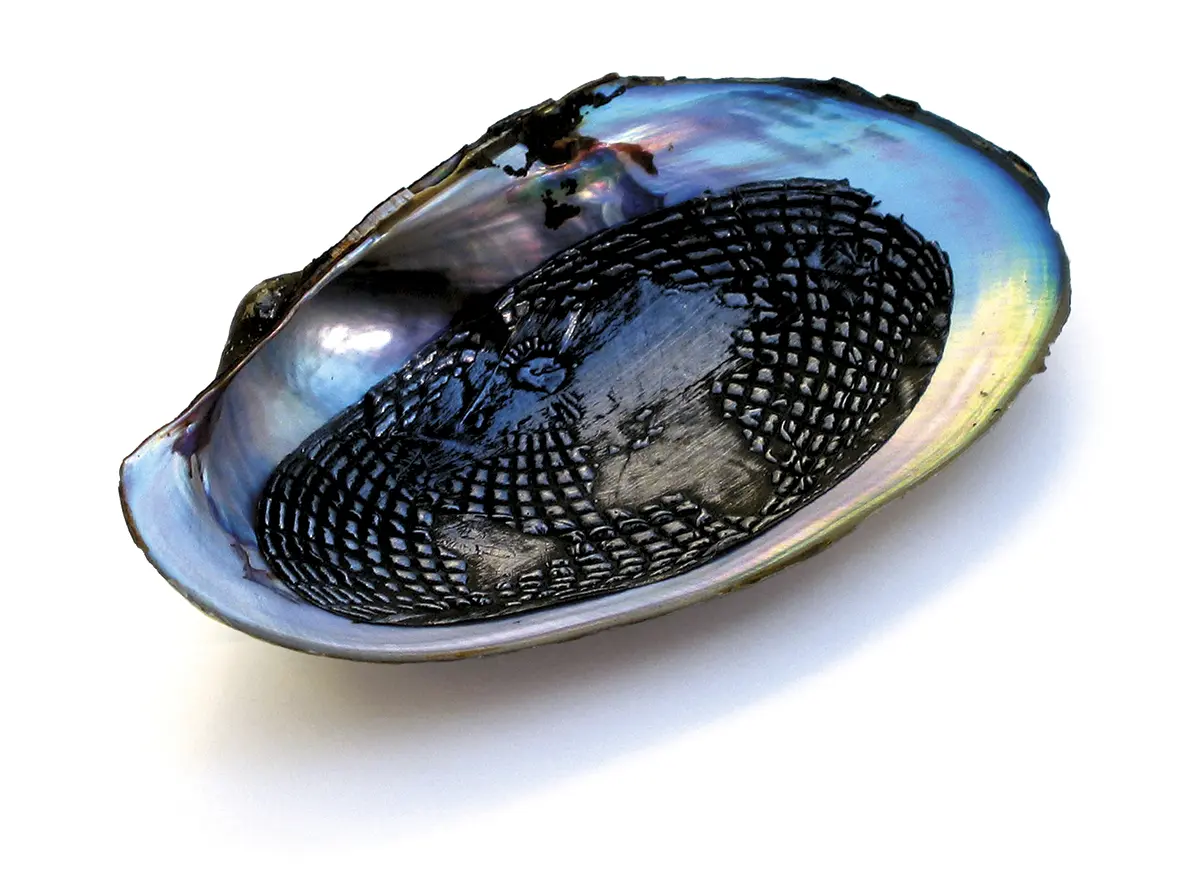
demonstrating the inconsistencies between understanding the world by observing nature or through man-made representations. A similar theme is explored in On Nadar (Sobre Nadar), 2003, to wholly different effects. In this mixed media work, Geiger juxtaposes a photograph of what appears to be two adjacent train tunnels where tracks separate and recede into the distance to two small tubes of metal rolled up into conical shapes. Over one, the representation of a map is clearly visible, though distorted, while the other is covered with a layer of fine mesh. Through her contrasting of a photograph and a map with real objects, Geiger puns on the very notion of objectivity within established systems of representation. Different representational modes also come to a head in Place with Waves and Meridians (Local com Ondas e Meridianos), 2004, where the artist integrates the meridian lines of conventional maps of the world into an image of The Wave by the renowned Japanese printmaker Hokusai to create a dynamic, unexpected composition.
Other works also bring seemingly disparate materials together, such as in a recent series employing archival drawers filled with encaustic, which often contain impressions of maps on the wax as well as embedded thin metal sheets molded to either represent or suggest geographical boundaries. In these objects, the organic look of the wax, with its irregular surface and subtle tonal variations, stands in contrast to the sharp edges of the metal. In a strictly formal reading, the dichotomy of the materials appears to revive old debates between line and color. Probing deeper, the works contest systems for organizing knowledge (archives, maps) in the face of randomness and chance.
Geiger’s earlier use of maps had more evident political overtones often relating to the social problems of Brazil, and Latin America in general; this is evident in Our Daily Bread (O pão nosso de cada dia), 1978. This work, consisting of a paper bag and six postcards, some of which feature slices of bread with maps of Brazil and South America bitten out of them, comments not just on the problem of hunger but also on the absence of responsibility. This is implied most poignantly in a postcard that depicts the artist herself about to bite into a slice of bread. The work exposes that a high level of social commitment has become an expectation in artists from developing countries, whether they like it or not.
Other social and political commentaries in Geiger’s early work often employ humor. In Bureaucracy (Burocracia), 1975, a caption reads, “About Art / Say it with us: BU-REAU-CRA-CY,” (Sobre a Arte / Diga conosco BU-RO-CRA-CIA) while four women appear mouthing this word. In Brasil nativo / Brasil alienígena (1977), the artist contrasts ethnographic photographs of Brazilian natives in villages with self and group portraits assuming similar poses against an urban backdrop, humorously exposing two different Brazils. Geiger also employs her self-portrait in Diary of a Brazilian Artist (Diario de um artista brasileiro), 1975, a photomontage in which she appears dressed as a bride, staring triumphantly out of the composition alongside Marcel Duchamp. The caption, written in English, reads, “The Bride Met Duchamp Before the Bachelors,” in reference to Duchamp’s well-known work on glass, The Bride Stripped Bare by Her Bachelors, Even. In Geiger’s version, the artist inverts the terms of that equation by empowering the bride (herself), who multiplies in the photomontage. Duchamp reappears as his alter ego in the more recent Rrose Sélavy Mesmo (1997-2002), a series of prints superimposed on newspapers, which combine the famous Man Ray photograph of Rrose Sélavy with enigmatic text (“Who are you?”) and inkblots, both arbitrary and also recalling the ubiquitous maps of Geiger’s oeuvre. In this juxtaposition of different systems of representation (textual, indexical, geographic), the artist creates a slippage of meanings.
Among the most illuminating juxtapositions made by the curator was the placement of Geiger’s early works—color prints and watercolors from the 1960s depicting what appear to be abstracted organs and body parts—alongside her most recent mixed-media maps. Through this comparison, it becomes all the more evident that Geiger’s career has been guided by a questioning of the conventional means of representation, both visual and verbal. In her quest to challenge traditional assumptions on the nature of meaning, she proves that seeing definitely is not believing.
TATIANA FLORES