
Armando Morales is undoubtedly one of Latin America’s leading painters so it is surprising that there have been so few major exhibitions of his work in the United States. (The works described in the beautiful catalog produced by Robert Miller Gallery originated in MARCO. Others from private collections in Miami were added for this venue). This exhibition at MAC/Miami Art Central is therefore significant as the first major show of his works although it includes only twenty-five oil paintings, because the selection and quality mark it as a retrospective with the most representative examples of his long, distinguished career. The emphasis is on recent works, including large stunning paintings of the rain forest that are varnished with beeswax for extraordinary surface effects. For the past five decades, Morales has explored the realm of abstraction and figuration in works that focus on themes based on female figures, animals, violence, death, and tropical landscapes. Informed by literature and affected by the cultural isolation and strange social and political circumstances found in his homeland of Nicaragua, his works transcend the obvious physical references of subject matter to reveal a highly metaphysical interpretation of life. Women, horses, bulls, trees, bicycles, and other objects and forms are visual allusions to a world that is as much of the imagination as it is real.
Armando Morales was born in Granada, Nicaragua in 1927 and although his career as a painter has taken him from art school in Managua to New York, Paris, London, and beyond, nostalgia for the mysteries of the decrepit colonial city remains; it will always be his home and essential to an understanding of his art, if only because of its surreal description and history. To describe Granada as a city of the past, surrounded by nature’s beautiful lakes, volcanoes, and strange hybrid ecology, is to simplify its reality. To describe the paintings of Armando Morales as visions of beautiful women and tropical paradises is also to simplify their reality. Each work is as conceptually complex as it is technically difficult, but in the end, it is all about painting.
Over the years, Morales has allowed his constant exploration of painting’s most substantive concepts to challenge its processes as the means to express a personal vocabulary that changed its basis from abstract formulation to figures to objects to landscapes. His dreamlike settings for classically inspired nudes are perhaps the most familiar, yet most puzzling of his works. In this exhibition, women appear as reclining nudes on the edge of the forest and bathing in coastal waters. The females in Three Bathers in the Forest (2003), and Bathers and Waterworks (2001) are as calculated in their composure as fruits in still life, and Morales regards their presence with the same calculated and practical eye. Emerging from the shadows of his velvety brushwork, the figures are but memories of time and place, illuminated in the dusk or dawn of nostalgia and scraped from layers of paint, like so many layers of imagination.
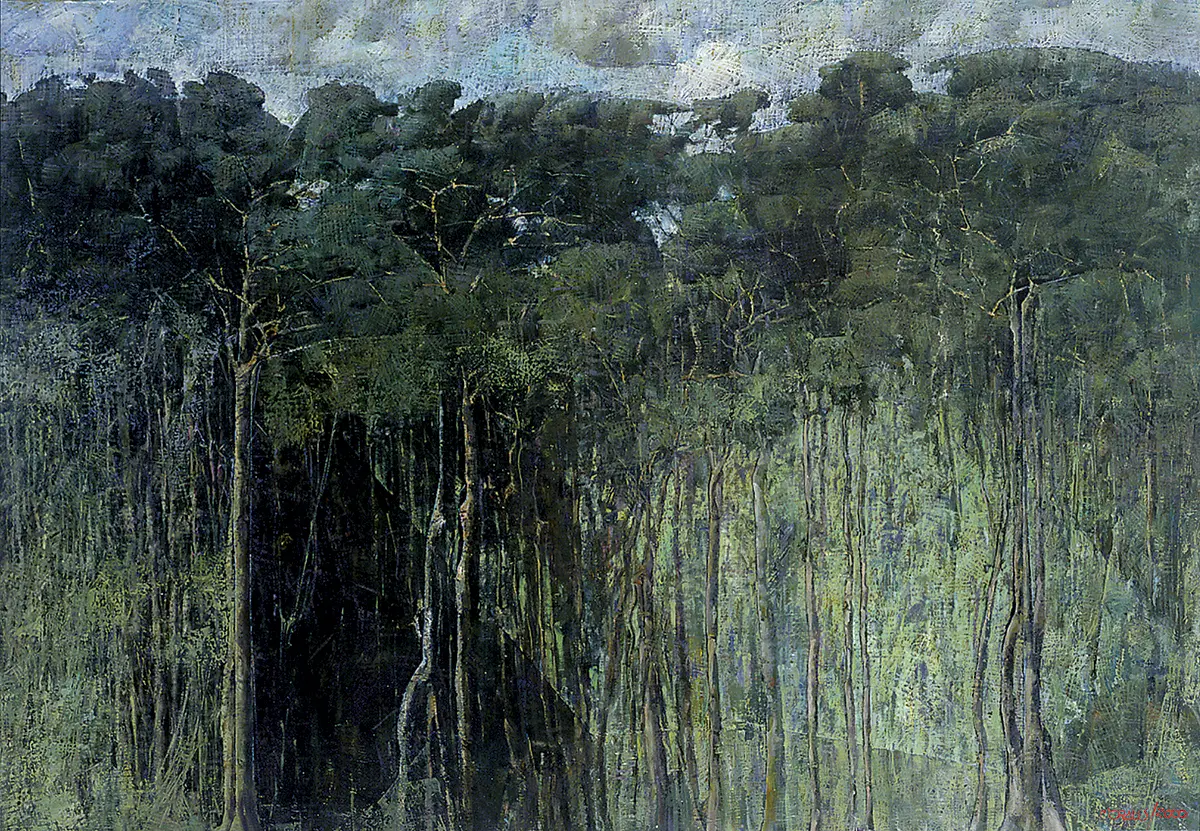
Memories and nostalgia result in countless variations on the theme of the tropical rainforest. From the familiar rain forests of Nicaragua to recollections of a trip to the Amazon in the late 1950s, the landscapes in this exhibition reveal the artist’s most recent focus on the idea of paradise lost and the search from afar for one’s origins in time and place.
Monumental in conception and grandiose in scale, his rainforest paintings are jungles of secrecy and personal reverie. Rain Forest and River (2002) lures the viewer into the depths of the jungle, where land and water, trees, and sky appear to be advancing forward, compressing us into the shadows and darkness. Even more claustrophobic, Tropical Rain Forest (Ravine and “Ojo de Agua”) (2004) takes on a life of its own where trees are anthropomorphic creatures lurking in the nadir of the obscure. It is the depiction of such forbidden territory that transports the viewer into the realm of the sublime and the eerie nostalgia that Morales calls his own.
CAROL DAMIAN