Recently, the A.M.S. Marlborough Gallery in Santiago de Chile exhibited twenty monumental-size gres ceramic heads. Sober and efficiently mounted, this exhibition constitutes a landmark in the career of noted Chilean artist Benjamín Lira (Santiago, 1950).
Many painters have entered the terrain of the three-dimensional, but very few have become fully accomplished there. Many sculptures by Matta, Obregón, and Tamayo, all eminent painters, are highly questionable. The case of these pieces by Lira is different. The artist has been able to retain his vocabulary without falling for a three-dimensional illustration of painted works.
Lira has always been interested in volume. In fact, many of his two-dimensional works are collages built with thick elements: relieve and depth are evident, but the character of those constructions is closer to architecture than the volumetry of free sculpture. After more than four years of labor, the twenty pieces exhibited here bear witness to a period of persistent quest, not exempt from an arduous process of trial and error, of technical failure.
The human head, a formal representative apocope of the human in general since the earliest times of our experience on Earth, has been a permanent theme in the work of this artist. The present sculptures summarize the best features of his way of dealing with the topic, developed since the 1970s in paintings, drawings, and prints. A seemingly closed-up form that is nonetheless permeable to the thousands of tracings, scratches, and graffittoes that complement it. Lira’s volumes turn out to be the pretext for an activity more gestural, repetitive, almost obsessive in character, superimposed on the basic formal compositions. His sculptures pick up that gesturality in their external and internal surfaces, and intervene in many different ways. The oven will then affirm or modify the gestural register imprinted on the clay.
Each head, close to fifty centimeters tall and weighing between eighty and a hundred kilograms, rests on a high pedestal so that these characters are taller than an average viewer and are imposing as totems. In a way, they allude to the sacred. They are not mere human portraits. They are powerful metaphors for being human as potential and awareness. Their facial features, if present, are synthesized to the maximum. A slit can be an eye of a mouth, and a straight edge can be the nose. Interestingly, ears are more figurative and often appear outsized and incongruous in relation to the rest of the physiognomy. Heads of unknown gods or forgotten heroes, these shapes allude, in essence, to the highest human values. They can refer us to ancient cultures, but at the same time, they are strictly contemporary. Such temporal dilation is one of their main attributes and, undoubtedly, one of their greatest attractions. In a conversation with the critic Edward Shaw, published in the exhibition’s excellent catalog, Lira emphasizes the concept of time. Ceramic sculpture has a time, a tempo, that is its own, distinct from that of painting.
Lira begins by extending prepared clay in a thick layer that he smoothes with a rolling pin. With the basic sheet ready, he raises the neck, a hollow cylinder or cone that will support the larger volume. The head that we see as a solid carefully balanced on the neck is also hollow, and worked both in its outer and inner sides. The crown has been eliminated, and this view of an empty head is rather unsettling.
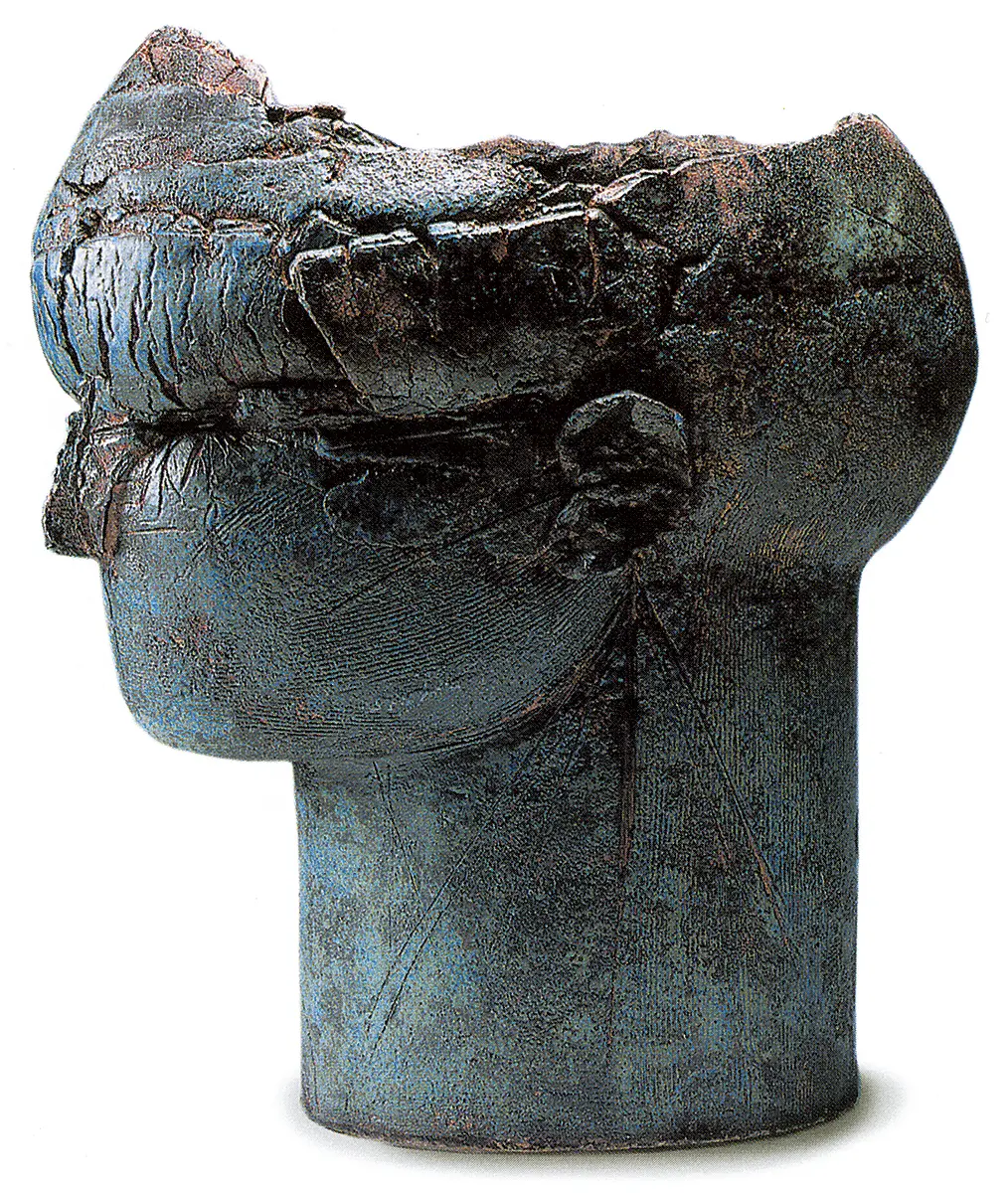
The metaphor of cranial trepanation is not gratuitous. Another allusion is to the helms of ancient warriors. An inside and an outside. A skin intensely worked over and an internal space of which we have a peek.
Thus, there emerges a reference to vessels, to forms that contain, ceramics itself, which since time immemorial has created receptacles for human use. Lira’s pieces impose themselves on the general space and at the same time determine an echo space in their interior. The semantic contents and possible interpretative keys are many. The plastic force of a strict, masculine beauty without concessions dominates the whole.
Baking these ceramic pieces is a technical problem. Temperatures above 1300 ˚C are required, as well as great respect for the physical processes of heating and cooling and the time necessary for drying before baking. The slightest error would destroy the piece, and there are always elements that are not entirely predictable, even for the experienced craftsmen of the Huara Huara workshop who assist Lira’s work.
Lira’s sober browns, coppers, greens, and blacks have variable and mysterious results. The touch of color is deployed with the most extreme economy, and the same goes for the sheen or matte applied to each surface. The almost monochrome heads contrast with the festive colors Lira has used throughout his career as a painter. Their shades, which at times seem to relate them to metal, are more solemn. Perhaps the latter adjective is what best describes the heads in this Santiago exhibition. Some of them will be at the Marlborough Gallery in New York next January.
MARÍA ELVIRA IRIARTE