In his post-war New York seminar, when giving the young abstract expressionist painters his rich personal vision of the legacy of Surrealism, Roberto Matta also reminded them of the importance of paying attention to scientific advances of the era. He wasn’t too far off the mark. The atomic bombs that the United States had launched against Japan, which would alter radically our framework for understanding the world, gave credence to his visionary intuition.
Half a century later, and in Colombia, the work of Matta is present in a new exhibition of Diego Mazuera (1950) at La Cometa gallery, titled Agujeros negros. Also here is art and science. But not as much from the angle of a cosmic Eros that keeps the planets in orbit around that pink sexual diamond that pulsates at the core of Matta’s big canvases, but as a prod to the exploration of a space that, sometimes cold and silent, deepens and stretches in the expansive blackness of its energy.
A large black background from which Mazuera extracts, as if recording, the shapes that his imagination dictates. Some come from his own creative past —a boat, some transparent sheets, a dotted line that links two nothingnesses, a faded profile—, but now, in general, he prefers abstract shapes, with a distant, reminiscent spatial texture. Shapes surrounded and compressed by bunches of vibration or shaded transparent sheets that truly turn those panels into an uncertain border: do they close or open? Are they aleatory machines moving slowly, or is it just the background revealed by the artist by scratching hat absolute blackness?
This is why his night blues or his warm yellows with a fleeting red loop seek to make concrete those ideas, those scientific hypotheses, those theoretical models with which science, be it physics or astronomy, posits its working lucubration on experimental models that live more in a mathematical formula or in the virtual truth of a computer screen than in the old recourse of a piece of canvas, a brush, and some colors.
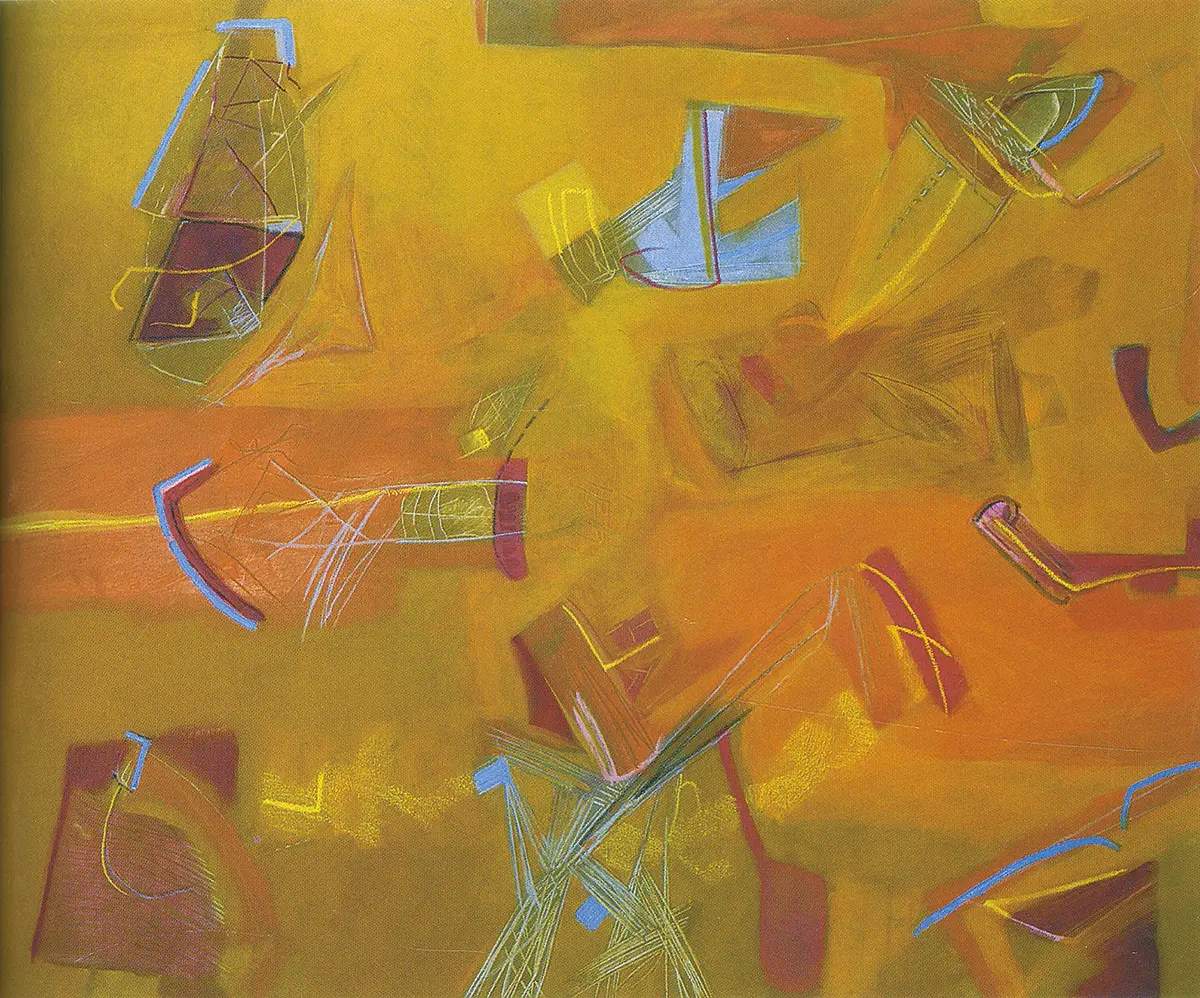
Yet what Mazuera brings to the foreground by wounding the canvas with the blunt end of the brush or with the spatula that unfurls an unexpected multiplicity of rays, is a different dimension, an underlying cosmos where arrows break through the visual membrane or cones start gyrating in that absorbing dance with which black holes attract everything, even light itself, in an infinite reabsorption.
Thus this painting becomes an exploratory filed of forces and tensions, of undulant folds that curl up on themselves and turn that contradiction of opposites, light and shadows, night and clarity, the initial, and full in itself, step towards transcending such dichotomies, all of this within a cosmos that is barely conceivable, in continued expansion.
Light has become just another matter, and now in blues, grays, off-whites, or diluted greens, as in Aclaración oscura, confronts new challenges. An alphabet of signs to visualize and form those paintings where the initial explosion of the Big Bang that originated the universe persists, in a continuous flight, towards the unpredictable borders of a world identical to so many others. Our world.
Perhaps this is why this second series of paintings, with color rather than black in their background, are more prone to erratic dispersion or the drive to accumulate plastic blocks to stop and direct those galaxies on the verge of reabsorbing themselves. From the original explosion to the final eclipse, Mazuera tries to stabilize the impossible: a cosmos that remakes itself, in the aleatory chanciness where Chaos theory is much more rigorous than Aristotelian logic.
So, those six small-format maps, 27.5 x 51.5, are able to reconcile, in a remarkable way, the goal of transforming ideas into matter and offering, in the delineated horizontal or vertical rectangle of those relieves and those terse surfaces, a felicitous counterpoint of what can very well be dubbed a visual touch. The graver, deeper colors and the effort of concentrating on smaller operative areas make his figures, arrows, funnels, and triangles, “non-determined maps,” as one of them is titled.
Yes, the map is not the territory, but without the map that same territory would not exist. The laws of painting, strict and at the same time utterly free, have traced it, in that drive to form a frame that remains open to infinity.
In her recent book El efecto mariposa. Ensayos sobre arte colombiano, 1985-2000 (The Butterfly Effect. Essays on Colombian Art 1985-2000, 2004,) Carolina Ponce de León reminds us of the existence of three generations of painters that, having started alongside those masters who are already leaving us (Obregón, Wiedemann, Grau) continues through the bridge laid by Fernando Botero into a second wave, where we could locate Beatriz González, Santiago Cárdenas, and Luis Caballero, to arrive at a third, more introspective one in the 1980s. “a time when painting prevails beyond any other visual medium” (p. 250) and where both Italian transvanguardia and German neo-expressionism supported the option opened by “Lorenzo Jaramillo, Víctor Laignelet, Diego Mazuera, Alberto Sojo, Gustavo Vejarano...” (p. 251)
A generation at its creative peak that deserved greater critical attention, like the attention demanded by this intriguing and revealing exhibition of works by Diego Mazuera. Yes, and who would have believed it: in Colombia, painting is in great health.
JUAN GUSTAVO COBO BORDA