
Dino Bruzzone’s images are not innocent; for years, Bruzzone (Paraná, Argentina, 1965) has been building a presence on the basis of absence. Obsessively and with great craftsmanship, the artist recreates existences and composes possible scenes, then captures and presents them to the viewer as true (?). The artist shoots his photographs in such a way as to render impossible any distinction between reality and its image.
The day Bruzzone presented his Arquitectura escéptica (Skeptic Architecture) at Dabbah-Torrejón, a passing hurricane tore apart lives and estates in several Caribbean islands and the East Coast of the United States. That same day, an earthquake with its epicenter in northeast Argentina caused extensive damages and death in several parts of the country.
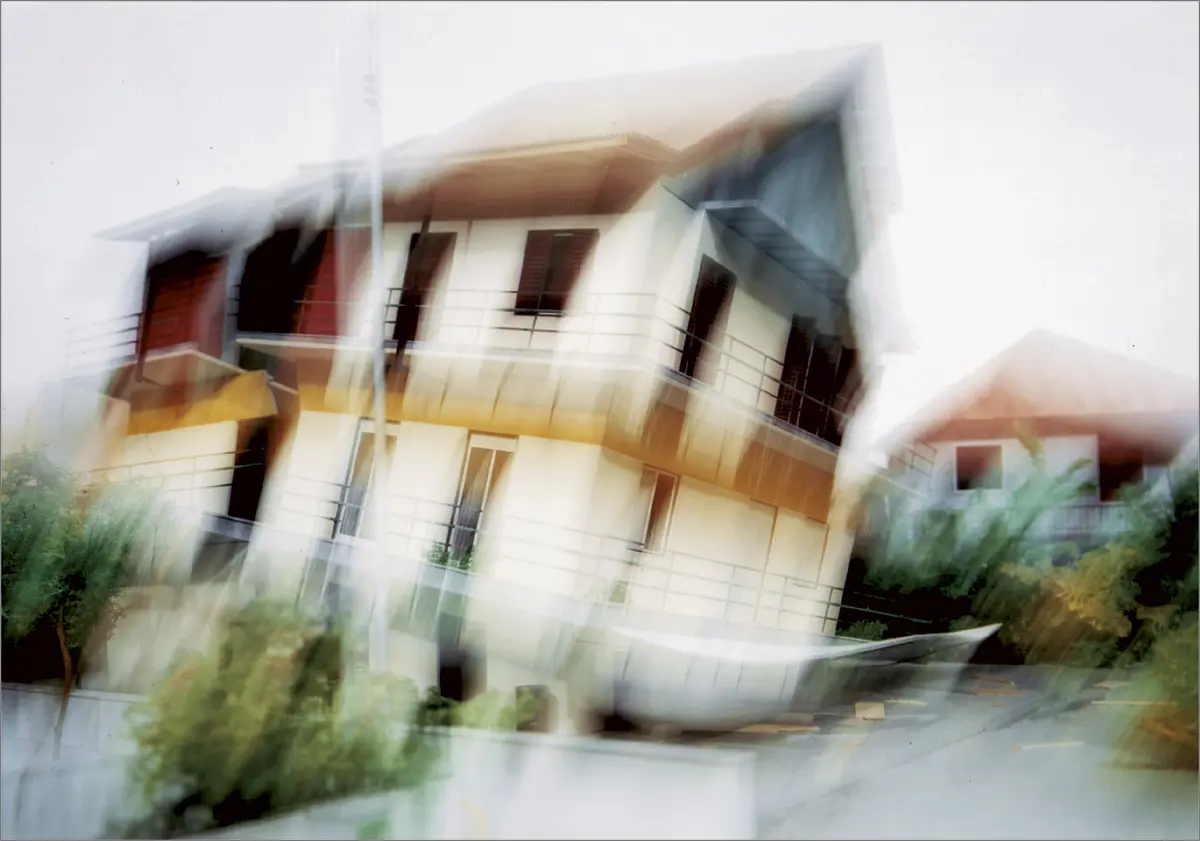
Instead of stopping rhythms, fragmenting designs, and congealing evident landscapes through the photographic register, Bruzzone simulates “decisive” instants through prefabricated movements and models of uncommon perfection. Thus, the unexpected photographs in the series Arquitectura escéptica possess a strange beauty and appear, mostly, as the displaced, blurred moments of a commotion, the remnants of a devastating event. Is this an anticipatory art?
The photographs in this series, dated between 2002 and 2004, are intelligent visual traps that leave no room for the representation of any individual. The sensation of chaos reigns in the appearance of a hospital surrounded by fog and an unmoored house. Confusion dominates semi-ruined lots and buildings that are under threat of unknown dangers. An uncontrollable wind seems to have wrecked some of these landscapes, where, miraculously, certain things still stand.
Sport as love (?) and disappointment (?) in the invented expressions, in the manner of newspaper shots taken by aerial or edge-of-the-field cameras provided by the infrastructure of sports, built around a well-focused soccer goal —from the presumptive perspective of an invisible striker whose vision is blurred beyond his objective—; decentered sports stadiums; flags with the colors of his favorite team and of its archrival, flapping ethereally like ghosts.
In a world where the only certainty is the persistence of the ephemeral, where regional wars and urban and rural violence blossom and proliferate, Bruzzone presents a single, shaky image of two airplanes. They are F-15 bombers, speeding before take-off, seemingly designed to confirm the indications of our insecurity and uncertainty.
Even though none of these architectures, panoramas, or visions possess the ontological status announced by the photographs, at first glance the latter does not make evident the subtleness of their artifice. The images are the result of manual movements, long expositions, and direct shots; they question conventional presumptions about the truthfulness of photography and can be taken as a meditation on the photographic medium itself.
The large dimensions (some of up to 120 x 240 cm) of these color photographs capture the viewer’s attention, but it is their excellence that retains his or her gaze. In all these images, vestiges of something that never was, there is also a negation of time. When did that all-enveloping fog, that destructive earthquake, that furious wind, the whirlwind of sand, the airplane’s flight actually take place? Representative of a hyper-real world of simulacra, these photographs can be read as a zealous documentation of that which never happened.
In his generosity, Bruzzone invites viewers to see the backstage of his work, to discover his technique. The artist, who is also an architect, displays in a side room an installation with the models used in his work —buildings, landscapes, stadiums, planes—, pulling back the veil of mystery in his fabrications.
Bruzzone, who represented Argentina in the Venice, MERCOSUR, Santiago de Chile, and São Paulo Biennials, has been showing his work since the 1990s. Arquitectura escéptica will be displayed later at the Centro Cultural de España, in Córdoba.
The small, precise stages built by Bruzzone and his (doubly) fantastic and conjectural photographs, molded by the vision of a world in which nothing endures, refer time and again to disarticulation and ambiguity. These are beautiful works of art that trigger timeless meanings and chimeras.
VICTORIA VERLICHAK