
The character of Édouard Duval-Carrié’s approach to Afro-Caribbean religious syncretisms is an aesthetic and “documentary” character, inasmuch as he is not a believer in those myths and rituals. He is, on the contrary, a “Westerner” intent on recording a spiritual world in the throes of extinction, almost an archaeologist, or an “ecologist of culture.” He is also one of those artists who are still interested in exploring what can be considered the distinctive signs of a “cultural identity” —in his case, Haiti’s. Rather than focusing on other topics that have of late gained a protagonic role in the contemporary scene, such as intercultural relations or the echoes of the phenomenon of migration in the world and in the region… He is not, at any rate, an artist in the mold of an André Pierre, a Voodoo priest who, despite the extraordinarily felicitous chromatism with which he accepts the challenge of the boldest polychromies, refuses to enter the international circuits of Latin American art, and defines his work strictly as a religious ritual.
In any event, Duval-Carrié interests are both contemporary and timeless, in the sense that an investigation marked by the sign of authenticity in terms of its own cultural roots, is always an encounter with the world of archetypes, characterized in essence by universality and intemporality.
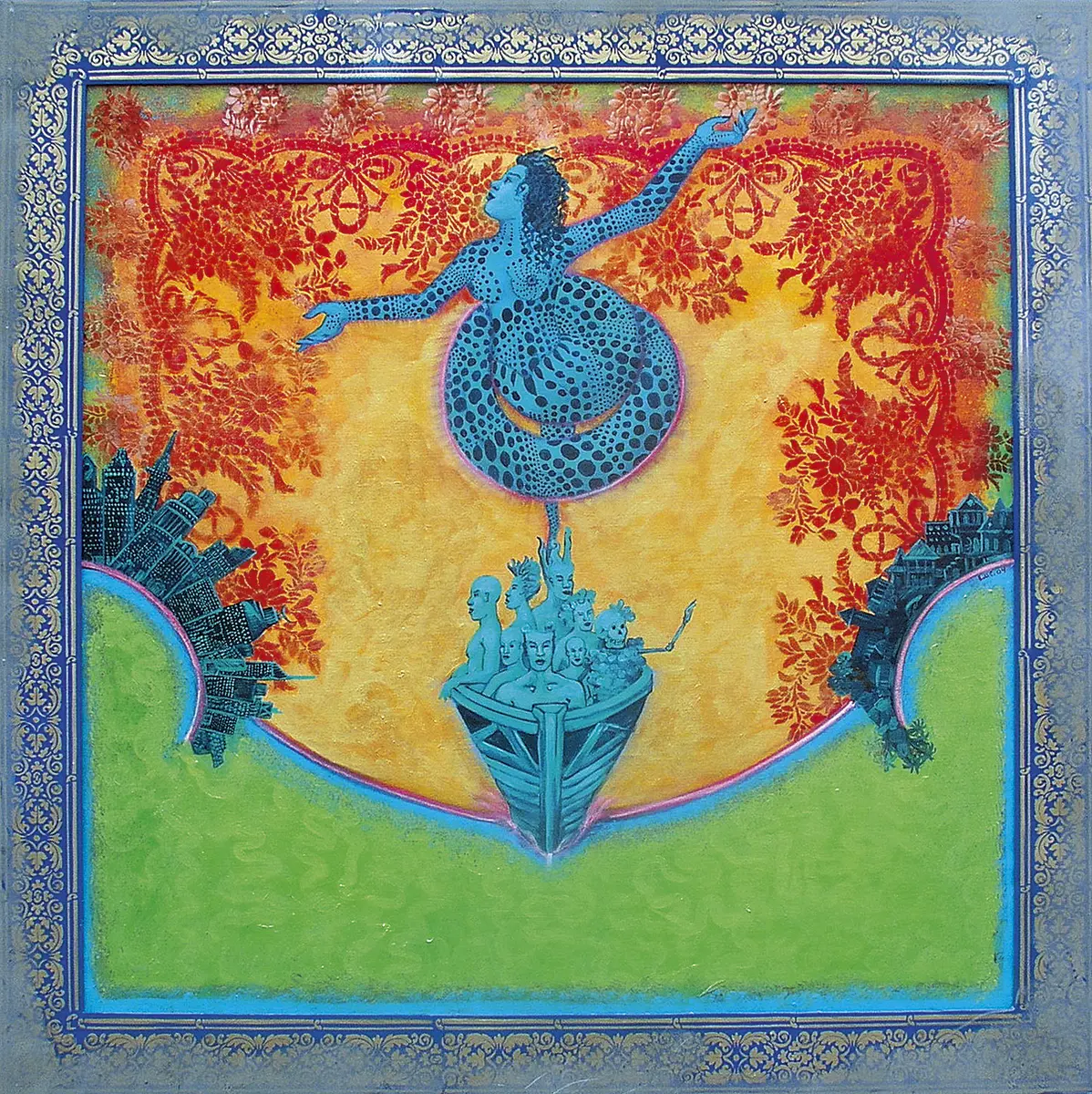
This is why his investigations take us, unequivocally, through ancestral African deities, to our common humanity and to the same sacred intuition that, in a return to the origins of the West itself, drove Thales of Miletus that “everything is filled with gods.” It is the myth of a Golden Age, the myth of a primordial harmony between Man and Beast, between the theriomorphic and the divine, that gives these unsettling images their foundation and inspiration, based on a secret agitation that shakes them internally with an intensity that becomes all the more evident the further we move into contemplation.
Duval-Carrié deviates now, in a plastic sense, from the radiant white altarpiece he presented at the 5th Caribbean Biennial, in one of that event’s most dramatically scenographic installations. Once again, the artist turns chromatic and baroque, although his harmonies are often articulated around a specific spectrum, from green to violet, or an asordinated contrast between complementaries, in the manner of classical art, such as greens and a reddish earthen tone. The primordial harmony among beings is primarily expressed through the promiscuity of anthropomorphism and zoomorphism, sometimes even reaching the point of fusion —with deep roots in Haitian Voodoo—. And in a similar treatment of figure and ground that, although related in artistic terms to some forms in the Cubist imaginary, is also rooted in the work of Renoir, and assumes in the present case symbolic connotations that are clearly pantheistic and worshiping of Nature and its magic.
Especially important is the use Duval-Carrié makes of the painting's support and frame. The latter ceases to be an element isolating the “reality” of the painting’s illusionistic phantasmagoria. The fantastic element spills over then and breaks into the context of the quotidian as an excess that overflows its boundaries. Beyond the pure, indisputable handcrafted beauty of Duval-Carrié’s pieces as “artistic objects,” what occurs here is a re-signification of objects that are not isolated from the everyday world but merely a concretization and concentration of their essence whose function is to make visible the deep nature of reality, the universe’s large analogies, unveiled by the magical-religious conscience and by the remnants of those strata of the archaic psyche that the work of art is, even today, capable of invoking.
LAURA GIL