
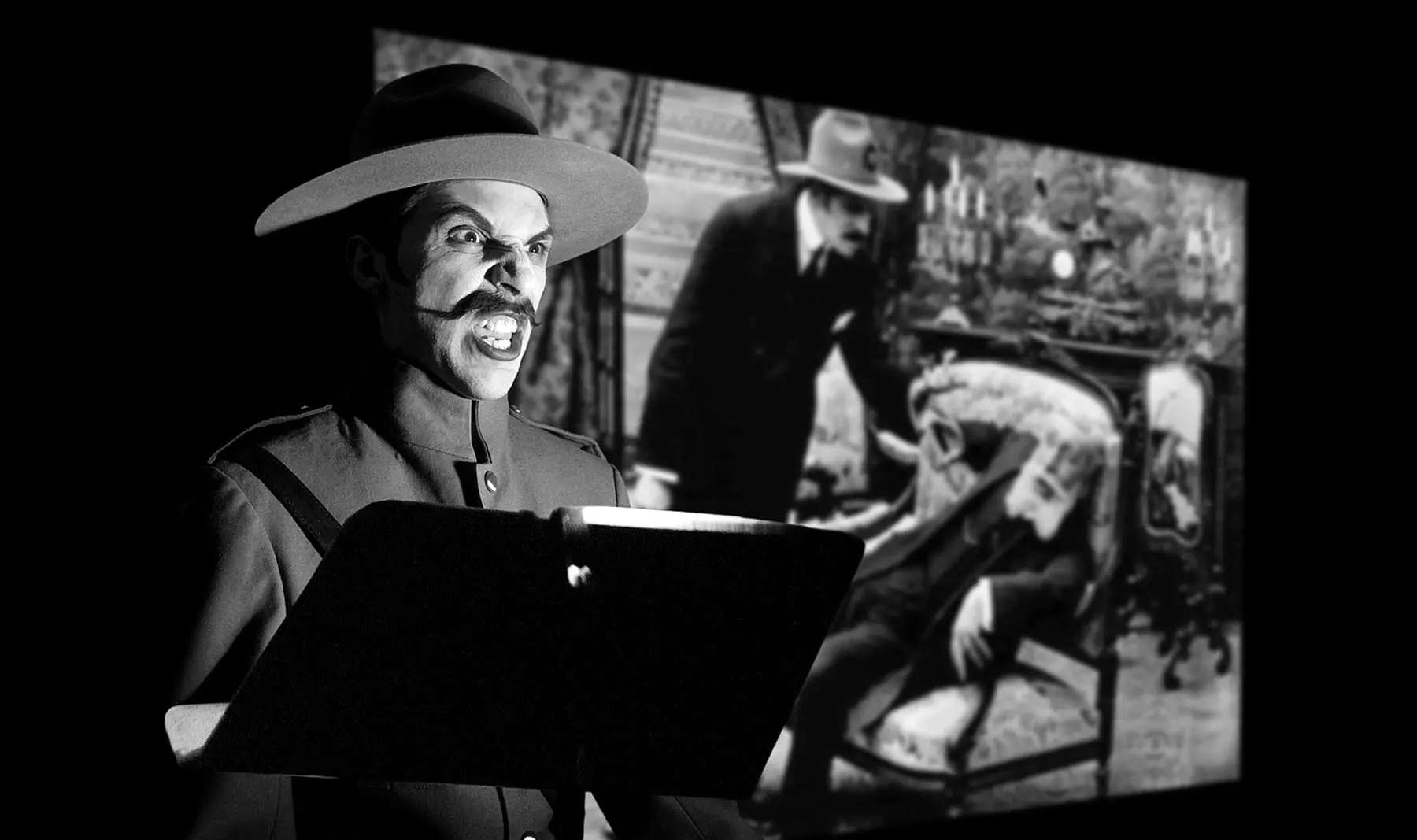
After touring Germany, France, Spain, Chile, and its native Mexico, El Automóvil Gris made a rare U.S. appearance at the Wexner Center for the Arts at Ohio State University. It is an astonishing work of art, as difficult to categorize and describe in words as a musical symphony might be; it was fitting that the multimedia piece was staged at an auditorium normally reserved for music concerts. Teatro de Ciertos Habitantes, the theater company based in Mexico City and directed by Claudio Valdés Kuri, rediscovered an important historical document from the silent film era, and now Enrique Rosas’s 1919 movie comes alive in a riveting “voicescape” that compounds the musical, theatrical, and cinematic dimensions of a drama which—by today’s definition of documentary film and television—has a true story based in “real life.”
The stage is a large film screen. Adopting the Japanese benshi tradition of silent film narration, Ernesto Gómez Santana sits down at the piano and Irene Akiko Iida (Japanese benshi) steps to her microphone. They are later joined by Enrique Arreola (Mexican benshi) and Claudio Valdés Kuri (English, benshi). Together the four performers create the voices, music, and emotional narrative of the silent film classic that was based on the legendary exploits and subsequent capture of a notorious band of robbers who terrorized Mexico City during the tumultuous months of the Revolution. Rosas’s docudrama was filmed on location at the original crime scenes and at times used some of the real-life victims playing themselves. The film constructs an extraordinary narrative history of the Automóvil Gris gang, depicting in heightened melodramatic style how the robbers posed as soldiers, donning authentic military uniforms and presenting official, signed search warrants to carry out searches of the homes of the wealthy, thus gaining easy entrance before terrorizing and robbing their victims. Their stunts, which would end with their getaway in a grey automobile, made them legends in the Mexican oral tradition. While stories about the gang still abound, the silent film itself is rarely seen today. The group discovered a two-hour cut of the film from 1933; the original five-hour copy was lost.
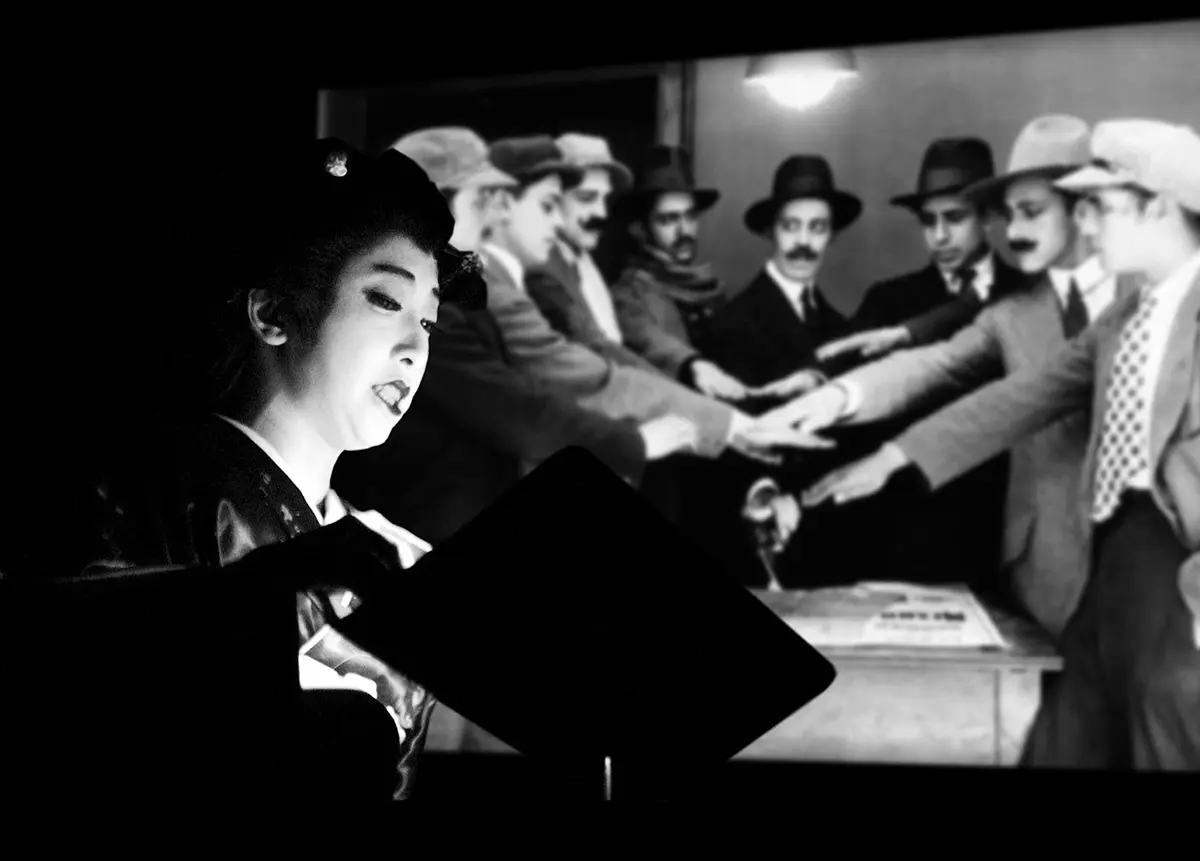
The production is a tour de force, a rich and complex mediation of the legend and the silent movie’s subtext, which have lost none of their provocative political significance today. On the contrary, compared to contemporary popular culture and sensationalist spectacles as we see them on reality TV, the live performance of the mediation of the story—through voice-over, multilingual fake “dubbing,” musical soundtracks, amplified audio effects, and partly manipulated and recoded visual footage (new subtitles and animated graphics on the company’s DVD remastering of the film)—highlights the completely effective illusionism of the montage. There are many poignant ironies. As a real-time theatrical montage, their performed voices and sounds at the same time disrupt the illusionism of the film narrative. The filmed history now becomes the present: the actors are also commentators constructing a precarious pseudo-documentary where a gap opens up between facts and their representation, then and now, here and there, between the onscreen melodramatic images and the articulation of speech, text, subtext, “character,” and the codes of morality and conscience acted out in this archetypal crime thriller.
The actors adapt a culturally specific, historic theatrical technique to present-day technological interfaces in which sampling and sound engineering are crucial modes of digital mastering. In terms used by Nicolas Bourriaud in his critique of contemporary artworks created on the basis of preexisting, found materials (for example, Douglas Gordon’s slowed-down reruns of Alfred Hitchcock in 24-Hour Psycho, or Pierre Huyghe’s recent The Third Memory, which revisits the Hollywood movie Dog Day Afternoon), El Automóvil Gris is “postproduction.” But in this case, the processing involves not only a preexisting cultural object but also a complex performative context in which the actors revitalize a forgotten form of live Japanese benshi narration. That tradition is itself derived from older Noh and Kabuki traditions containing narrative elements that tell the story being shown and turn it into a fantastic musical and vocal polyphony of arias and dialogues. The benshi performance of storytelling over silent movies emerged in the early twentieth century when foreign films first appeared in Japan and benshi narrators gave voice to many different characters, acting as cultural translators and commentators to scenes that may have been unfamiliar to local audiences.
When Akiko Iida intones the opening Spanish titles of Automóvil Gris in Japanese and continues for some time to voice a multiplicity of male and female characters in her native tongue, changing pitch, rhythm, and tone to “impersonate” different bodies, genders, and physical behaviors on screen while we read printed subtitles in Spanish and English, we are drawn into an operatic world that stretches from burlesque comedy to tragedy. When the other actors join her, Spanish and English idioms, along with some German and French, as well as animal languages and sonic abstractions are added to the bewildering mix which never fails to captivate us and focus our attention on the emotional tenor of the story. Teatro de Ciertos Habitantes creates a multilingual provocation, a work with so many layers of language that it teases and frustrates Western audiences in its presumed global sophistication.
Nuances and subtle inflections of voice create such a rich texture that we never lose sight of the serious political drama of subterfuge, terror, and corruption that is played out on the screen as we are jolted, repeatedly, into stunned recognition of the unfolding plot as well as the mechanics of melodrama. We know how important the soundtrack is to our emotional identification with narrative, but here we see precisely how the pianist and the actors at the microphones manufacture and “edit” continuity and heighten our suspense. And how the actors, over a crazy quilt of early twentieth-century Mexican and Japanese music mixed with early American jazz and ragtime, can launch into poetic arias or wildly creative and “unrealistic” interpretations of a particular character that make us choke with laughter. The story turns bad and the classic film ends with Rosas intercutting documentary newsreel footage of the gang’s actual execution by firing squad. The auditorium falls silent, no commentary is offered when the “real” federales shoots the robbers in the false military uniforms. Under Valdés Kuri’s careful direction, which is attentive to the smallest details and can only have been achieved after many months of rehearsal, Teatro de Ciertos Habitantes produces a powerful dissonance, a disjunction in our reception of what appeared to be a melodramatic comedy of good versus evil.
JOHANNES BIRRINGER
Independent choreographer and media artist, and Principal Research Fellow in Live Art at Nottingham Trent University.