Our first conversation takes place in the café of Galería Quetzalli* at a corner table, away from the gaze of the hundreds who walk up and down the cobbled street alongside one of the imposing walls of the Cathedral of Santo Domingo. We are in the last days of the Guelaguetza,1 and in the background, we can hear one of the many music groups that pepper the neighborhood. Toledo’s words mingle with the music, which often drowns his voice. After a cup of coffee, we begin walking through the gallery.
Santiago Espinosa de los Monteros: I was just remembering that story about the cowhide, how as a child you sometimes slept on one.
Francisco Toledo: My father had a dream that his bed became smaller and smaller while he was sleeping, and, sure enough, he ended up falling off. This was a recurring dream he had for a long time. And he had it after he had been in business and had become successful and all that. He came from a very large family. His own father, my grandfather, was a shoemaker, and so he bought large hides for the shoe soles, and the children slept on them. But of course, if there was an order for shoes he would cut pieces of hide, and so the children had to snuggle more and more until, in the end, there was no more hide. Then a new hide came, and my father somehow linked that dream he had with the story of the cowhide my grandfather cut in the shape of shoe soles, and he remembered that they slept on those cowhides, and that is why in his dreams his bed shrank and became so tiny. So, well, I’ve been trying to create that image now with mica. I’ve been cutting up soles, shapes of soles, and those hides I made are hides I bought in Ocotlán, in Rodolfo Morales’s hometown; in fact, it was he who took me to see the man who makes those hides to be used as parchment. Indeed they are parchment, but not of the highest-end quality, they are a little thick and they are used for school diplomas and such. I bought several of those hides.
SEM: The influence of childhood continues to appear in your work. For example, there are those cowhides from your grandfather’s workshop, your father's experience, the micas, the shoe sole shapes, your shoemaker grandfather; all of these images return again and again so often in your work.
FT: Well, yes. I don’t know whether to call it an obsession, or maybe it is a refuge. At any rate, it brings back so many childhood memories. My father’s personality marked us deeply, and it keeps him very present because his world, the Juchiteca tradition, all of that is very strong. In fact, when I had been in the provinces four or five years,2 I came back to Mexico and later went to Juchitán; I wanted to return to the place my father came from to be with my father’s sisters, and to live some of what he had lived as a child. And it was from there, I think, that I left for Paris.
SEM: Would you agree with the proposition that childhood is destiny?
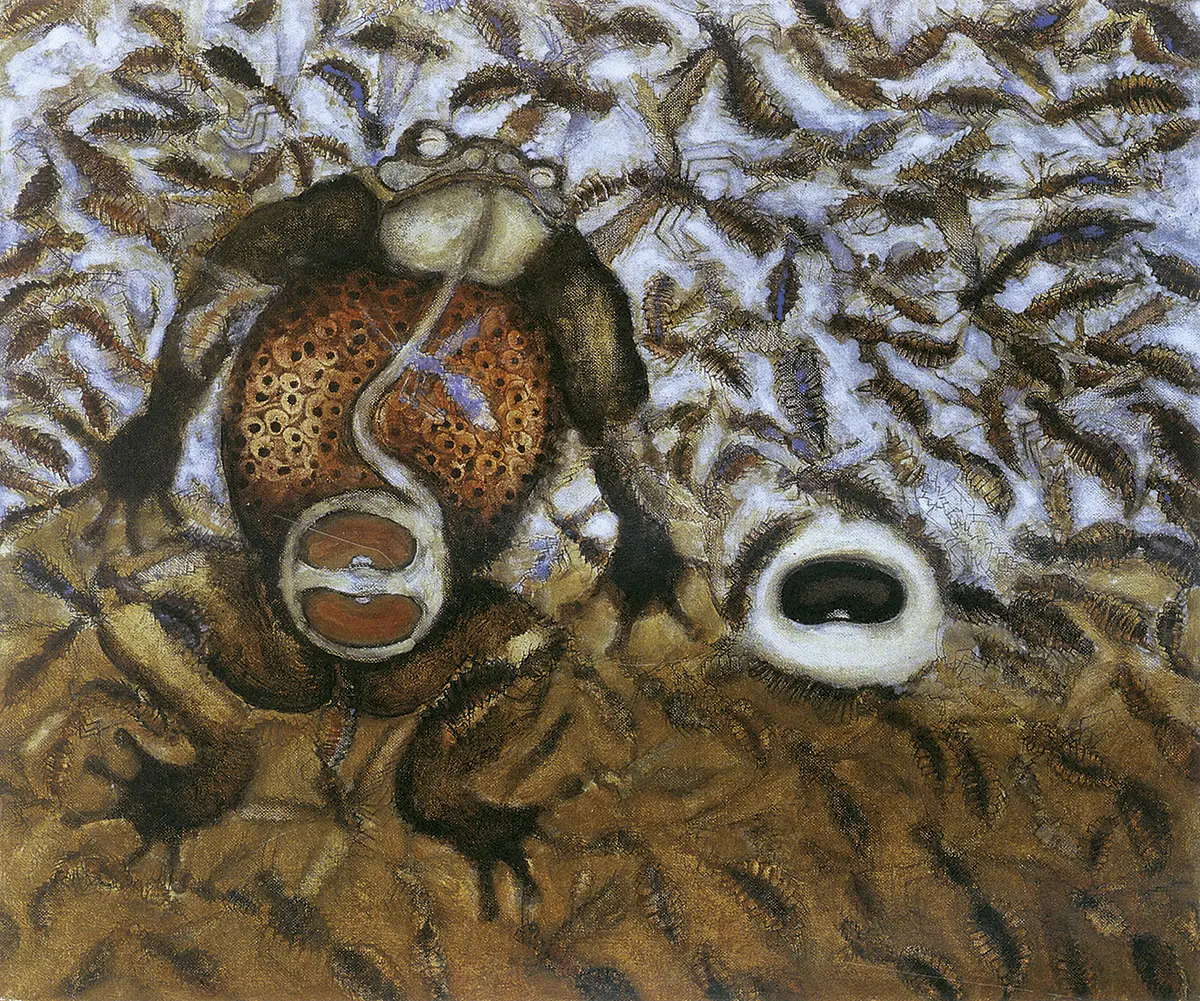
FT: In part. Well, I don’t know, I really have nothing to say. (He laughs.) I remember things, for instance, in Minatitlán we lived near the river and there were some animals, but in Juchitán, with Elisa, there were frogs because we were right at the river’s edge. Elisa had to sweep the frogs away, there were so many. Sometimes thousands of them gathered, because in front of the house,e we had a light that remained on all night, attracting moths and other insects, and the frogs came to eat during the night, so that by morning there were so many, you couldn’t even open the door, and we had to push them aside and then sweep them away. One of my aunts had a cure done with frogs. She had a nervous illness and they undressed her and covered her with a bedsheet that was full of frogs. Santiago Ramírez attributed the cure to her fear, to the trauma of having so many frogs moving next to your body, without escape, but he also says he once read that frogs secrete a tranquilizing substance.
SEM: Reviewing your work, I find many links to your early youth, to your first European sojourn, and to all that formative period of your life.
FT: Well, yes, everything I painted when I was living in Paris is made from being homesick, but I was homesick for a place I had barely experienced myself, a place I experienced mostly through what my father told us. When I returned to Juchitán, I truly discovered a new world, not only my father’s world but an altogether new one since it was me who experienced it, I married Elisa,3 the mother of my children, there, and we found the Casa de la Cultura. Those were extremely important experiences, and, of course, I saw many of the things my father had lived, but I also discovered many things he hadn’t told me, like the story of our family, of revolutionaries, of [José F.] Gómez, who was indeed mentioned at home but only rarely. We never really knew who this character was until I went back to Juchitán and dug everywhere and found documents and family letters and interviewed people who had lived as children through those days of the uprising.
SEM: But Che Gómez is somewhat hidden in the stories your family tells. Is that because he was assassinated, or because of his partisanship positions?
FT: Well, my father was in a tight situation, because on his father’s side, they were Reds, that is to say, what we call Conservatives, and on the side of Che Gómez, my grandmother’s side, they were Greens, more radical. I think my dad was more inclined toward the Red party maybe because his own father was a Red and he had an influence, as well as the stories that were told. It is also true that it was they who won the war. But when we discovered the Green cause was nobler, my father also understood the situation and that was that. The people were very divided, and everybody took sides. I was told that my grandmother painted her chickens red with a dye from Campeche that’s very resilient so that she was able to identify them and keep them from being stolen. So she had those red chickens running all over the place, red like the party.
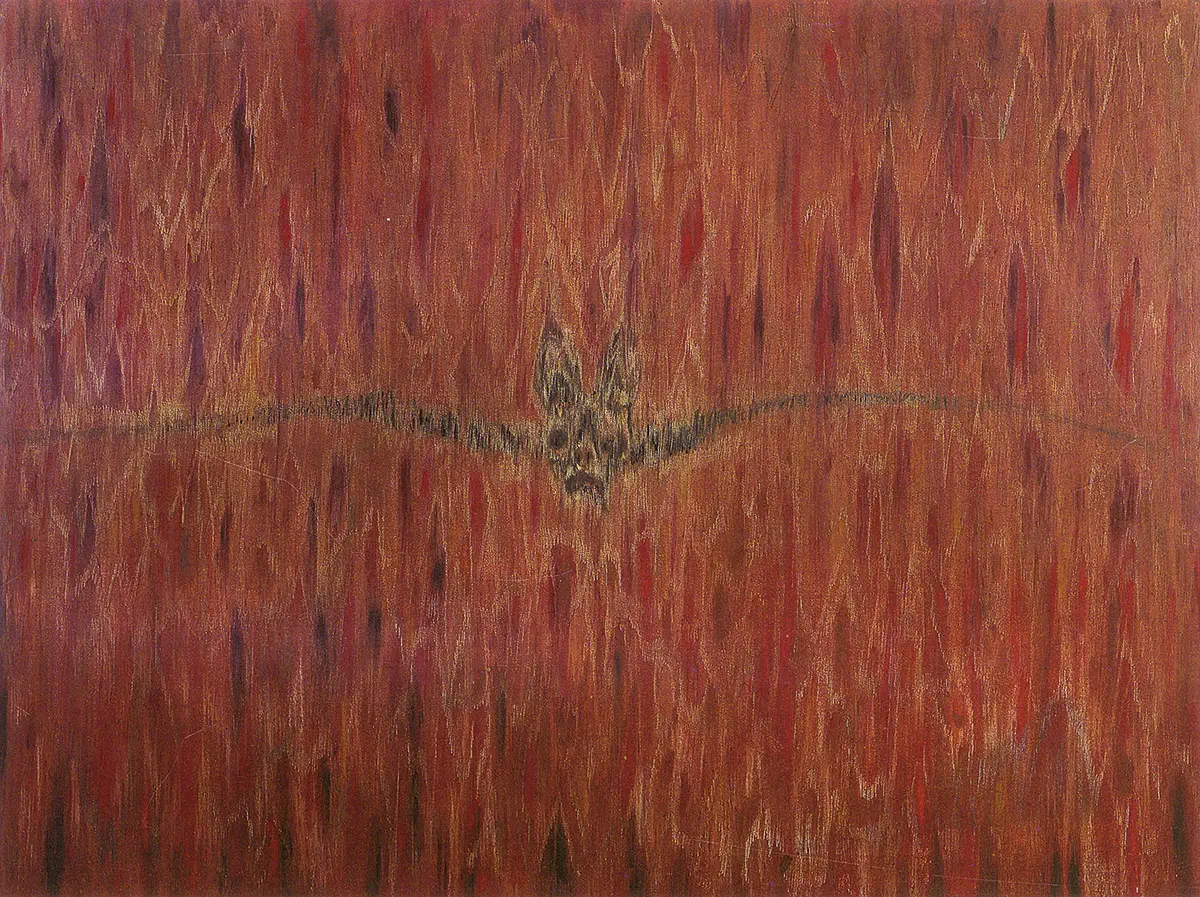
We have stopped several times in front of his work and the conversation moves in unexpected directions. His interest in explaining some of his techniques reaches down to the smallest details. We are surrounded by the current animals, his ever-present animals. Toledo’s imagery is endless and so abundant that in each one of his pieces, he would seem to rescue beings that are already endearingly familiar to us, the inhabitants of his particular zoology. We are now in front of a bat that seems to fly at great speed toward us.
FT: This is Bat-Ikat. It is like the kind of weaving used to make shawls. I don’t know what the Ikat4 is called in Mexico City, but it is a term used throughout the world to refer to that kind of weaving. This part is what the weaving looks like [He points to the back of the room, behind the bat.] I titled the piece after the animal—bat—which was more sonorous. I liked Bat-Ikat.
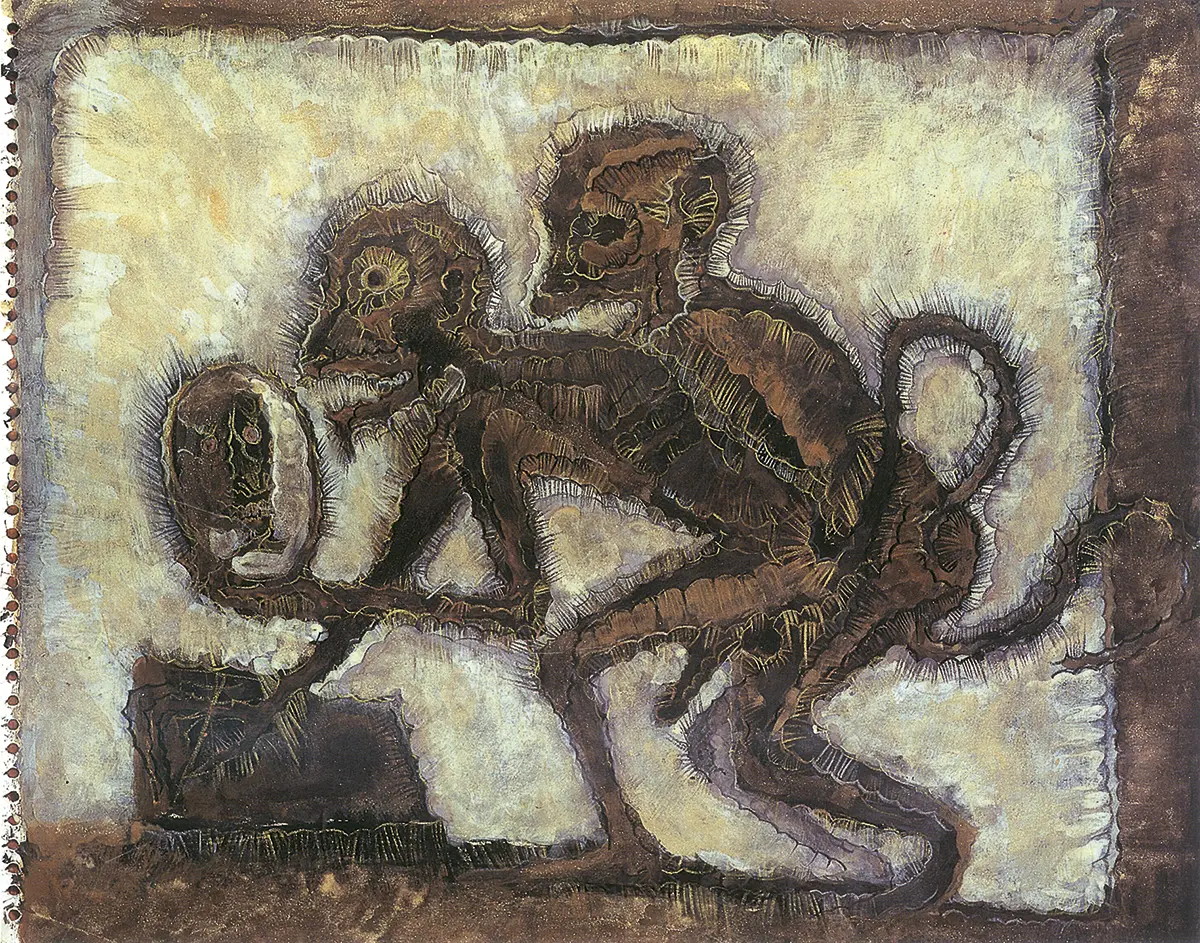
SEM: And these monkeys, are they the wild monkeys of previous years?
FT: Well, in part I work now in terms of Kafka’s Academy,5 with that story of a monkey who is captured and later taken to civilization. But on the ship that is transporting him, he acquires learning; the sailors start smoking and drinking and he observes them, and later he starts speaking and walking. Well, he is taken to the civilized world and there he has to choose between the zoo and show business, and he is giving a report on his life, and, what else happens?
SEM: But you were already using the iconography of the monkey in previous years. Does it all come from Kafka or are there other sources?
FT: The Popol Vuh always comes into play, I am very interested in that book. On the other hand, at this moment that Kafka thing is striking to me, because I saw in the news that in the Tel Aviv zoo, the monkeys were sick with some stomach ailment, they were dying, and one of them after coming out of his crisis has stopped walking on all fours, he walks on two legs! I have 100 prints, you can see them if you want in my workshop, they aren’t finished yet but there is progress.
We continue walking, and we talk of common friends. The music hasn’t stopped and some visitors recognize Toledo and ask to have their picture taken with him. He agrees, smiles, looks at the camera, and thanks those who express their interest in him, but hastens to drown any possibility of striking up a conversation with quick movements that take us to the next room.
SEM: Can you find this mica stone here?
FT: Sure. In pre-Hispanic times, Oaxaca was a mica-exporting region. All the mica found in Teotihuacán, in those urns with eyes and decorated ear ornaments, it is possible it was all brought by Zapotec and Mixtec merchants to the Valley and to Mexico City, and also I believe, to Chiapas and all the Maya regions. I don’t know if all the mica mines are concentrated here. I discovered them when they were restoring Monte Alban; they raised the floors and there was a lot of mica that was used to insulate the buildings against humidity. There were large amounts on the floor. That’s where my interest in mica began. And there are several kinds. This is white mica, the most difficult to find. In this way, I have found pieces of cut-up mica from inside those irons. But it is a shape that also refers to pre-Hispanic ear ornaments.
SEM: Do you feel you are somehow returning to that way of setting up, of building your paintings like you did in the 1960s and 1970s?
FT: I don’t know, I don’t know if I am, or whether I am coming back from that.
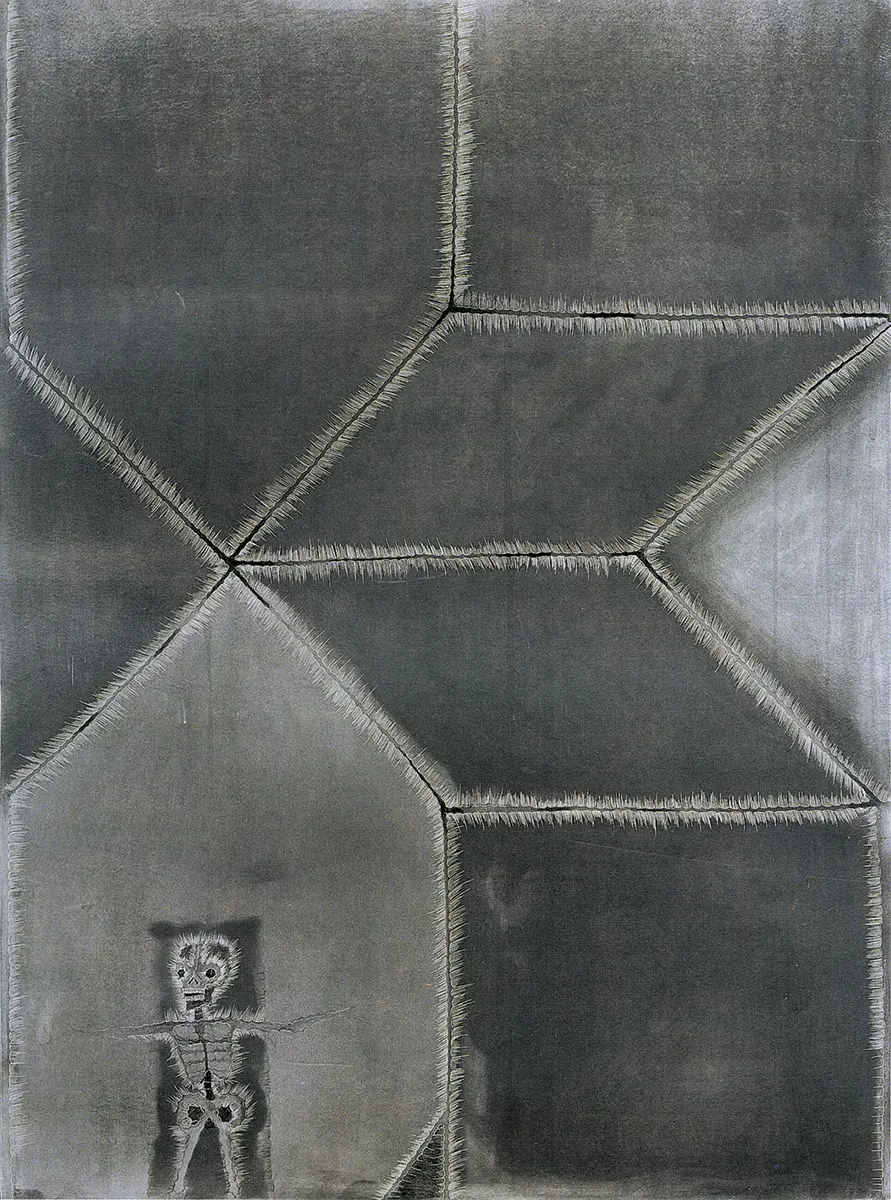
SEM: Mi casa es tu casa, cortesía de la muerte [My Home is Your Home... Courtesy of Death]. (I read the title out loud and look to Toledo as if waiting for a comment. He laughs.)
FT: Of course. Death is so courteous!
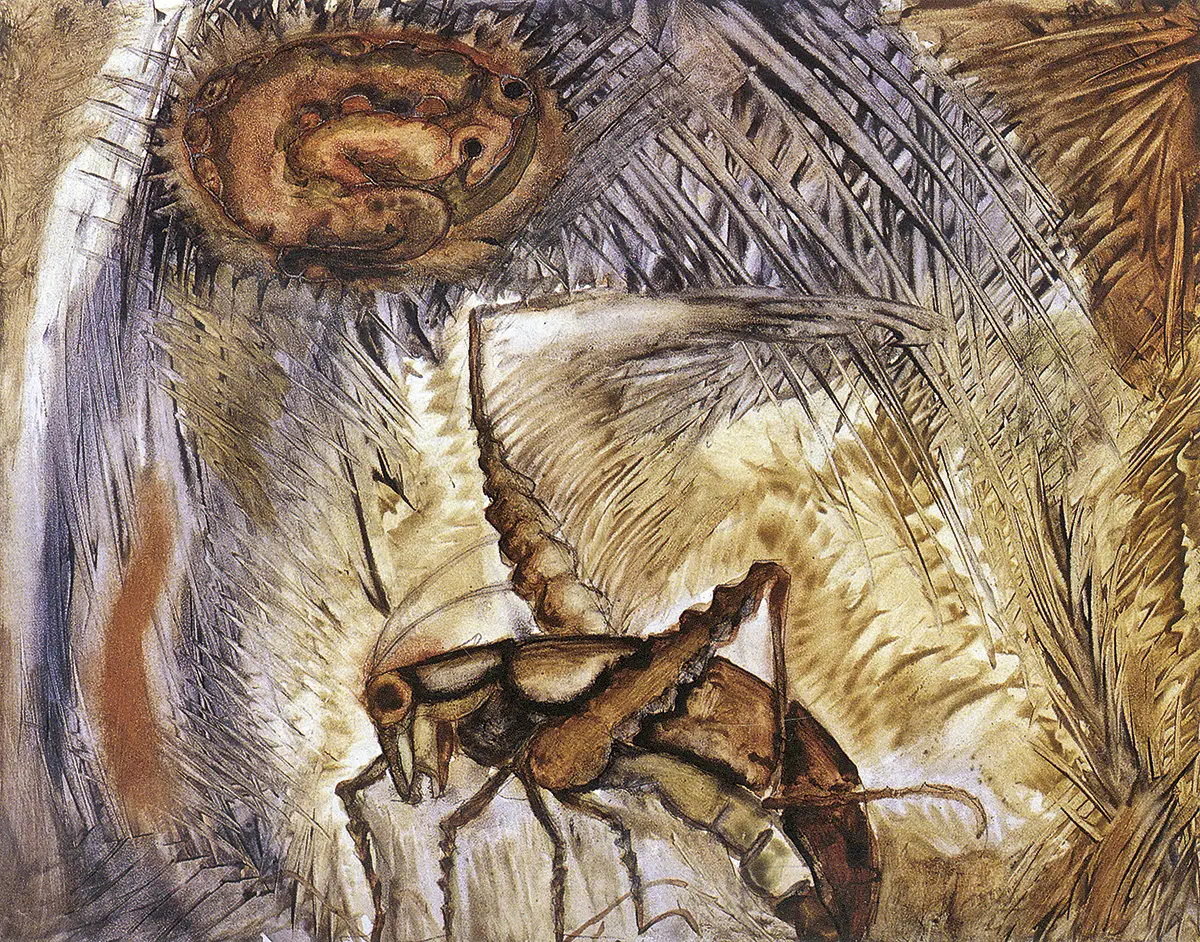
SEM: That aspect really interests me. To me, these paintings titled Juego del lagarto ausente (The Game of the Abscent Gator), and Mi primera lección de botánica (My Fist Lesson in Botanics) feel completely different, except perhaps in terms of the materials used. They are different from the rest, they are somewhat apart from the rest of the composition of your work. Do you feel the same way about them?
FT: Yes, sure, there’s something in them. But they are very recent, and so are the ones over here. (We are in front of Frijoles, laberinto [Beans, Labrynth] and El misterio del frijol saltarín [The Mistery of the Jumping Bean]). Yes, they are different. But, well, this thing about jumping beans, do you know the story about the Surrealists? André Breton took a jumping bean to Europe and it was a sensation, because the bean jumped, and one of the Surrealists said, “What on earth is this?” and cracked it open. And Breton got very upset and he said, “You don’t do that,” and explained that one shouldn’t do such things because mystery is mystery and one shouldn’t be going in to know, to see. I think he expelled whoever cracked open the bean, he expelled him from the group or stopped talking to him; he was vetoed.6
SEM: Do you feel that your work, in some way, is like that jumping bean where mystery is mystery and we shouldn’t seek any further, but just take what is there?
FT: Yes, of course, it is like not doing any revisions, keeping your distance, not asking too many questions.
Many works in this show refer to beans. There are jumping beans, beans in a labyrinth, pinto beans, beans up and down, beans in any imaginable way. But they are here also as a representation of life, of fertility, and as a germinating symbol of narrations born of farm work.
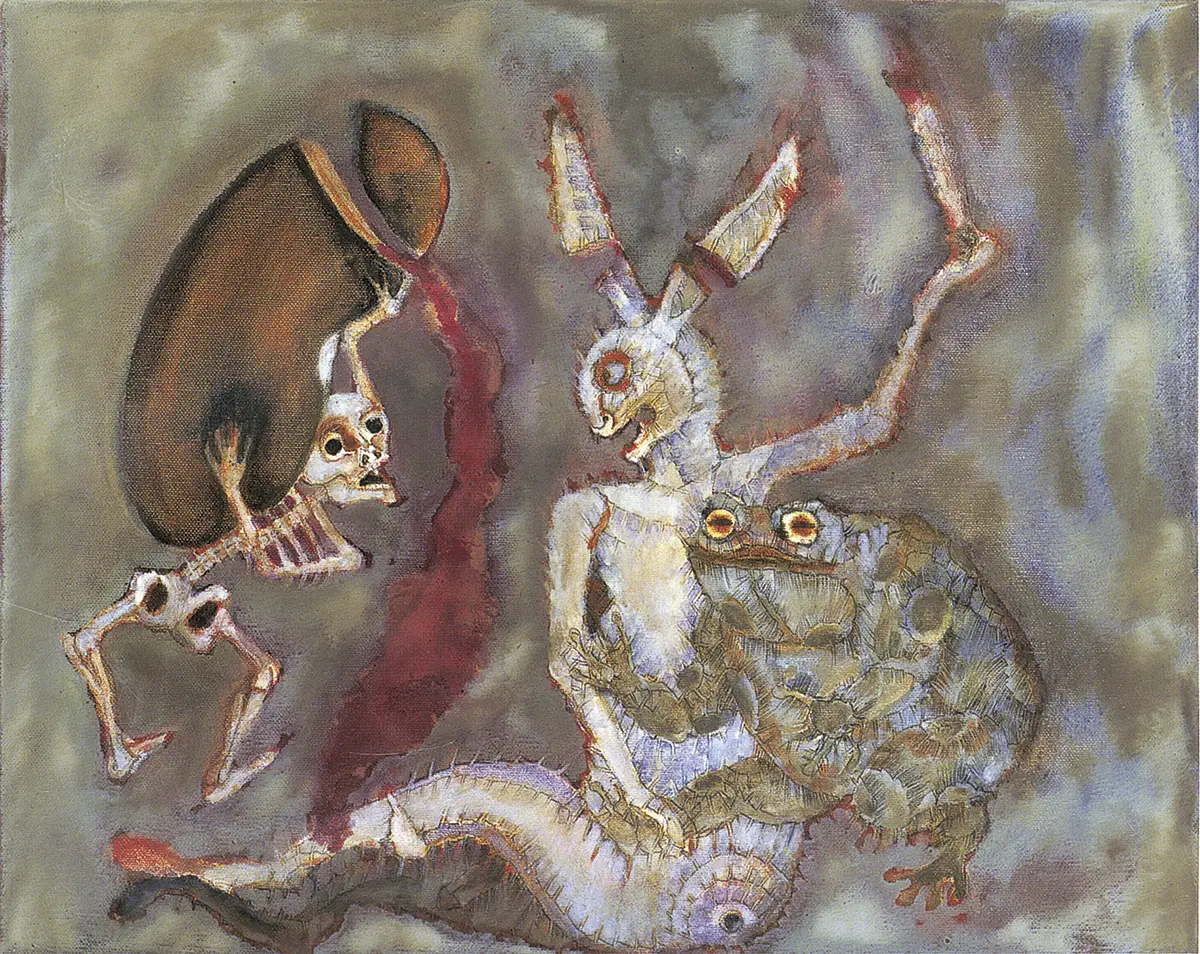
SEM: Your Conejo descabezando frijol (Rabbit Beheading Bean), not only beheads the bean, he also cuts off his own ears, and both the bean and rabbit bleed. There really is blood there!
FT: Yes, but I don’t know why. Maybe some red just slipped past me.
SEM: Does your own history come into play in Preocupaciones de un padre de familia (The Concerns of a Family Parent)?
FT: Yes, yes, yes, yes, of course, it’s me. (He laughs.) You see, it was inevitable, although I don’t recontextualize it inside myself, but look at this piece, this is interesting. These mica circles come from an iron.
We continue our walk, now in the warehouse of Galería Quetzalli, where most of his works are on display. Here also are the ceramic pieces he made in the workshop of Adán Paredes. They are a series of frogs that may soon go to the fountains of cochineal water in Etla, not far from the city of Oaxaca, an old factory Toledo is turning into an art center. Our conversation takes a more private turn. The treasures so zealously guarded behind one of the most intense gazes in the contemporary Mexican art world, begin to reveal some of his most personal stories, which, in turn, outline the artist’s intimate structure.
FT: My mother offered home services so that I was able to go to school, that was a very generous gesture on her part. She was a sweet, soft person.
SEM: I met her, remember?
FT: Yes, that’s right.
SEM: One day we had dinner and then I drove you to an apartment in Colonia del Valle and Chacha7 and your mother were there. I was only dropping you off but your mom wouldn’t let me leave, she insisted I stay and visit. I drank something, and we were there chatting for a long while.
FT: Well, yes, that was her, very soft, very patient. I don’t know if that’s where my interest in people comes from but it has a flip side because people also annoy me a lot. Sometimes I feel I’m fed up with everything, I want to just take off, I want to close down and move on. Maybe those two aspects are there, aren’t they? My father’s and my mother’s: impatience and patience. I can be very neurotic and at the same time very timid and very courageous, very bold, I can fight and be in matters of life and death. And at the same time later I realize that’s not really me, I’m not really that, but it is also a way of being. On the other hand, there is that whole history of Juchitán, and of my family. That’s when I realized there are two elements that influence me. Well, but before that, I was telling you that in my family there was someone who led something, an uprising. Maybe that’s where we get our desire to be part of a movement.
SEM: When you had your show Lo Que el Viento a Juárez (What Wind is to Juárez) at Galería López Quiroga, when they were in their Avenida Masaryk site, I remember we talked about an exhibition proposal, and I remember your need to recover a series of stories about Juárez as governor when he burned Juchitán because it was against him; they are stories that draw tears and which some Juchitán people, as well as the official histories, would just as well forget. It was a terrible thing. And there you were with that need, with that vocation of yours of revaluing and reassessing myths.
FT: My father was the one who told me so many things because he had such a great memory. At the table at home, he was always talking, about lunch and dinner. He always talked about remembering and studying our family’s history, our town’s history, and then sometimes he told us things and we didn’t know what he was talking about, who was Che Gómez, who was Don Pablo Pineda, who was the revolutionary who fought against Che Gómez, who was also our relative on my grandmother’s side. I had the chance to meet him in Mexico City when I was five or six, and he didn’t want to go back to Juchitán, there was something terrible going on with the other party. So, all those stories we kept in our memories, without fully knowing what it was that happened. That’s why I went to see people who told us stories, in order to recover all this and have a good record. And, well, at that time two of my grandmother’s daughters were still alive. One was Aunt Guillermina. We called her and had her tell stories; I have pictures, I have letters, I have telegrams, I have everything. And we bought her archives and published them, all the telegrams and the letters, and there were suits that were filed. Elisa and I interviewed people; we went all over, gathering materials and we put everything in the Casa de la Cultura de Juchitán where we also worked, and people started talking and we got to know the full history. With all those materials, we came to know it more in-depth.
SEM: Where are those archives now?
FT: Coincidentally, they are here in Santo Domingo. The archives of Benito Juárez Maza (President Benito Juárez’s son) who was the governor at the time of the uprising, are here, plus a section of the archive that had been stolen. The telegrams were in the Government House in Oaxaca and were part of the documentation, but the documentation was incomplete because someone had taken them, Later I found out that what was missing had ended up with Aunt Guillermina and that is what I was able to recover and hand over to the State Government, or at any rate to the institution in charge of Justice Maza’s papers. And it’s there. And sometimes we still find stuff that we continue to take there. All the family photographs as well, because since it wasn’t the custom to take photographs all we have are those in certificates, or from weddings, from quinceañera parties, but I started finding more when I became interested in photography, at around the age of sixteen.
Our conversation extends to the topic of his family’s history, the revolts, and the relative who led an important revolt and was marked for assassination, and who got a safe-conduct pass from President Francisco I. Madero so that they could meet for what was to be a historical interview; the interview couldn’t be held because he was the victim of a fatal ambush in the mountains organized by Governor Juárez Maza, who had joined the forces of Porfirismo. In Toledo’s sentences, the story flows as if one opened one of the least-known chapters of our recent history. And from social leader Toledo, we come back to author Toledo and to the human being, who tells us about his children and their names.
SEM: Is that why you named your children after people in your family? Laureana and Benjamín.
FT: My grandfather was named Benjamín. I’m also named Benjamín.
SEM: You are Francisco Benjamín. But, do you celebrate on October 4?
FT: No, I have never done that, I don’t celebrate my birthday or my patron saint’s day. But I am named Benjamín like my grandfather, and I was always called Benjamín until I moved to Oaxaca, when they started calling me Francisco Benjamín. After that, I was mostly Francisco, but the nickname for people named Benjamín in southern Veracruz was Mincho, and I was Mincho.
SEM: You are now coming out with all these works after two years partially spent in Los Angeles. How do you relate to them?
FT: Well, I am somewhat at a loss; really, it is kind of exceptional. These are works I created and then locked away. I haven’t seen them in two years. I thought they were better! (He laughs.) No, I wasn’t delighted. I don’t think so. I was somewhat disappointed. I glance at it sideways.
SEM: But these are undoubtedly major works. Why didn’t you want to see them in your house?
FT: I don’t know. It was such an effort to leave Oaxaca and go to Los Angeles, to do such ugly work, abroad, in such an ugly neighborhood. No, the fact is that it was so difficult for me, it should have come out better. Many things were put away and I never saw them again; they were all packed until just now.
SEM: How do you feel the new ceramic pieces you made recently relate to those works you had packed away?
FT: The recent work for me is like coming back to pottery after twenty years. The two materials are different, but there are indeed some similarities. In a way, ceramics gave me new air to breathe during this period. What happened is that I did have a difficult time. I was in Mexico City doing blood tests and stuff like that; I got very tired; I was very depressed; I fainted twice just like that, fell unconscious, got up, and fell again, without even noticing. So that’s why I went to Mexico City to have those tests done. I already had difficulties with some things; I was tired, in a bad mood, tired of working. They found something in my lungs, a stain or something, I don’t know what they call it, and they had me do many different tests of some kind, but nothing came out. My spirits were low. There are periods like that. I don’t know of these things. So the doctor said to me, “I can’t find anything,” only something about my sugar levels, my blood pressure, my hypertension, and my long nights of painting.
SEM: I see you full of projects, full of work, full of energy.
FT: I try to rest sometimes. But I can’t drink any alcohol and I tend to need that in order to be with people, to be communicative. I used to drink one or two beers around noon, which is really not a lot, but now I can’t even drink those. I guess I’m older now. Also, I don’t have a strong constitution. My father was very, very strong, but what can I tell you, I am not.
SEM: No, but you have to work very hard. You often work very long hours.
FT: I am rather quick, I can do things fast and work for eight hours straight, as if in some nervous state. These ceramic pieces for instance are three weeks old. Three weeks ago we brought all these works together, and there is more, they have to go in the oven, but it is not too much, it is time that I’m investing, but it is not too much. I have time and energy left to do other things. We’ll see what happens.
NOTES
1. The Guelaguetza is one of Mexico’s oldest live festivities. It is held in the state of Oaxaca and it is also known as Lunes del cerro. Its organizers insist that it is the largest traditional celebration in Latin America, with thousands of participants from all the towns and villages in Oaxaca. It combines Zapotec and Mixtec indigenous traditions, and Catholic beliefs brought to Mexico in colonial times. The word Guelaguetza refers to the fulfillment of social debts and the exchange of products and services. It is celebrated annually in mid-June.
2. When Toledo speaks of the provinces he is referring to Minatitlán, Veracruz, where he lived for a time with his father, as a child and a young man.
3. Elisa Ramírez, daughter of the famous psychologist Santiago Ramírez.
4. Ikat is a weaving technique in which the outer layer and the grid are tied and die in such a way that the programmed patterns appear in the final product.
5. Toledo is referring to A Report to the Academy, a tale by Franz Kafka that recounts the story of an ape who, in order to survive, learns how to be human and becomes a vaudeville star. This subversion of roles and identities creates a context for the story’s characters to be tamed beasts as well as beast tamers. This work questions human intellectual superiority, probing the limits of nature and culture. Perhaps the key sentence is the one that asserts that the ape “mimicked because he was searching for an exit and for no other reason.” Any reading of Toledo’s use of monkeys in his work must take into account this important literary precedent.
6. André Breton became very upset when Roger Callois defined the act of cracking open the jumping bean as an attempt to find rationality where it seems to be absent. Indeed, Callois commented he had lost his faith on December 16, 1934, as a consequence of these events, which makes his distrust of “marvels” older than that of Claude Lévi-Strauss. Although Callois flirted with Surrealism for many years, he always questioned the movement’s lack of scientific objectivity. From Robert Level in “The Linguistic Machines,” La civilisation surréalist, coll. by Vincent Bounoure (Paris: Payot, 1976), 73–78.
7. Chacha is Graciela Toledo, the artist’s sister.
* The exhibition presented in Galería Quetzalli traveled to Galería Juan Martin and Latin American Masters, who we thank for the images all of them illustrating this text.
SANTIAGO ESPINOSA DE LOS MONTEROS