Cada vez es ahora (Every Moment Is Now) has traveled from the southernmost country in South America, Argentina, to the southernmost country in North America, Mexico. Audiences have had a chance to view Gladys Triana’s work for the first time in these three public institutions. Triana comes from a family of talented siblings. Her brother is a playwright and her sister is an actress and opera singer. The artist’s career has developed over a period of time, in several countries, sometimes in difficult circumstances. Born in Camaguëy, Cuba, Triana began her professional life as a teacher, then taught herself painting; her work was shown twice at the then-respected Lyceum Gallery in Havana (1962-1963). Her work was also included in an encyclopedic art history book (Pintores Cubanos) that documented Cuban artists from the 1920s to 1962.
When she arrived in Madrid in the early 1970s, she began to study art at the San Fernando Academy. Following Triana’s early career in New York, where she arrived in 1975, is similar to tracing the history of alternative spaces devoted to Latin American artists. She was first shown in the Sarduy Gallery (1974) and then in INTAR Gallery (1975). Triana is now known for painting, work on paper—both drawing and printmaking—and more recently for sculptural objects, installation, and photography.
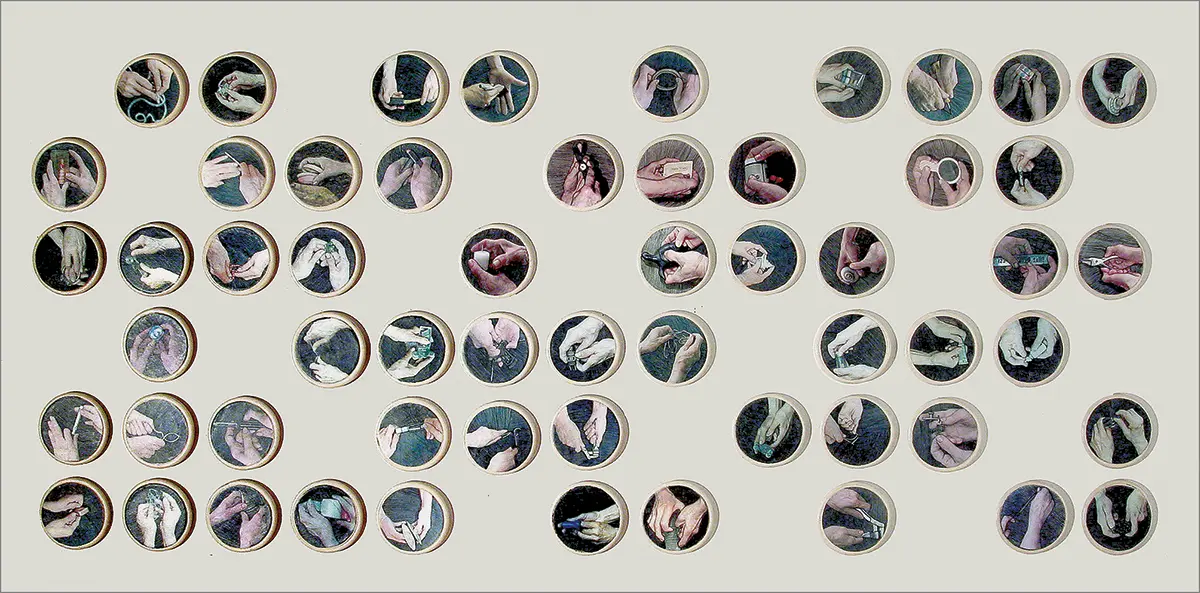
Gladys Triana’s new body of work features three wall installations, two of which are drawings, and the third, photographs. Each series of drawings presents the artist’s hands holding objects commonly used in everyday life. Of special interest are the two series of 121 drawings on embroidery hoops, one of which is installed in a triangular format and the other in a loosely defined paragraph format. The images in the triangular format feature the hand holding or presenting the object, as if to signal its significance; the images in the paragraph format feature two hands activating the object as if it were in use.
The subject of hands in art has a long pedigree. The image of hands has been interpreted realistically, surrealistically, literally, symbolically, abstractly, politically, and so forth. Studies of hands, in addition to rendering their dynamic lines and physical features, have communicated strength, agility, and movement. Sometimes they have conveyed a sense of beauty or revealed a chronological stage in one’s life. Hands are expressive; they communicate human feelings through gesture and touch. Triana seems to have chosen her hands to signal life’s thrust, its vital sign, and she makes this point by engaging her hands in routine movements with ordinary objects. She seems to be saying that there is something paradoxically special about recording a fragment of an ordinary activity. In calling attention to mostly domestic objects found either in the artist’s home or her studio, Triana marks a moment in life, one of the countless activities performed in a routine manner.
There are more than 137 images of objects featured in the two wall drawings, including accessories used for grooming—a hairbrush, a mirror, lipstick, nail scissors, soap, and a compact powder; utensils used for eating—a spoon and fork; gadgets for preparing food—a can and bottle opener, a knife, a garlic press, a saltshaker, a vegetable peeler; accessories for our environment—light bulbs, socket, plug, screwdriver, and a drill bit; artist’s materials—a miniature watercolor kit and a thin brush, a can of paint, a magnifying glass, scotch tape, a marker, an orange stick, a charcoal eraser, an ink roller, and linen tape, among other images.
In selecting support for the drawings, the artist decided to use an embroidery ring or hoop. As an adolescent in Cuba, Triana was taught embroidering in school as a life skill. The artist took 121 hoops, placed a small piece of linen around the inner ring of each one, and then fastened the inner and outer rings together. She then attached the scanned images of the photographs she took of her hands manipulating objects and cut the photographs to the shape of the hoop, which she pasted to the linen. Then she placed Hiromi paper over the photo and drew the outlines of the object and the background on the paper. The final image, far from being hard-edged, has a soft, hand-drawn quality about it.
These everyday objects are so mundane as to be practically invisible. And the routine tasks we perform with them are of hardly any note. We take for granted the infinite ways our hands move. Once the objects are selected and highlighted, they assume a newfound importance because of the consideration we begin to find in their objecthood and function.
Where does Triana’s artistic exploration fall within contemporary modes? This particular work involving drawing, photographic manipulation, and the labor of cutting and pasting, not unlike collage art, is performative, labor-intensive, and repetitive. Triana works in the interstices where handicrafts, fine arts, and everyday life are interchangeable subjects of art making. From this perspective, we are reminded of the poet Pablo Neruda whose Ode to Common Things is a testament to beauty and poetry embodied in the everyday objects that fill our lives.
JULIA P. HERZBERG