A box, a can, bricks, light bulbs—there’s nothing extraordinary about the sources for Iran do Espirito Santo’s sculptural works. In fact, what links them is their reference to a common, everyday reality that we usually ignore. The Brazilian artist seizes on this unconscious disregard as an opportunity to reawaken perception. His works are so thoroughly conceived and constructed that they shift the common out of context, disrupting the veil of familiarity. As a result, these lyrical works exist both as objects and ideas.ten
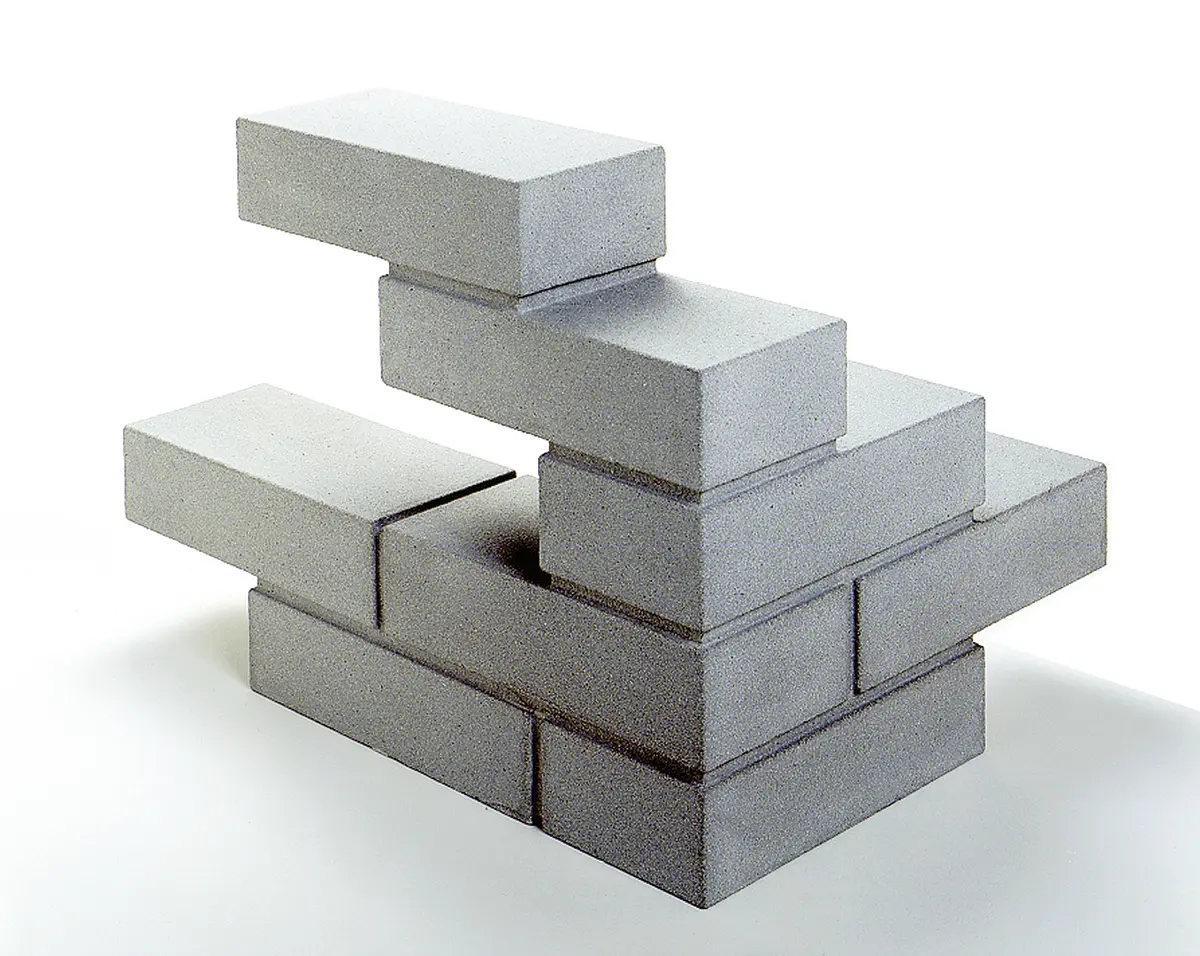
Debris, a series of sculptures displayed on a low platform, is the best example of this strategy. Resembling groupings of bricks, these architectural “excerpts” embody the duality of object and idea. We can engage these works as fully contained within themselves or as eccentric fragments pulled from a larger, implied reality that nevertheless continues to hover around them in the mind’s eye.
Their construction also evokes this duality, carved as they are from single blocks of Pietra di Tuoro (gray sandstone) to represent agglomerations of mortared brick. The nimble conceptual trick here is that the objects refuse to be what they look like. In the main gallery, the idea of a solid architectural excerpt is reversed with Evasion. The sculpture is a door-size empty space that “pushes” a shallow cavity into the surrounding sheetrock. This ingenious installation redefines the surrounding architectural context by existing, essentially, as a void.
The opposing dualities of solid/void, presence/absence also operate gamely in various stainless steel objects. Can G, one in the artist’s series of distorted can forms, is wider than and twice as tall as the standard canned good. More importantly, what we expect to be lightweight aluminum is in fact solid-cast steel and terrifically heavy, a dangerous candidate for a game of “kick the can.” Unfortunately, gallery visitors are not free to handle the piece in order to experience all the qualities that make it such a striking contradiction.
In another room, six stainless steel “light bulbs” are displayed in Teflon socket fixtures mounted on pedestals, mirroring actual fixtures in the ceiling above. Again, there is a sly menace at play, considering the shocking consequence of screwing one of these objects into a live socket. More germane, perhaps, are the concepts of containment and illumination that are subverted by these solid-cast anti-objects, which defy their implied nature, again refusing to receive or perpetuate projections of the familiar.
With Untitled (Unfold), this dynamic is reversed. Here, the familiar object—a box—begins as an oversized abstraction. Constructed of individual, glossy white aluminum panels, the suggestion of an unfolded box comes together only when the panels are arranged in certain configurations. The viewer’s task is to pull the work through a mental transformation, to perceive the materials as a gestalt rather than as separate panels. The gallery helps by periodically rearranging the panels, thus accentuating the illusion of pliable box folds while at the same time multiplying the work’s potential for abstraction.
These various punning pieces are successful because do Espirito Santo bets everything on a single caveat—seeing is not believing. When contradictions are present, the mind always chooses to expand on what the eye sees, sometimes poetically. In the case of the artist’s keyhole sculptures, previously shown at the gallery, this impulse generates a paradox—a hole, strictly speaking, cannot be an object. Undoing a truism, the artist gives form to empty space, challenging the real and metaphorical boundaries of both. This tension between the material and perceptual realms is potent and all the more impressive given the artist’s disciplined economy. It’s the sensation of two worlds quietly colliding.
JOHN EWING