
León Ferrari’s New York show seems to be framed, with tragic coherence, by an urban circumstance. A section of the street is closed off, even to pedestrian transit. If one comes from the city’s south —the symptomatic south, doubly symbolic here—, it is necessary to go around the block in order to enter the two galleries of the Drawing Center. A patrol car watches over these proceedings. The show is garrisoned, and the desolate SoHo street brings to mind the wreckages, persecutions, attacks, and other situations the artist has experienced in his life, situations many of us have experienced in our lives, situations Argentina has lived through and Latin America knows all too well. These are lived experiences that today mark “globality,” the disgraceful circumstances exploding all around us. León Ferrari opposes all violence against human beings. Suffering has driven him to dislocate writing in order to show the deformities caused by torture, by the oppression of thought. His drawing becomes text in order to express agony and struggle. The preoccupations of this artist with an active and solid political position structure his mode of expression. Ferrari, born in 1920 in Argentina and exiled to Brazil during the years of the military dictatorship, retains a marked identification with the state of affairs in his native country. With more than eight decades of life behind him, he confronts the delirium of a crazed species that repeats and repeats the same mistake, as if following the model of a Moebius strip.
The Drawing Room at the Drawing Center presents a careful exhibition of his works created between 1962 and 1964. Documentary in appearance, a single panel holds thirty-one ink-on-paper works and one collage, the latter contributing a reference to an option that is also to be found in Ferrari’s work. Well-spaced, and intense, these pieces even try for some elements of humor, for those who can read Spanish. Interesting and still valid with their 70-ish content, they even gain a sadly renewed legitimacy today. This selection of “Politiscripts” includes several untitled pieces, some more from the series Escritura deformada, and some that respond to musical references. The show’s title is an invented composite word, and it clearly indicates that the pieces on exhibit are to be understood as political sketches, writings, or scripts, without being any single one of those things to the exclusion of the others. It is a group of calligraphic drawings that have suffered alterations and express the interaction between thought and the gesture of drawing.
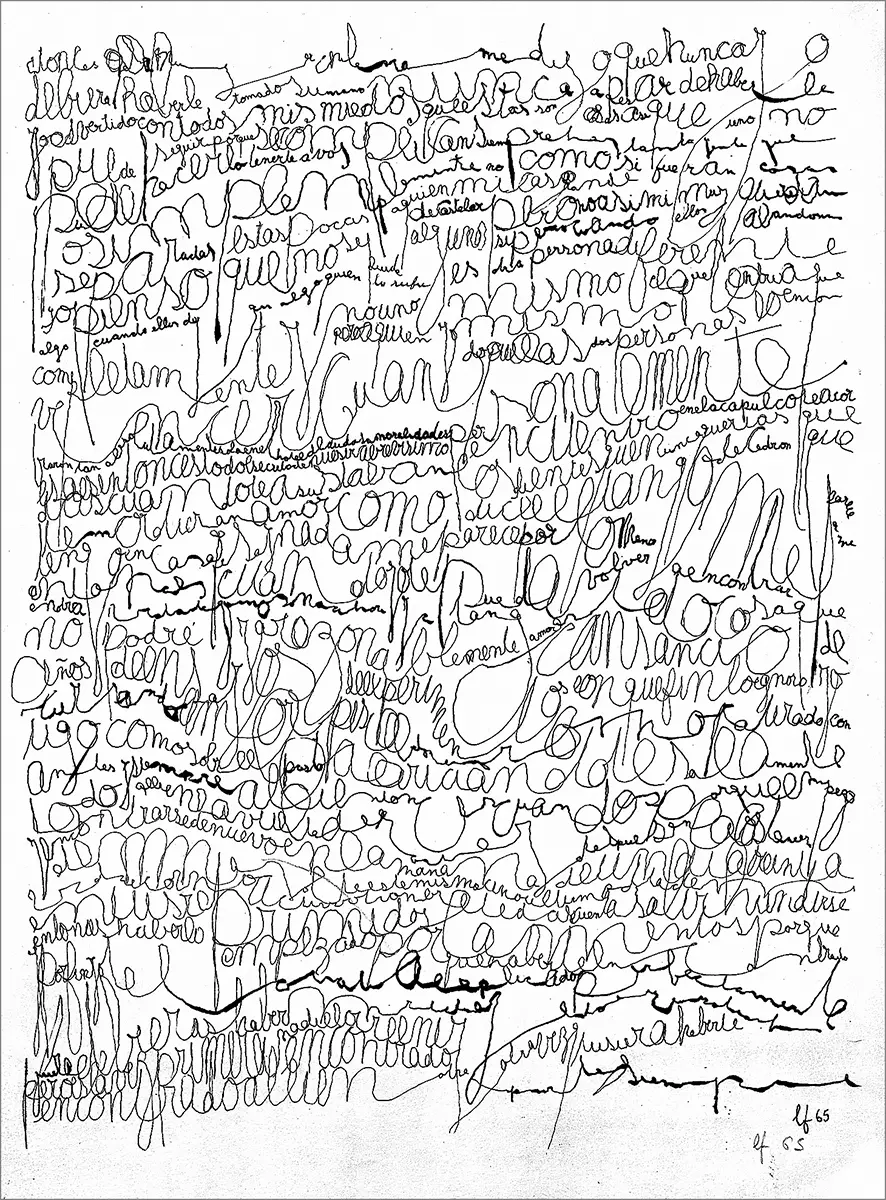
Some will surely see León Ferrari’s exhibition at the Drawing Center’s Drawing Room as a stereotypical porteño event. But reality overwhelms all stereotypes. The work of this artist responds to meta-readings, naturally overflows those confining borders, and belies such a reductive perception. From a formal standpoint, understanding language as its idiomatic expression, Ferrari makes graffiti of Spanish and the Spanish-language variations found in Latin America, in a unique conceptual modus that is not alien to Surrealism. But his practice is marked by writings and drawings he creates, or he integrates, some of them on the basis of newspaper articles, as is the case with Swish and Swallow, and also ink on paper with collage from a newspaper clipping with a text the artist reads and re-reads, writing and interfering it. In terms of its themes, what has been mentioned so far must be accompanied by references to the female presence and the execution of calligraphic drawings. In terms of the organization of those calligraphic drawings and how surface, sense, and space impact each other, they can have a pentagramatic composition, be open-plotted, close-plotted, with unplotted intervals, in organic deformations, with circumvolutions of the letter “I,” unreadable, clearly readable although their syntax and meaning can be altered, lantern-like (as in Oriental paper lights), and more.
Some people might be stuck on the linguistic aspect. In that case, the press release, the gallery text, and the printed materials allow the audience to enter the artist’s history, which has become once again tragically current. In those texts, artist Luis Camnitzer makes clear Ferrari’s aesthetic and political relevance. Undoubtedly, at a time when destructive forces collide the world over, the decision to exhibit this artist is a responsibility; it implies taking a position and elaborating on it. In the booklet published by the institution mentioned, Camnitzer makes an intelligent reference to the quest for antecedents, belaboring the point by mentioning all the possible influences. He quotes, however, Venezuelan Simón Rodríguez —Simón Bolívar’s childhood tutor—, with an “Opinion of the author about the freedom of the press.” This is not only a well-deserved tribute to Rodríguez, nor is it just the documentary tracing of creative precursors in the use of writing and drawing, or the vector that encourages the search for individual freedoms. This reference also responds to the current call by contemporary Venezuelans, who are hounded by ignominy (although political denominations might have changed since Ferrari started on his humanistic pilgrimage in the 1960s.)
Ferrari is a foundational figure in Argentinean art, and those who know his work can’t separate its conceptual side from the artist’s actions and expressions against the political, military, and religious powers that be. In the 1960s, an anti-fascist position seemed urgent and necessary; it remains so in the Twenty-First Century. We still, and even more drastically than before, live in wounded societies, societies deformed by the practices of the political right. In the destruction of all channels for humanitarian responsibility, León Ferrari writings/drawings make their voice heard. In terms of content, this is the core of his work. This show displays thirty-one calligraphic drawings; perhaps the best-known side of Ferrari, although the artist has also created sculptures, formal texts, heliographs, declarations, and more. In the 1970s, under a military dictatorship, Ferrari took part in Tucumán Arde, a protest movement, unveiling the province of Tucumán’s misery and its exploitation by the military government. His sustained denunciations repeated since then continue to be valid, as several Latin American countries continue to suffer under that fate.
Ferrari makes explicit his position in a text written on the occasion of the first encounter of Tucumán Arde artists, held in Rosario, Argentina, where he writes that “Art won’t be beauty nor novelty; art will be efficiency and disturbance.” As an author, he is as selective as he is broad-based, focusing primarily on the elements of destruction, negation, and oppression in 1960s Argentina, and claiming against the Church’s silence regarding campaigns of massive extermination in the country. In his 963 ‘Letter to a General’, Ferrari manifests an abstract writing/drawing capable of skirting censorship. However, we must remember that history bears witness to the minimal tolerance or abstraction characteristic of all repressive groups.
This is the third time that León Ferrari’s art is shown in New York in approximately twelve months. To wit: in the Argentinean Art show presented by ArteBA (the producer of the Buenos Aires art fair); at Sotheby’s; at the Drawing Room; and at the Museo del Barrio. He is also garnering attention in other states of the American Union and in Argentina. It is symptomatic that this small space belonging to the sole not-for-profit US institution devoted to drawing and its ancillary expressions is showing now an artist whose voice, of undoubted historical value, is driven by the dual imperative of making itself heard in its whole magnitude and all of its variety.
GRACIELA KARTOFEL