
The Museum of Contemporary Art (Marco) of Monterrey presents the exhibit Sólo los personajes cambian (Only the characters change), with the works of a group of Mexican artists including different forms of expression and curated by Magalí Arriola, Patrick Charpenel, and Ana Elena Mallet. At first sight, a constant feature of visual arts in the last 15 years stands out: the plural treatment of the eclectic daily reality in which decontextualization, fragmentation, and representation should be co-opted and redefined in a discursive framework from the artworks themselves.
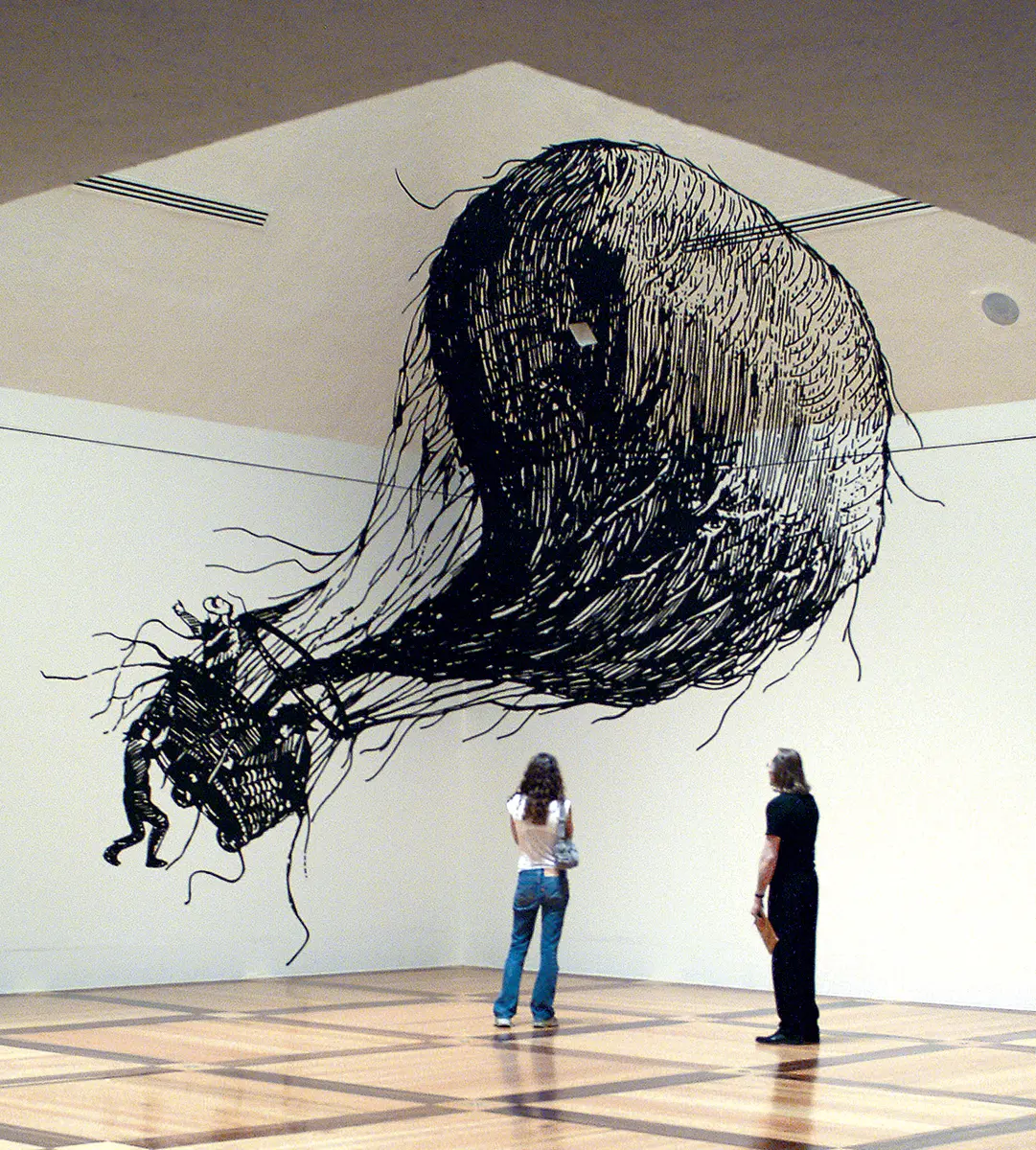
The exhibition overall achieves conceptual coherence as regards the curators, who formulate a very interesting narrative proposal, and the artists, who present very solid results. The appropriation of elements from everyday life, as well as the deconstruction of previously fabricated accounts and the simulation of actions, are constant features in the sample. The title itself was taken from a video by Jorge Méndez-Blake, who makes an amusing list of a Romeo and Juliet scenography of which the spectator doesn’t see the real functioning, but only interpretive and imaginative allusions to the characters, the situations, and circumstances in which they become involved, with a courtly music background. By the same artist from Jalisco, work is presented incorporating sound inside a corridor that takes the spectator by surprise not only because of the low roof that suddenly seems threatening and the absence of any other motif on the walls but because of the whispering voice that echoes the following pleading: “Tell them not to kill me... have pity...". This piece greatly differs from the mural painting (some halls further on) in which two characters in the basket of a rickety hot-air balloon that has lost its course wonder what to do.
Emanuel Tovar is another young artist from Guadalajara who sculpts in epoxy resin the representations of three creatures in an allusion to one of the most devaluated elements of contemporary life: the traditional nuclear family in which two people of different sexes live under the same roof with their children. Tovar makes a parody of the family as the core of society when he presents the parents looking like a pair of vagabonds—"dark", as indicated by the title— who distractedly take their child by the hand. Likewise, he shows photographs in which he debates his own technique. In one piece, a landscape with two trees, one luxuriant and the other one without leaves, in which the following text is superimposed: “Elvia, Wishing you a Happy New Year, from Ramon”—is a parody of those greeting cards that for more than 50 years have promoted the most mellifluous relationships at a distance. In another example, two enlargements of photographs taken some decades ago in the Versailles Gardens depict a tourist posing with a photographic camera hanging from his neck, compelling the spectator to meditate on the appropriation of an appropriation.
Artemio works with Raul Luna on a subtle deconstruction in the video of a fragment of the movie Gladiator. Russell Crowe enrolls to fight against an invisible enemy and challenges the empty tiers. In The Crying Game Artemio uses different takes from films in which Hollywood actors make grimaces of sadness, resignation, deception, repressed cry, and so on, in crescendo up to scenes in which the characters start screaming, start crying, and become hysterical.
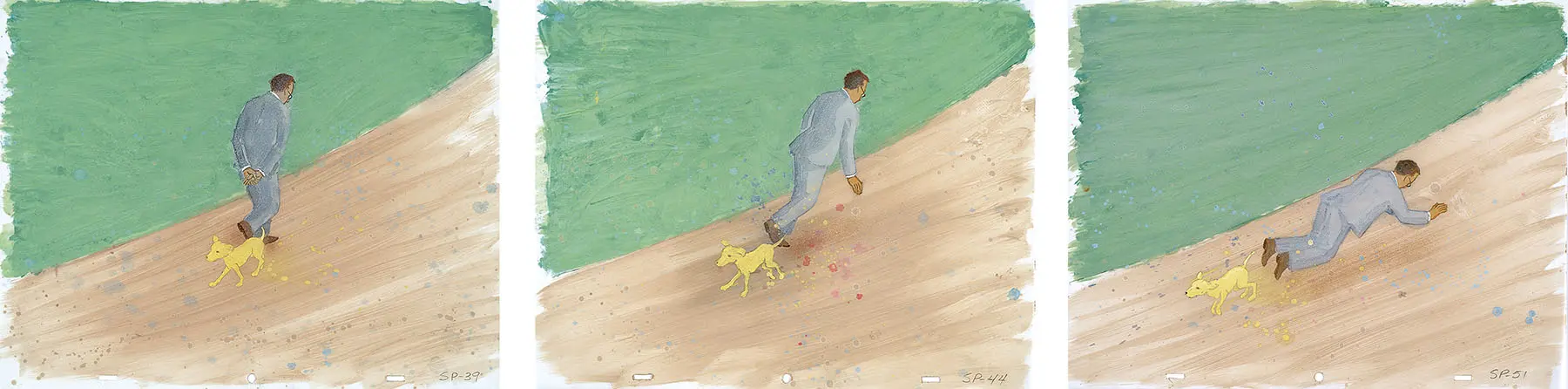
The Tercerunquinto collective from Monterrey, recently settled in the Federal District, includes photographs, drawings, and a video recording of a project that the owners of the piece should carry out in the south of France whose task consists of sowing, fertilizing, caring for, and harvesting a wheat field throughout the different seasons of the year. Equally interesting is one of the pieces shown by Francis Alÿs, which documents through painting, drawing, and sketching, an closed circuit animated film of a man who walks distractedly and trips over a dog’s tail, he gets up and goes on walking downhearted, and for a moment turns to watch the spectator with a somewhat challenging expression. Another piece by Alÿs is a small trunk embedded in a wall with a carved hand whose index finger seals the closed lips as an indication of forced and abrupt silence.
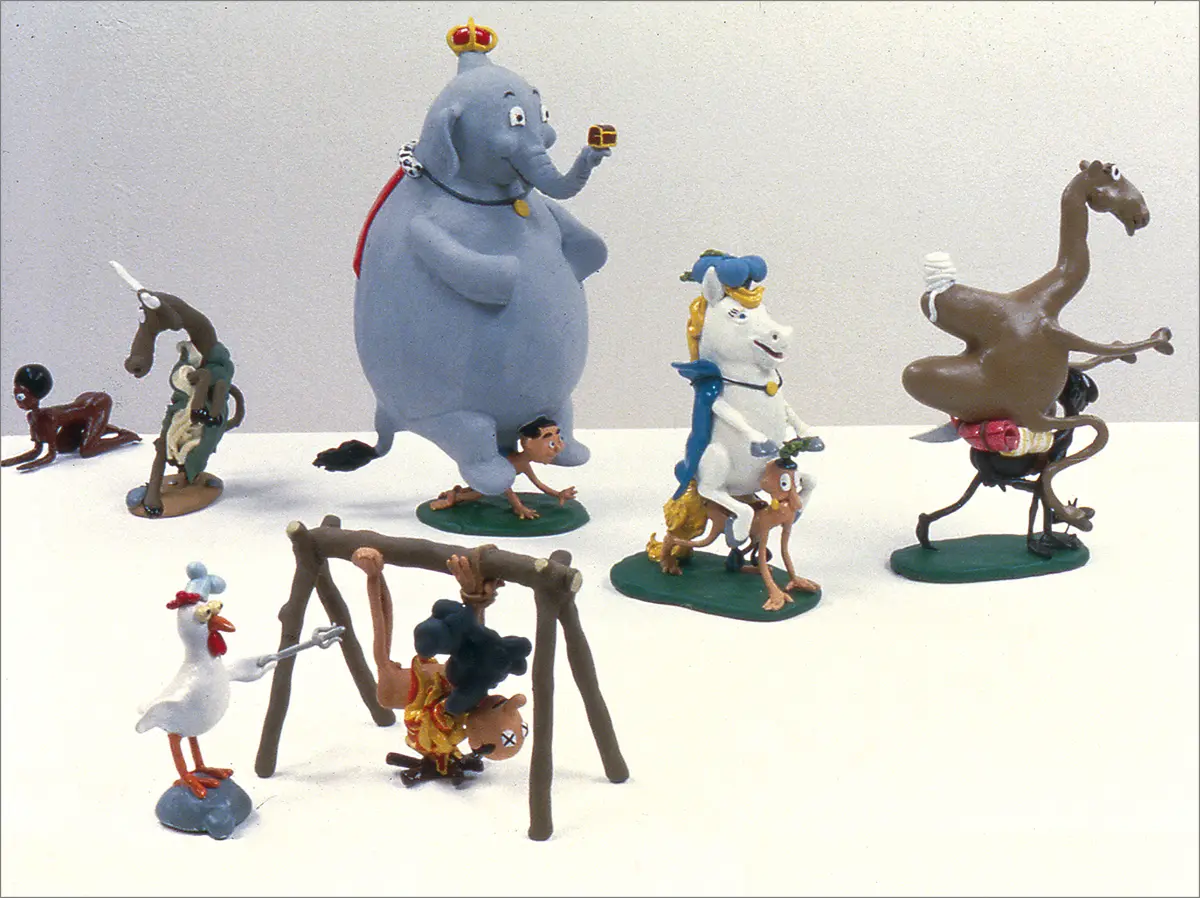
Eduardo Abaroa works caricature-like characters with epoxy resin. He depicts them in ridiculous situations in which human beings carry an elephant, a camel, or a circus horse on their shoulders. He also represents an ironic birth in which a baby donkey with an erect penis is surrounded by a sow with swollen breasts and other human figures. A lamb is arrogantly dressed as a shepherd, a donkey flogs a woman on all fours who carries a load of straw in her back, and thus, this carnival of grotesque creatures arouses sympathy despite their awful appearance. In another piece by the same artist, a life-size skeleton is filled with, surrounded, trapped, and threatened by plastic animal figures that, rather than instilling fear for the organic beings that will populate our extinct body, prompt a playful vision of the fauna’s parade. A child’s plaything—changuera—deprived of functionality and color and surrounded by the remainders of the dismantling of the artifact is, in my opinion, his best achievement. With this piece, he does a “reverse engineering” of the toy and exhibits it with the tools (lab coat, gloves, goggles, paint thinner, and brush) that conferred the plaything its new nature.
Fernando Ortega presents two videos. The first one, on a 5 x 10 cm screen on the wall depicts the slow lying in wait of a spider on a fly and the moment on which the arachnid catches and devours its prey. On the other, several characters in a casting must sing a melody accompanied by a piano. Damián Ortega, on the other hand, changes the tires of a vocho, later on, greases them, and ties the vehicle with strings and pulleys, in such a way that the vehicle slides rhythmically when turned on, all of this takes place in a parking lot and with the atmosphere loaded with the sound from the rock group that sings the most high-pitched notes is the performance shown in Luis Felipe Ortega’s video.
Pablo Vargas Lugo plays with time when presenting three displays of different sizes forming a column, where the public may watch the random passage of each second. In other examples, the artist makes a “pop-cult” allusion to the Apollo I spacecraft and its fruitless trip to the Moon, also showing collages of airplane accidents that, in my opinion, do not fit in with the rest of the exhibition.
Verena Grimm presents a video triptych in which people from the Navy carry out different activities around a building and training ground and the montage is much better than the last she showed at the Bancomer Hall of the Museum of Modern Art of Mexico City. Melanie Smith presents a series of slides where she recorded diverse scenes of actors at work and outside, while in the collective hall with background music, to one side of a dance floor, a display on the floor shows a video of the inauguration, in which a dance teacher tries to teach the steps to the artist.
Stefan Brüggemann takes us by surprise again with his neon signs. The first flashes out these words: Why think? Why not? The sign at the end of the exhibition reads: Q. What’s the work about? A. About nothing maybe. Something or just anything, or things.
The exhibition Only the Characters Change will be open to the public until next month of February.
LUZ MARÍA SEPÚLVEDA