
This Paris exhibition (19 mixed techniques on canvas and one plexiglass and paper sculpture, all from 2004) confirms the Franco-Venezuelan artist’s mastery of a spatial universe that is ordered and at the same time in perpetual mutation. For several years now, Pancho Quilici has been truly possessed by the exploration of space and its vertigos —with full rationality?— and here he launches forth to interrogate emptiness, combines various gestures, and conjugates into a symbiosis the hand and the machine. Brushes, pencils, rulers, and protractors are accompanied by computer-generated drawings that the artist superimposes to the original pictorial matrix. The result is large paintings where two conceptions of the world, two different ways of apprehending matter and space, coexist and confront each other.
When we approach the Chinese aesthetic imaginary where mountain and water interact in a relationship of “mutual flow” —in the words of Port François Cheng—, we enter a highly symbolic universe. Thought and spirituality find there a fertile soil for existence and experimentation, joining forces to go through a body of philosophy strongly dominated by metaphor. Cosmic breath and brushstroke are inseparable and interact in a process of reciprocal transformation. In the Chinese landscape imaginary, pregnant with “divine resonance,” yin-yang opposites (mountain, river, rock, grass, etc) answer to each other to create acts of life and thought that are permanently undergirded by the dominant idea of emptiness.
Although Quilici was educated following the requirements of Western spatial rationality and respects them in many ways, he allows himself to break its codes in order to create a utopian universe that is closer to being an intellectual preoccupation than a demand of the sacred. Perspective, distribution, close-ups, and horizon lines are respected, but their integrity is “violated” in a way by those endless lines, circles, and geometries that the ruler and protractor impose, with the help of the computer, on the body of his landscapes. The latter encompass water, hills or mountains, rocks, and vegetation, and are submerged in a fog that breaks the empire of geometry to give them a little more humanity. While Quilici’s work reasons give structure to space and draws a different landscape to be superimposed or fused to the first one, it is only to foster a dialog between the real and the virtual, to imagine a symbolic projection that only our mind and our imagination elaborate, in their desire to apprehend and dominate nature. In The Empire of Signs, Roland Barthes wrote that “The mirror only captures other mirrors, and that infinite reflection is the vacuum itself (which, as we know, form.)”
Pancho Quilici has made us accustomed, since the early 1980s, to an archetypical landscape that mixes past and future, where planes with abstract or figurative drawings intermingle and overlap, where the borders of the frame and the traditional construction of the painting have been blown to smithereens. Image on the image, circle in the square (or the other way around,) lines of flight, labyrinths, unending roll-ups, and unrollings. In this enigmatic mise-en-abyme (or mirror-effect) as virtual immensity recomposed with each plane, the gaze is lost in order to be even more astounded. His constructive work reveals, since several years ago, a progressive and ineluctable unfolding of form, which projects itself outside the frame, as a “bass relief” on the very surface of the painting and in harmony with that which, supposedly, cohabits or dialogs. It also is testimony to the progressive disappearance of filled architectures, very present in his landscapes, for the benefit of a sole architectural outline, oriented more towards the evocation of referential structures of an artistic, allegorical, or symbolic nature. On the other hand, the artist inscribes his spatial and pictorial quest in a nebulous aura and in the transparency where both contrast and fusion occur, evanescent structuring oppositions of a constructive conception of our relationship to nature, according to a Latin American spirit that mixes sensorial perception, spiritual consciousness, and intellectual demand.
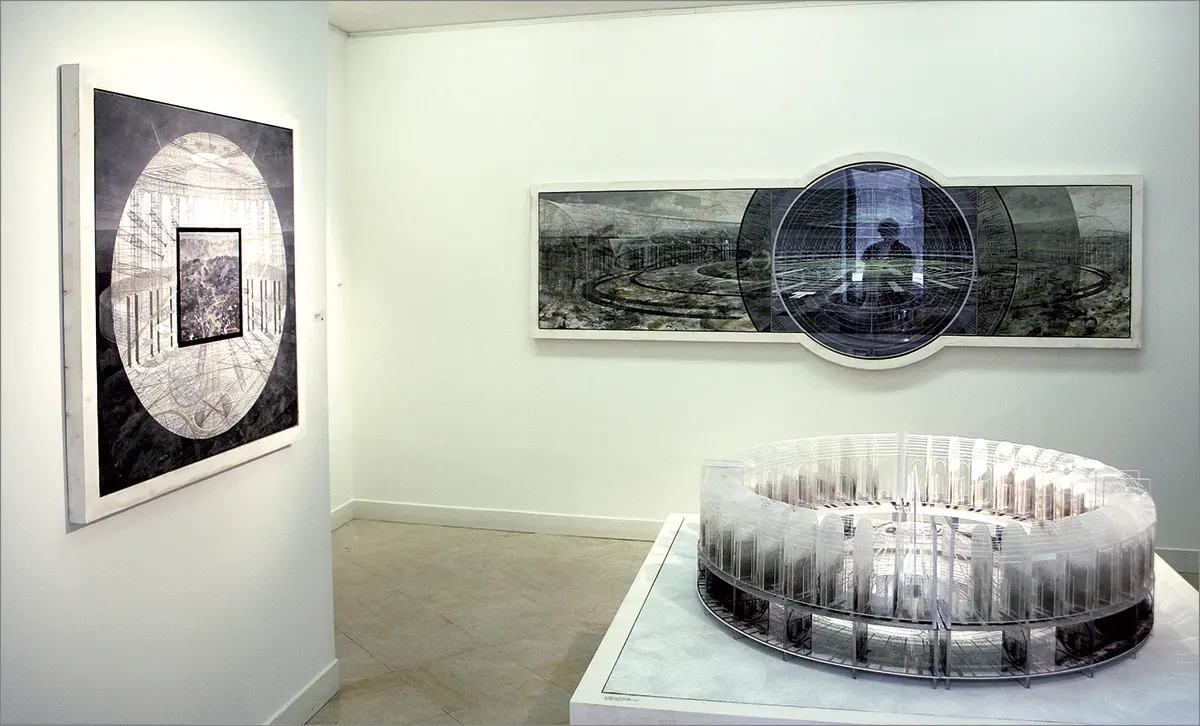
The three large canvases in the first gallery —grouped in the catalog under the generic concept of labyrinths— have shared characteristics: the montage (a central canvas, more colorful and “figurative,” dominated by pictorial matter and a sketch of a landscape) is surrounded by a series of juxtaposed canvases where the dense complex of computer-generated lines extends and cris-crosses, the distribution of space similar to the glass plaques that Duchamp, and later Matta, so appreciated (Gravitating Ubiquity); the white lines drawing a concave labyrinth (Convergent Escape) or a convex one (A Multiple Unit in Itself), and creating a kind of net. But also a plot constitutive of a landscape that does not belong to any reality, which is nothing but what Quilici imagines and which traduces an aspect of his mediation of the universe. The landscape of utopia, a dreamscape? Imaginary cosmos impregnated with vernacular realities and forms? Purely mental landscape? The environment of a synthesis, dominated by geometry and reasoning? What is certain is that Quilici conceives a landscape that belongs to his time, where the human and the scientific dimensions must be closely interrelated. A series of six small paintings serves as a transition to the second gallery. In these new universes, grouped in the catalog under the title of Ausencias, Quilici lets his brush slide in space and plays with tactile textures and color. Water, hills, skies, and vegetation stretch harmoniously, traversed only by a few furtive marks that form bubbles, lightning, and white curves. The latter constructs a different interpretation of the landscape, a new dimension, a sort of aracneal counterpoint to the omnipresence of matter.
In the second gallery, eight pieces, three of them vertical, and an installation sculpture titled Nitesencia en sí, grouped in the catalog as Emanaciones and Excéntricos, reinforce the feelings of great coherence of the presentation. Two works capture our attention. First, a sculpture that materializes the three-dimensional transcription of Quilici’s pictorial concepts provokes —perhaps in its “model” aspect— a certain nostalgia for his early architecture studies. Design and construction combine to form a kind of circular agora surrounded by a tunnel punctuated by translucent arches. If transparency and luminosity are keywords here, they don’t make this work any less cold; its construction is impeccable, a restraint to all human vanity. But we can also find there a positive relationship with those extraordinary (and real) “ephemeral” constructions of the late Nineteenth Century, the London or Madrid Crystal Palaces. Generating Sequences is the exhibition’s most imposing work, by the sheer strength of its size. Comprised of three distinct parts —at the center, a digital print covered by glass; to the sides, paintings of landscapes with dark skies coexist with computer-generated drawings—, this piece is emblematic of the artist’s current work, where digital creations play an ever more important role alongside painting and in interaction with it. In fact, Quilici’s paintings do not push aside blotches in ochre, white, greenish, or bluish gray; in contrast with the evanescence of lines and shapes, this could be the invulnerability of what is, set against the vulnerability of what could be.
Instability, evidence; humanity, minerality; interior, exterior; cosmos, Earth; illusion, reality... Quilici’s latest art reinforces these opposites and goes beyond them, as painting moderates the unreality of the image of synthesis making it poetic and fragile. His virtual “landscape” can be seen as the pretext for personal introspection, with its utopias and its limits. As Agustín Berque writes: “No matter how spectacular virtual realities get to be, they are nothing more than just that, spectacles, and they feel like spectacles, a world of fiction distinct from the real world. We haven’t yet reached the point of believing that the image of something is the thing itself, even though, from particle physics to teledetection and the mass media, image-treatment techniques play an increasingly important role in our relationship to reality. These techniques are not neutral, yes, but they lack meaning until they are repositioned inside that relationship the generality of which surpasses them. To avoid being its toy —to avoid being trapped in its fictitious world— it is necessary and sufficient to exercise that relationship. It is a matter of scale or measure; in the most general sense of the latter term; to wit, the “sense of measure.”
This incursion in the virtual world opens up a dream-like path and gives density to the plasticity of Quilici’s work. Having kept his distance from the trap of a purely computerized creation, the artist has been able to integrate it dialectically into his pictorial space, and, thanks to the presence of painting, has been able to link it to reality, an indispensable element to appreciate any kind of utopia.
CHRISTINE FRÈROT