As an artist of the visual, René Peña is more renowned for his series of “self-portraits,” where the critics have insisted on seeing a kind of representational egocentrism and narcissism instead of a certain “self-art” denoted by the codes of simulation, makeup (or its absence,) sexual and gestural ambiguity: expressive features the photographer articulated on his body in a plurivocal manner. It didn’t matter that he mutilated it with the help of violent frames; that some of its parts were utterly blurred; that those images of himself become ever more repulsive and barely showed anatomical fragments, in scrutinizing close-ups that also seemed to reject any inkling of self-complacency.
When it came to writing about them or contemplating them in collective shows, these works continued to be subjected to unilateral, reductionistic, and tendentious perspectives that couldn’t discern the multiple and integrating anthropological reach (sexual, racial, corporeal) with which Peña undid myths traditionally anchored in social psychology (not only Cuban.) Similarly, he continued to be considered an epigone of Cuban photographer Marta María Pérez (for his recourse to his own body as support for ideas) and of American Robert Mapplethorpe (for his eroticizing joy in male nudity and technical perfection.)
These are acknowledged and assimilated influences in René Peña. Yet, except in those sadomasochistic images with models that were not always black, in the American photographer’s work, the male nude had a subtle, sculptoric, even auratic expressive essence; men were displayed more as objects (of pleasure.) Whereas the Cuban’s proposals have always been aggressive, visceral, and much more allegorical. Peña can be also seen as the counterpart of Marta María Pérez, generally representing a masculine, dark-skinned subject who has not been associated with nor compromised by the imaginary of Afro-Cuban syncretic religious practices, and whose visual projection is more impressive.
Without denying their subjective component and irradiation (consubstantial to any human production,) the implicit author of these works by Peña, the one that viewers believe they can identify, unfolded into a referent of several social types, into an actor in various roles (as I wrote once.) Instead of a drag queen’s attitude (who assumes at all times the same adopted appearance and personality,) Peña followed the discursive strategy of a transformer, of a thespian facing the (photographic) camera’s eye, that mechanic and first viewer.
Yet, in a mutation that evokes the American poet E.E. Cummings (sic): “How can a crazy one who calls himself “I” pretend to embrace the innumerable who?,” Peña started to represent the other through models, “races,” and different sexual genders. This is corroborated by some of the eleven photographs in his show “Public Duty”, presented in September at the Wilfredo Lam Contemporary Art Center. They carry forward Peña’s inquiry into socially minted categories such as “whiteness” and “blackness,” in an operation that deploys certain acquired attributes (pale-colored clothes) contrasted visually with the naturally dark skin of those who wear them. Peña goes to the pores of the signifier, to the grain of the photograph. And, in a tautological fashion, takes advantage of the technical resolution in black and white.
But just as he directs our attention towards those symbolic sumptuary, silver, mobile objects (rings, necklaces…,) the photographer apprehends tattoos, even on white skin. These are also symbolic-decorative markings, although in some cases they turn out indelible, unmovable, for life. The artist induces us to notice the redimensioning of these traces, which in non-Western cultures indicate social rank or group, and have been used by marginals in the West by way of stigma and identity seal among themselves and in confrontation with the rest of society.
Today, however, these drawings that “speak” of their wearer’s aesthetic taste are considered art. And they have become a fashion phenomenon, albeit somewhat in retreat. The trend recently is to use adhesives or incisions with needles (the latter removable using laser.) Tattooing symbolizes, also, the rebelliousness of some youths against the authority of their elders, in the same way some hairdos/haircuts do (such as the one shown in Peña’s exhibition,) which contributes to outlining a personal identity within the frame of society, beyond any sexual delimitation.
Sometimes located in erogenous zones of male and female bodies, tattoos are a form of sex appeal, which would fit with one of the expressive preoccupations latent in René Peña’s self-portraits. Although he seems to go beyond that. He seems to suggest a dialectic relationship between the sedimented notions of “whiteness” and “blackness,” in an attempt to transcend racial limitations, the merely decorative, the strictly sexual. It is as though he were rendering the vision of these prejudices relative and reformulating, especially in a society such as Cuban society and in an ever more interconnected world, where there shouldn’t exist static, immutable concepts.
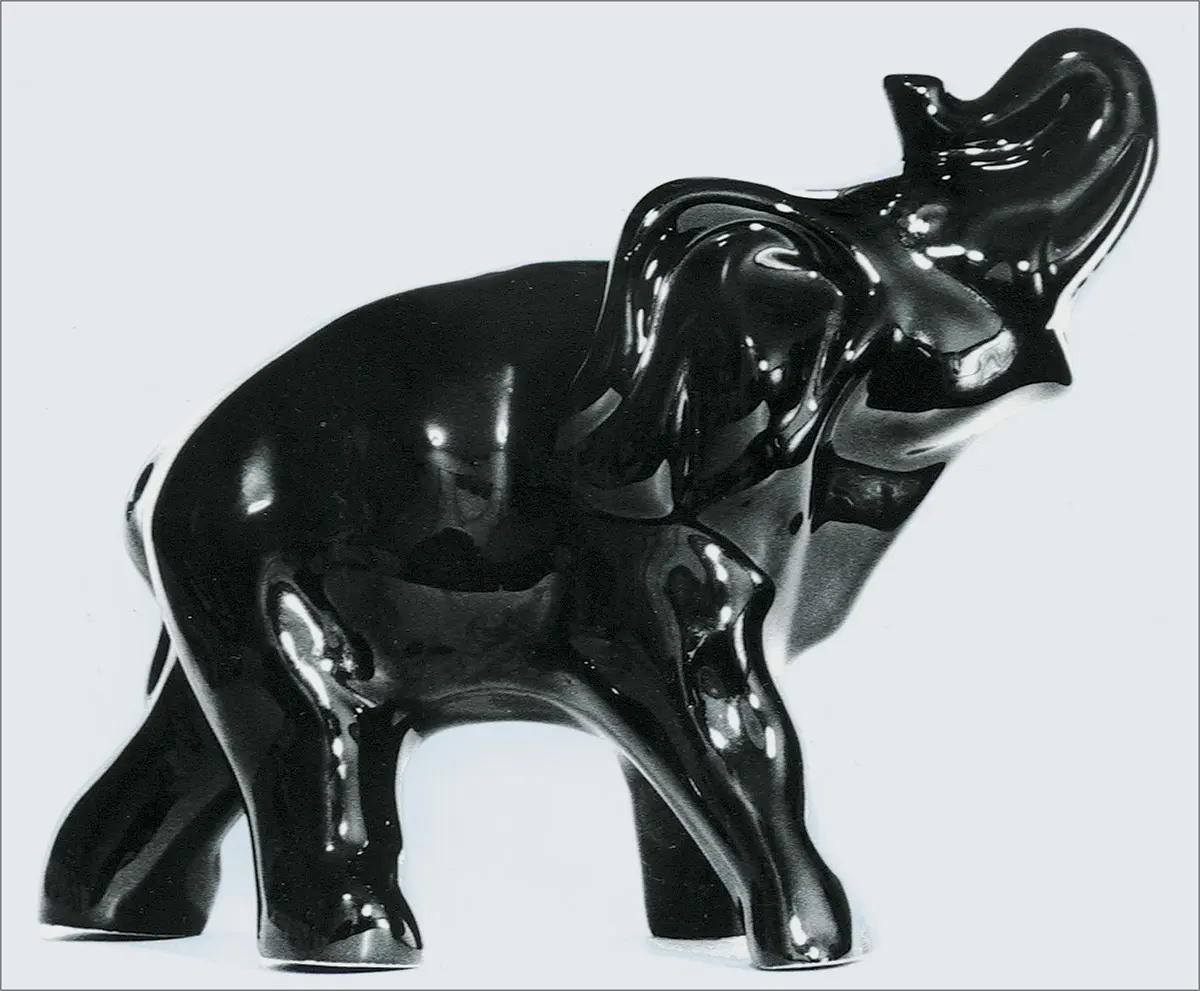
In this exhibition, Peña took by surprise many observers of his career, by exhibiting photographs that, although in black and white, represented industrial, mass-produced objects (mostly ceramic), just like photographs themselves can be in their technological aspect... Such objects, “decorative” or not, representing humans, animals, or other figures, replaced the “real” human boy as an object of cardinal attention and introduced “noise” into the show’s visual and thematic coherence. For the photographer, however, these ornamental or utilitarian items implied the individual and/or the group that identified with and was able to purchase them. The subject and the social rituals associated with them were thus elided.
At any rate, this is not the first time Peña has interspersed in an exhibition an advance sample of a different series in progress. Neither is this the first time he has exhibited images of a documentary appearance and/or character, alternating them with studio or interior photographs. Also, this is not the first time he has tried to mix diverse artistic genres: nude, still life, portrait… As a true creative artist, he experiments constantly and does not hang on to the styles that have brought him artistic and commercial success, and international recognition: Grand Prix at the 4th Caribbean Biennial (Santo Domingo, Dominican Republic,) first prize at the 3rd UCCI Photography Competition Spain,) and an honorable mention in the ACCU Contest (Japan.)
ISRAEL CASTELLANOS LEÓN