
Rostrum Ricardo Armas 1972-2004 documents in a fascinating and historical way Venezuela’s cultural memory through 98 portraits of notable personalities in a variety of artistic disciplines, captured over three decades by Armas’s incisive lens. Each of these characters is revealed and discovered —in black and white— in this show curated by John Lange, at the Trasnocho Arte Contacto gallery in Caracas.
A winner of the National Photography Award in 1997, Venezuela’s Ricardo Armas started in the profession under the guidance of Sebastián Garrido and Luis Brito. Public and private collections in his country and abroad hold his photographs, which have appeared in important newspapers and magazines in Venezuela.
Armas confesses his crossing of what he considers the narrowest of dividing lines, that between his professional and his private photographs, to present Rostrum, a bestiary of the movers and shakes in Venezuelan culture from 1972 to 2004, among them filmmakers, visual artists, cultural promoters, architects, sculptors,
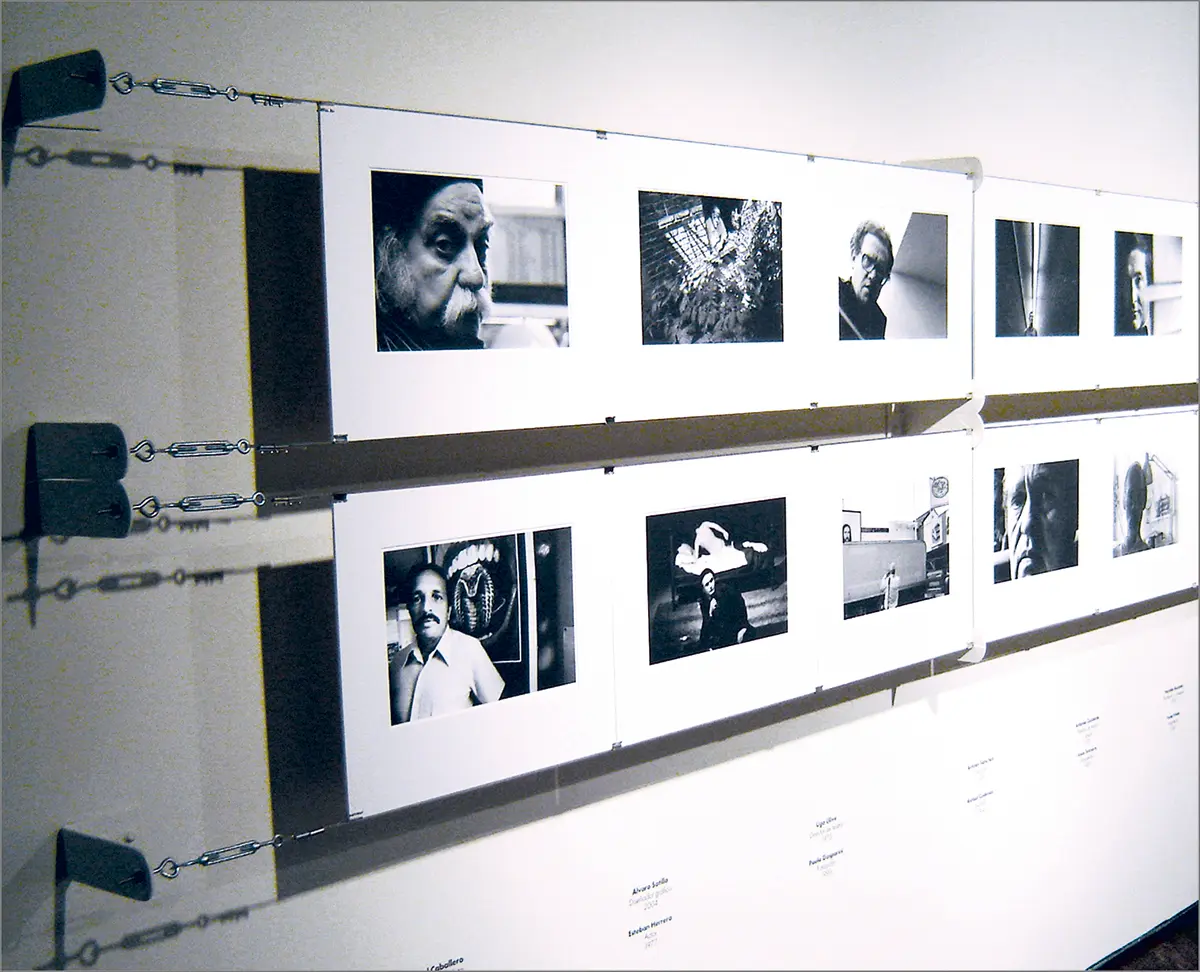
photographers, dancers, designers, actors, and poets, with whom Armas has established a double relationship, not only professional but affective as well.
Ricardo Armas reaches for the susceptibility of his subjects and offers these characters from the very fiber of his own sensibility as an artist and photographer. That is precisely the indelible mark he presses on each of his portraits, in which we are almost able to break through the paper that contains the illusion of the protagonists of his photographs, in order to discover what lies behind their fixed, ambivalently distracted gazes.
Rostrum brings together writers Fernando Paz Castillo, Efraín Hurtado, Miguel Otero Silva, and Salvador Garmendia; dramatists José Ignacio Cabrujas, Edilio Peña, and Isaac Chocrón; a large number of visual artists from different disciplines, such as Héctor Poleo, Jesús Soto, Alejandro Otero, Francisco Narváez, Régulo Pérez, Oswaldo Vigas, Pedro Terán, María Eugenia Bigott, Oscar Machado, Rolando Peña, Cornelis Zitman, María Luisa Tovar, Víctor Valera, Lamis Feldman, Ángel Hurtado, Gego; cultural promoters like Sofía Ímber, Elías Pérez Borjas, María Cristina Anzola, and Lya Bermúdez; graphic designers John Lange, Álvaro Sotillo, Annella Armas, Gerd Leufert; and architects Fruto Vivas, Gorka Dorronsoro, and Tomás Sanabria, among many others.
Each one of them was captured by Armas with premeditation and care. Comes to us as a drawing in light, as an allegorical figure that, surrounded by attributes, bears its essence for the benefit of our curious gaze as we discover them in this photographic compendium. More than portraits, there are 98 stories behind these characters who have embroidered each one of their realities to build, organically, the immense tapestry of all the references that give support to Armas’ thoughts and expressions during the last three decades.
As if in a double game, Ricardo Armas allows us to see the transparency of his subject's pupils, bringing us closer to them as new characters, characters with new meanings. All this artist wanted was to perpetuate them in time and show them to us as the crafters of a shared identity.
ELISA RODRÍGUEZ CAMPO