
Two years after the artist’s death, Victor Grippo: A Retrospective, curated by Marcelo Pacheco for the Museo de Arte Latinoamericano, was really necessary for Buenos Aires, the city where the artist lived for most of his life, and thus in his country. There were not one but two earlier comprehensive shows up to the point when each was opened: at Fundación San Telmo in Buenos Aires, in 1989, and at Ikon Gallery (Birmingham) and Palais des Beaux-Arts (Brussels) in 1995. The latter was an integral initiative of a group of European specialists. Evidently, the most recent one at Malba is also the most complete, offering a full perspective on one of the key figures in a certain kind of Latin American conceptual art. It was a nearly exhaustive show, missing only Grippo’s earliest paintings, some of his experimental work, and the kinetic works with mechanisms of the 1960s. Methodically included were all the steps of his development: from the foundational first version of Analogy I, 1970, the first work using potatoes —these were placed in cells and their electric charge was measured by a voltmeter—, to the most recent pieces shown in Grippo’s last solo exhibition, at Ruth Benzacar in March of 2001. Grippo’s artistic discourse was dense and multifacetic, externalized in big landmarks and through a process of emphasizing the quotidian in a constant aesthetic key. For years his artistic proposal could have been divided between his experimental “live” works and his boxes or pieces like Tabla (Board, 1978), more static only in appearance. In the first group, we would place Analogía I, already mentioned, or its 1977 version, with the potatoes arranged on a rectangular table like an expectant multitude, or Vida-muerte- resurrección (Life-Death-Resurrection, 1980), also an experiment in scientific observation, created using five pairs of basic solid geometric figures in lead; one figure in each pair is filled with beans, and water is poured inside through a hole. The action of water and time deforms and breaks the figures, making explicit the operations of nature.
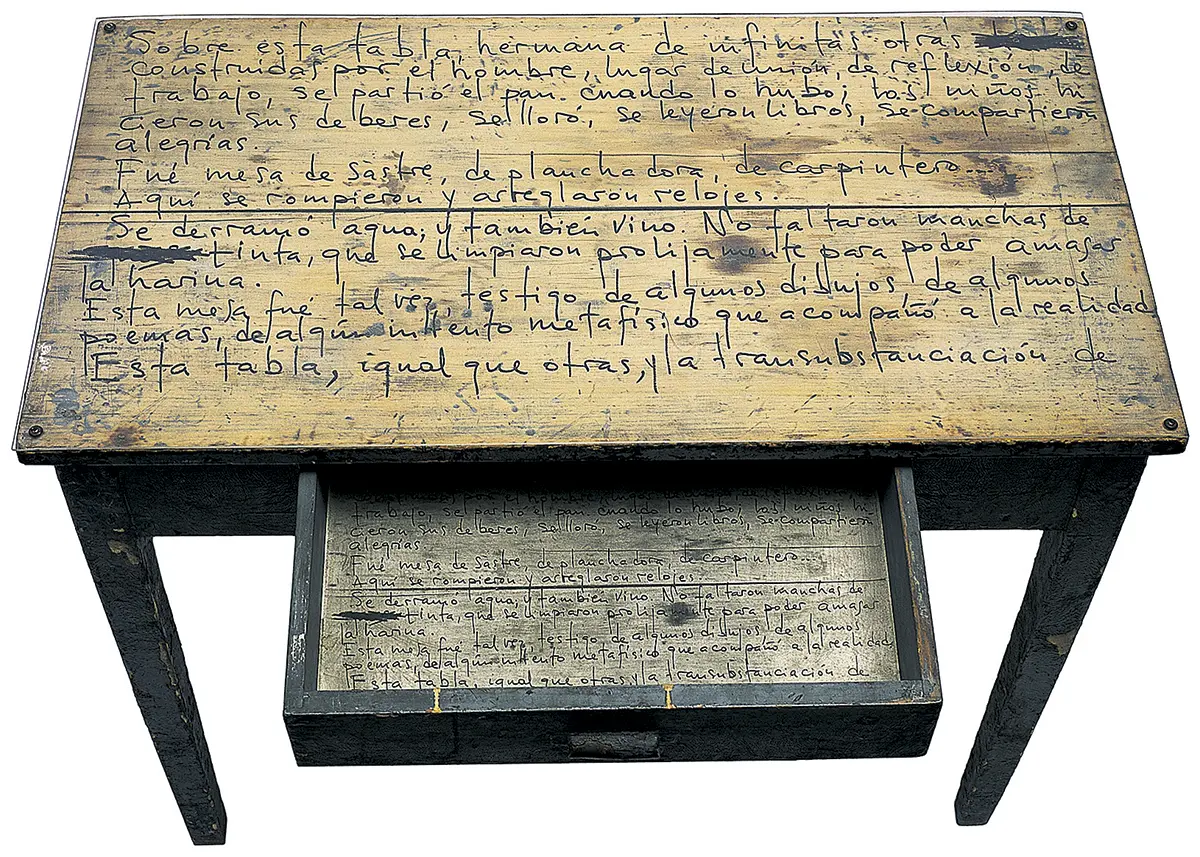
In the 1990s, as the international demand for Grippo’s work grew significantly, the assessment of several individual pieces also changed. In 194 the artist was invited to the 5th Havana Biennial. His proposal emerged then of elements found right there. This was the origin of his Mesas de trabajo y reflexión (Working Tables and Reflection), a series of school desks dating to the early days of the revolution. Grippo made a selection of texts by himself and others and carved them on each desk. One was by his friend the poet Jorge Calvetti, another one by his spiritual teacher Elías Piterbag, and so forth. The clearest precursor to this installation was his paradigmatic Tabla (1978,) where a text by the author vibrated. Today that text can be read as one of Grippo’s aesthetic declarations: “On this plank, the sister of an infinite number of planks built by man..” With a deep sense of poetry and humanism, Grippo created an integral expression that covered all aspects of human life, from the physical sustenance required for survival, through human work (so fundamental too to his aesthetic,) through co-generational communion of the species, to the teleological directionality of ratiocination, creation, and transcendence. This brief Cuban operation, to which he was invited by Lillian Llanes, was key. The following year, 1995, in Birmingham and Brussels, Grippo would once again show Mesas, and he would also re-install Algunos oficios (Some crafts), from 1976, another paradigmatic work, created in one of the most terrible moments in Argentinean history. At a time of brutal violence in a deeply divided country, Grippo presented a tribute to the five traditional crafts of the history of labor: construction worker, blacksmith, quarry worker, farmer, and carpenter. Builders, not destroyers or killers. The first option is the essential human archetype. One of his most frequent strategies was that of “opposites” In some cases it was revealed explicitly, in others it was an underlying presence. With the “crafts,” the issue was to represent, at the historical point when the dictatorship was beginning, the utopia of constructive labor counterposed to the reality of a homicidal power. Through this opposition, Grippo achieved an imaginary synthetic balance. That difficult balance was another of his great themes, illustrated in so many of his white boxes. Algunos oficios was complemented by a poetic text authored by the artist. And, finally, Grippo’s Mesas were presented at the 11th Documenta in Kassel in 2002, a few months before the artist’s death.
In his introductory text, Pacheco lucidly points out an indispensable triad that can be perceived in the show, science-poetry-alchemy, as fundamental pillars of Grippo’s poetic thought. This is why the weight of his experimental “live” works was measured by the protagonic role played by the poetic word and a revaluation of its previous appearances in his creative process. Each phrase becomes a statement in itself. “I believe in stone, elemental individual, mute form of life,” by E. Piterbag, he wrote in his installation La intimidad de la luz, at the Tate St. Ives, England, 1997, also recreated at Malba. “All of his montages are traversed by the corporeal, This is why he doesn’t need to represent the body,” said Julio Pastor Mellado the day after the opening of the retrospective. “The process of hominization,” as Grippo used to call the human transit on Earth, and the process of transformation were two topics also central to his work. The show was accompanied by an illustrative and very complete catalog with texts commissioned to Ana Longoni, Adriana Lauria, Guy Brett, Lillian Llaner, Angeline Scherf, and Julio Pastor Mellado.
MERCEDES CASANEGRA