
Mr. Alfons Hug, who was
also the curator of the previous polemic biennial, seems to have declined this
opportunity to set strict parameters to keep the exhibit within bounds. Under
the banner of liberalism, an enormous installation of contemporary art is
generated that does not follow any legible curatorial line. One hundred
thirty-five artists from 62 countries participated. Is this Biennial a breeding
ground for artists, most of whom lack a solid background? The first flaw of the
exhibition was the near-total absence of really important artists. Although the
curator assures us that the special halls were kept, its current occupants did
not measure up to their predecessors: with all due respect, Artur Barrio,
Thomas Struth, Eugenio Dittborn, and Cai Guo Giang do not yet resound as do
Mondrian, Torres-García, or Frank Stella, for example, or like Jesus Rafael
Soto, Anselm Kiefer, or Arcangelo Ianelli, to mention some of the artists
exhibited in the special halls of recent biennials. And this is not only the
endorsement of history. The point is to present the biennial works that do
not flounder when removed from their natural context or their private cultural
framework.
Most of the curator’s catalog text is self-justification, not in a personal capacity, but in an institutional capacity. As if the São Paulo Biennial requires justifications nowadays! There are several references to Venice and Kassel, and allusions to many others, quoted as a general and abstract number. The importance of our São Paulo exhibition in relation to the American continent was duly highlighted. But, of course, we already knew that.
The curator’s is not the only text that appears as a general introduction to the exhibition. There are also texts by Hans Belting, on the relationship between art and technology, and Nelson Aguilar, who discussed the crisis of traditional supports.
The criteria for placement of works followed, vaguely, the similarity of language, or rather, of the supports. On the first floor, large-format installations and/or sculptures with some photography, and a couple of videos were scattered here and there. On the second floor, were painting and some photography, plus an additional area reserved for video in more or less private halls called “Planetarium.” On the third floor, using only half the space that was previously partially reserved for special samples, there was a tad of everything. The curator holds that “to emphasize the thematic unity of the sample as a whole, the guest artists and those sent by the different countries were mixed in those 25,000 square meters... Despite the complexity of the diverse voices, a collective concert is created.”1 However, it could also be interpreted as a terrible cacophony. The orchestra never tuned its instruments and the assembly, although certainly well done, did not fully achieve its purpose. Photography became the most frequent means of expression of this biennial, to such an extent that the curator believed it to be the thread that gave cohesion to the three floors of the exhibit.
Free Territory admitted a wide variety of themes. We can rescue some of the conceptual lines worked by several artists: the urban context; displacement and globalization; consumerism; ecological issues; and domestic and external conflicts in different areas of the world. These concepts are not impervious or exclusive. Many of the works were based on some of them (and others totally escaped the above considerations). The bottom line revealed contemporary reality in its most recurrent aspects. The mass media seemed to act in the background, sound systems included. The Biennial had one thousand and one noises and sounds (or music) that were integral elements of the works exhibited.
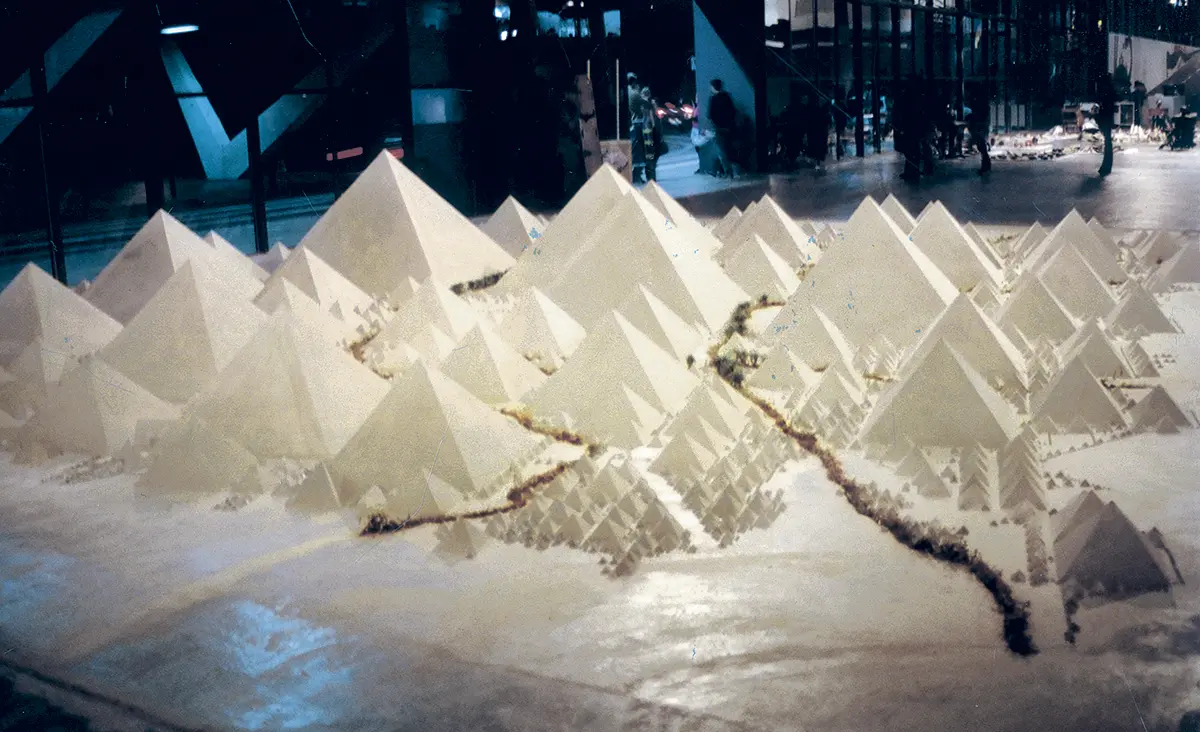
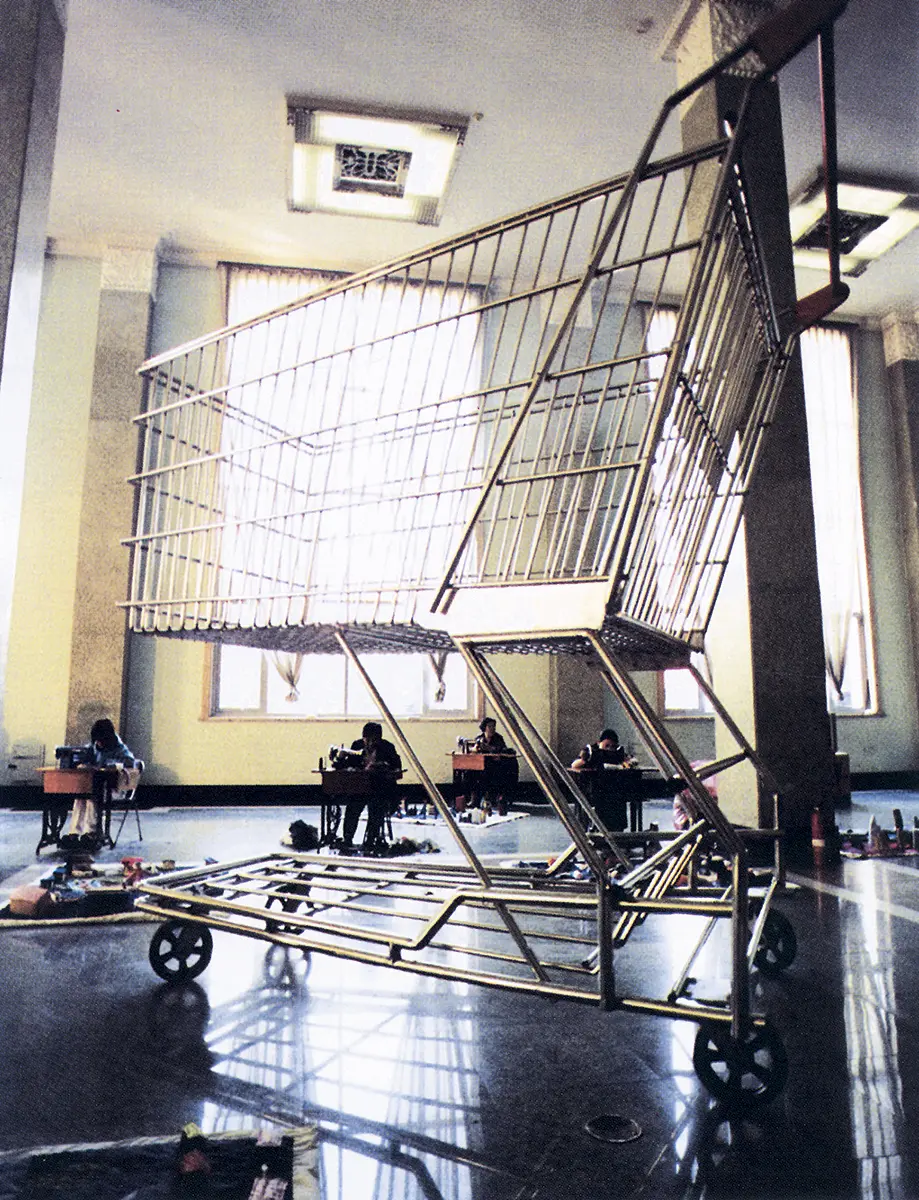
The urban theme was widely present. To start with, two large-format installations flanked the entry to the building. On the right, we found the work of the Mexican Pablo Vargas Lugo, a guest artist. On the left, was an installation by Yin Xiuzhen, a Chinese guest artist. The Mexican dealt with the urban image made up exclusively of pyramids organized in a dense fabric on the floor; it was his Visión Antiderrapante (Antiskidding Vision). The Chinese showed the tremendous cultural impact caused by the progressive urbanization of her country. Vargas Lugo’s more than one thousand pyramids, in an orthogonal array, clearly alluded to the city of the dead. The biggest dimensions were one meter, while the smallest was one centimeter. The regularity of the display seemed random thanks to small threads of miniature vegetation, free lines that sinuously ran through the installation. Urban utopia was contradicted by nature and the wish for perpetuity by its own impossibility. In Shopping (2004) the Chinese artist proposed a reflection on the impact of manifest urban forms through trade. A dozen old sewing machines alternated with the representation of miniature cities, a kind of naive volumetric scale model: little houses, airports, cities, and stadiums. With discarded clothing, the artist sewed, or made her cities sew; they could be taken for toys in a kindergarten. One element that appeared in the catalog was missing from the exhibit, a giant shopping cart. The metaphor was not self-evident, although it was poetic.
City elements, external volumes, and domestic spaces were also plentiful. The favorite medium was photography, and in several cases, serial photography, or compilations, from living rooms in the Malay Peninsula -photographed house by house by the Australian Simryn Gill- to new mass-produced houses of the anonymous suburb of a Japanese city, photographed by Noya Hatakeyama; the summer houses that the communist régime allowed in Czechoslovakia, exhibited by Veronika Zapletalová; or the rather insipid Dark Caravan by the Belgians Christine Falten and Véronique Massinger, a record of urban facts taken by means of a dark chamber set up in a van that traveled to certain towns in the country.
The materials handled with incredible skill and subtlety by the Cuban Carlos Garaicoa, are not the city proper, but rather its constituent elements. His installation consisted of three videos discreetly located and a series of numerous very small-scale architectural models. The videos are testimony of the construction of three small works also exhibited: three models made out of razor blades, sliced bread, and matchboxes, respectively. These, as well as the tiny buildings, were replicated with an imaginary drawing created with tightened threads on a spread of small nails on the three walls of the exhibit’s space. The set alludes to the utopian city, to an illusion, to “the establishment of a possible and ideal community.”2
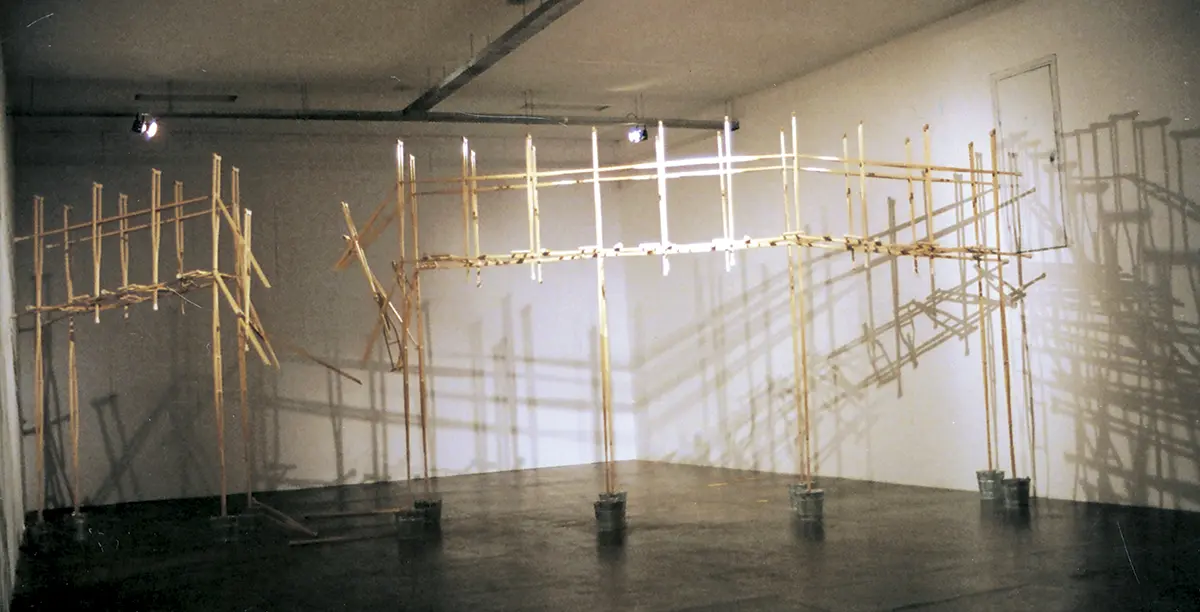
Another installation alluding to the city and its construction was that by Maxim Malhado. Using rough boards and round trunks, the Brazilian raised intricate and dysfunctional scaffolding, a metaphor for the incongruity of the urban environment. The rigorous structures drawn directly on the wall in charcoal by the Argentinean Paulo Siquier were a refined echo of the same problem.
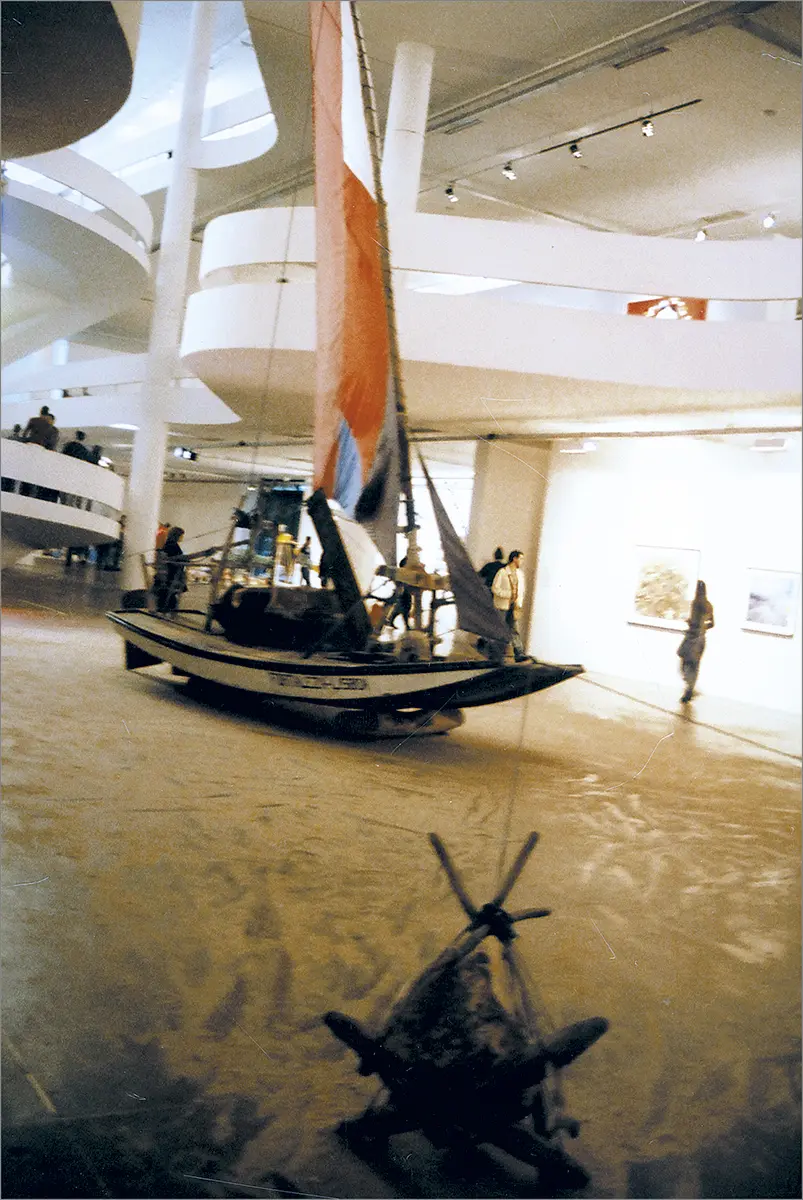
The concept of travel or displacement was readable in several works, beginning with the sailboat that Artur Barrio, Luso-Brazilian, installed in the central area of the first floor to one side of the ramp. This was accompanied, a certain distance away, by an old sofa and an old cabinet with notebooks and travel mementos. The catalog describes the production as “conceptual with body and odor.”3 The iconographic strategy was so explicit that, to a certain extent, it weakened the poetry of the installation. But this was not the only boat in the exhibition. The British artist Simon Starling brought another sailboat, turned it upside down, keel up, and supported it on its mast alone, holding it to the floor with steel cables. The wood is Brazilian moho, and the boat was made in a Scottish shipyard. These ships once sailed once, but not so the delirious structure by Milton Marques (Brazil) which barely floated, as evidenced in the accompanying video and justified the exhibition of the artifact.
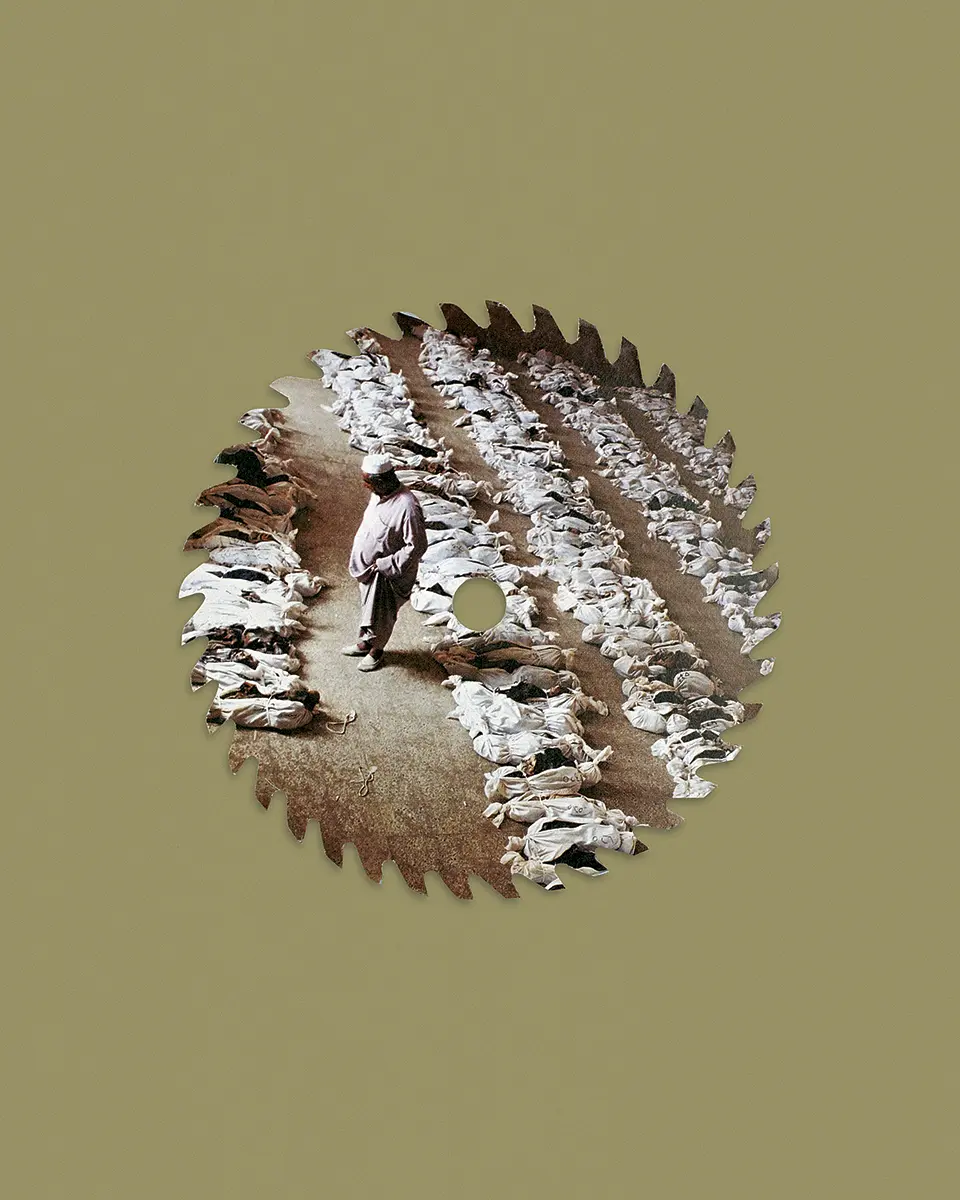
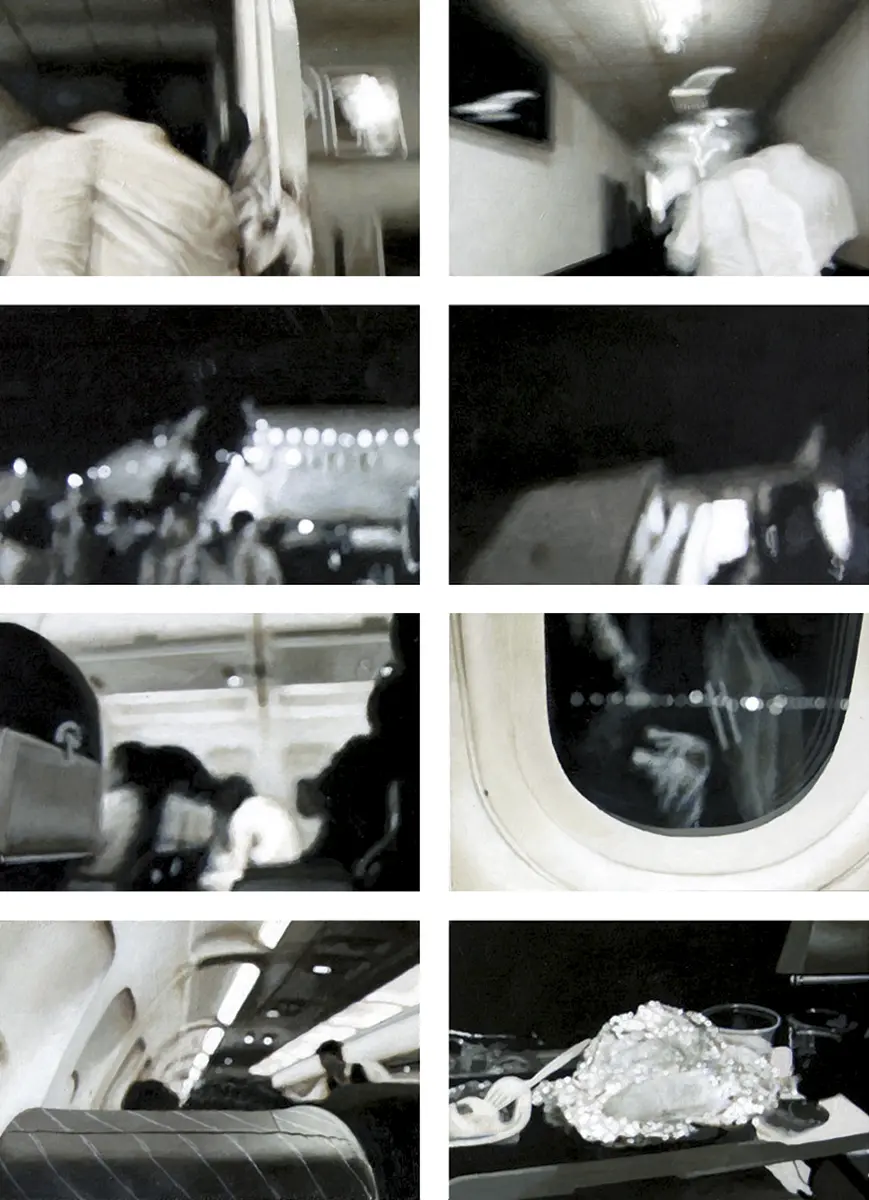
Pablo Cardoso, representing Ecuador, led the travel theme to a literal representation. Starting from a random photographic record of his own air trip between Cuenca and São Paulo, he painted 319 acrylics, 10 x 15 cm. Without color, with meticulous technique, Cardoso reconstructed the anodyne photographs, at times out of focus, to give us a casual view of a moving environment. Jaime Ávila, from Colombia, worked under similar assumptions. He was represented at the Biennial with several large format photographs, some manipulated; a text explaining the origin of the installation’s title-Fourth World; and three cubic constructions of paper printed with aerial photographs of the shanty towns of two Latin American capital cities. Each cube consists of a thousand small cubes. The real support of the work was a trip that Ávila made to several capitals of the continent: in all, there are two cities, the formal and the informal, the center and the periphery. The artist is interested in the latter and records it obsessively, deconstructing its syntax until it becomes almost abstract.
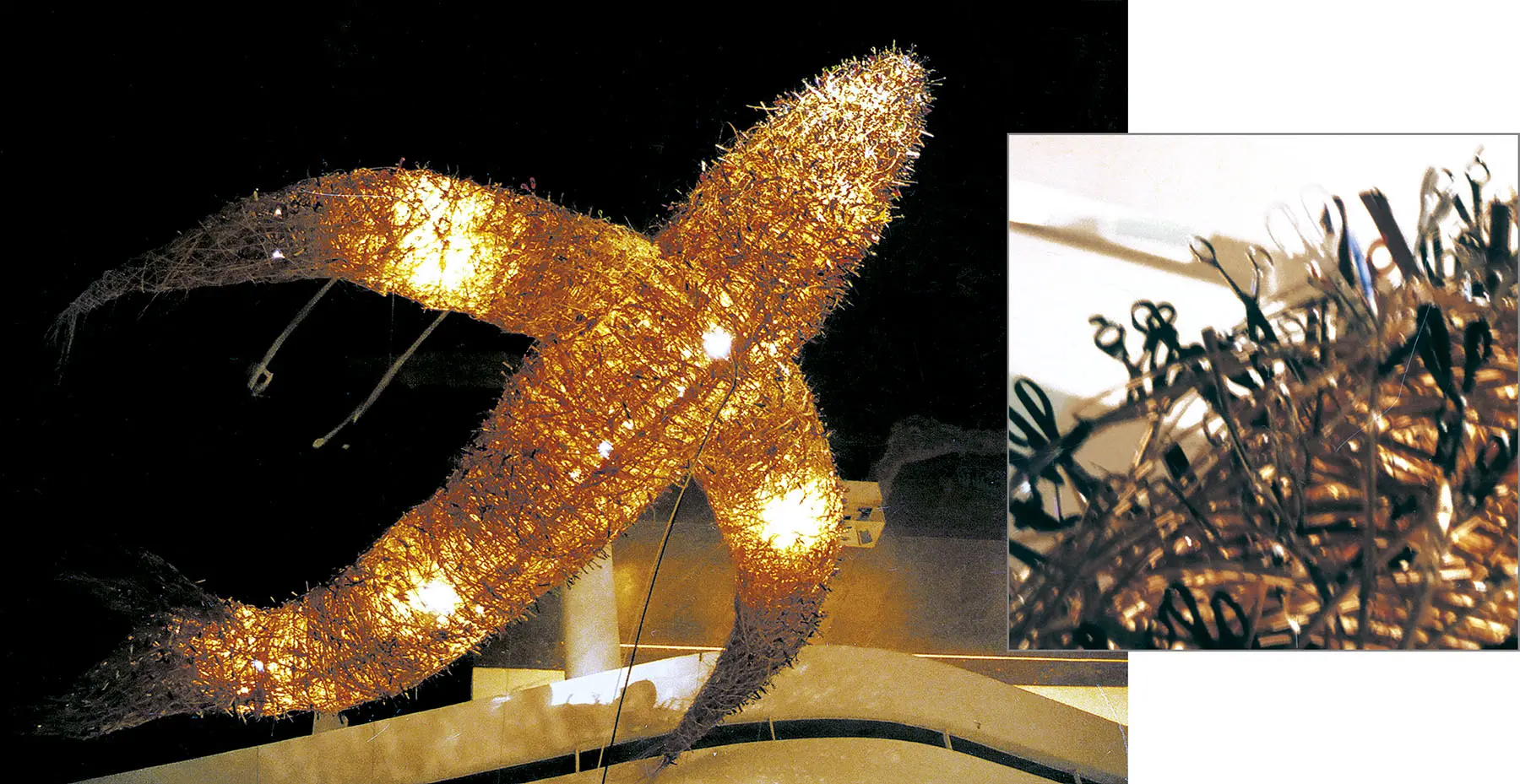
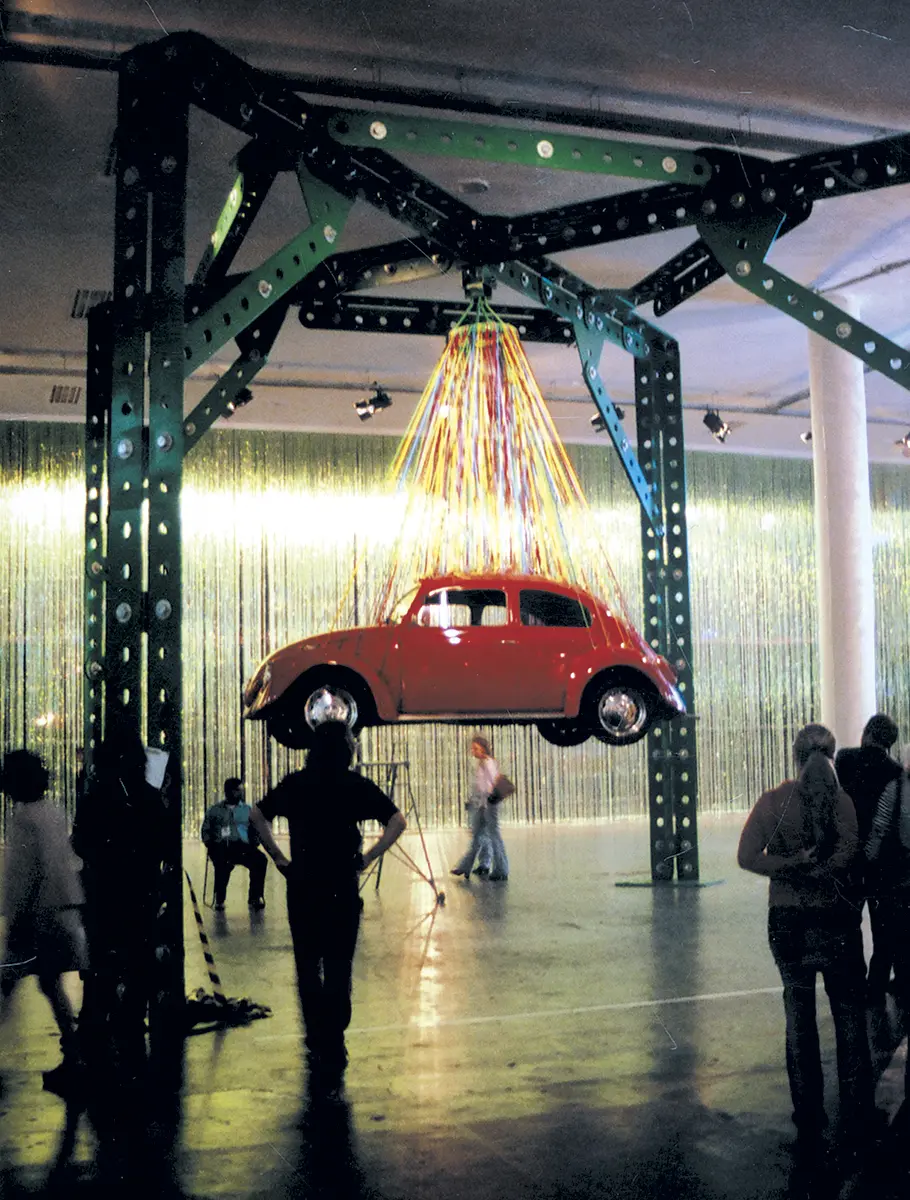
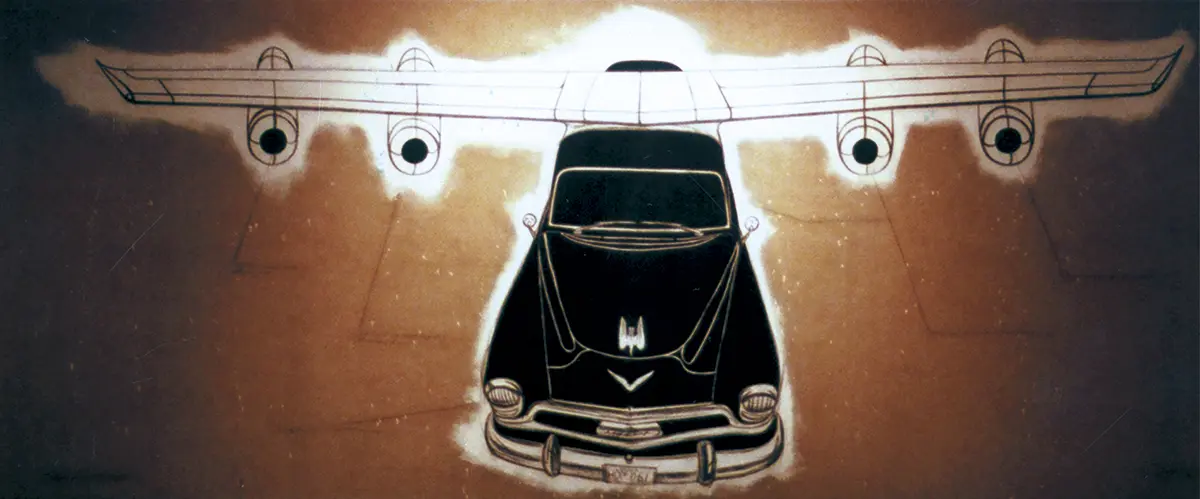
Esterio Segura, from Cuba, also alluded to displacement, or more precisely, to one of the most usual means of displacement nowadays: the airplane. In black and white on a raw canvas, he proposed hybrid beings with precise diction, airplane-whale, airplane-hippopotamus, airplane-automobile, which speak of the “silent protagonists of the new world political economy: the immigrants that carry the borders of their nations in their backpacks and restructure their identities at each airport terminal.”4 The series is titled: Todos quisieron volar (They All Wanted to Fly). There was another airplane bird in the great internal void connecting the three floors of the building. It was an enormous construction in wicker, drifting alongside the already-mentioned installation by Barrio. It had wheels and plastic tapes animated by fans that simulated the plane’s movement and also made continuous noise. The surface literally bristled with thousands of sharp objects, the kind that cannot be taken into the passenger cabin for security reasons: scissors, pocket knives, knives, pincers, and needles. The comment was rather funny; the author is Chinese artist Cai Guo Qiang.5 Another vehicle at the Biennial by the Austrian Leo Schatzl was the fuchsia VW Beetle suspended with elastic cords from a metallic structure like a giant mecano, or toy that could be made to rotate from its suspension point.
A contemporary team made up of eight Austrian, Brazilian, and American artists replicated Thomas Ender’s Austrian expedition, an eighteenth-century scientific mission that compiled images and information on colonial Brazil. The result of the current expedition is much less convincing than the original watercolors and its purpose of reinstating the foreign scientific mission as a tool of knowledge doesn’t seem a valid basis for the assembly at the biennial, anodyne and trivial. Another trip, or displacement was that of Brazilian Paulo Bruscky’s workshop. Bruscky is an artist related to the “holistic” movements of Fluxus. Three or four environments mimetically reconstructed the artist’s real shop in Recife. Curatorial self-confidence, no doubt. E d’aí? the Brazilians would say.
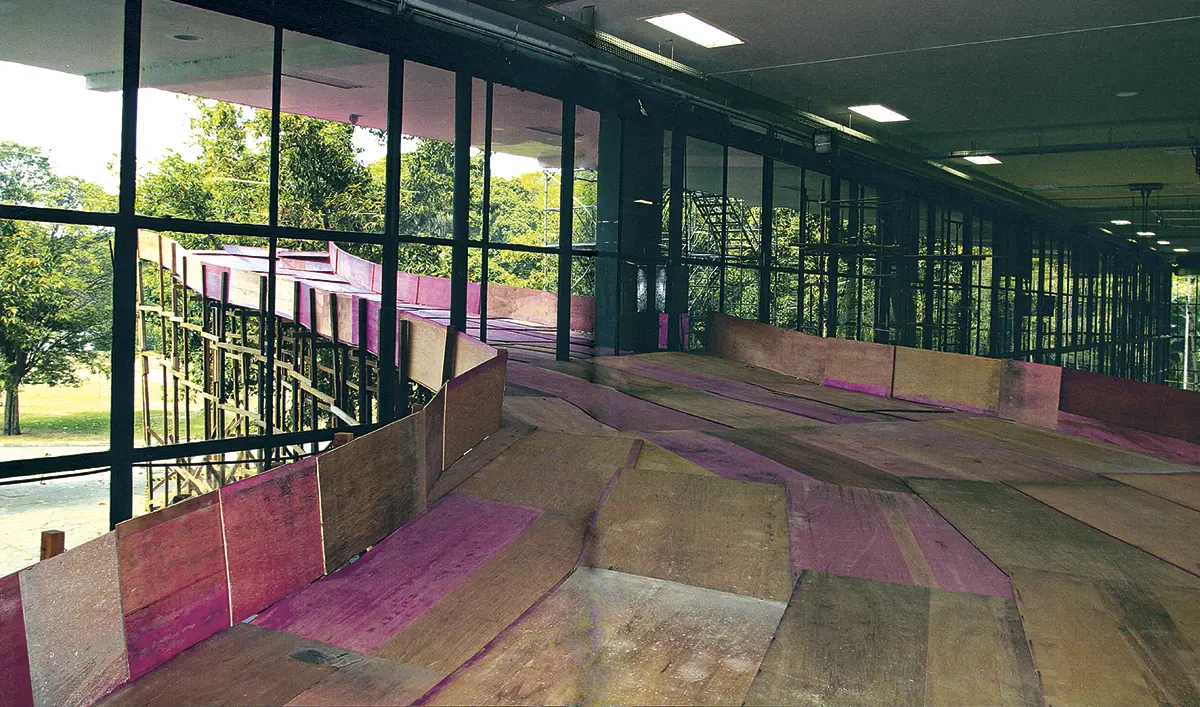
Two other installations could be linked to the theme of displacement. One was the curved ramp by Thiago Bortolozzo, a road that began already in the air, lifted with cheap construction wood. The ramp crossed the glazed wall of the building and was lost in the foliage of the neighboring trees. A metaphor of the future, perhaps? The other less optimistic installation was a sort of high runway built with wooden orthopedic crutches, titled El Puente (The Bridge), by José Morales, a New Yorker of Puerto Rican descent. The construction covered the distance between the lateral walls of the assigned space without connecting them. Passage was not possible. The doors sketched on both walls were only deceptively connected by shades. The trip did not end well. The legible contents alluded to both the displacement of immigrants and the enormous barriers encountered by the disabled. With frugal means and conceptual weight, this was one of the most forceful installations of the Biennial.
Three exhibitors made ironic comments on globalization. One of them was Son Dong, a Chinese artist. His work was an enormous planisphere made of sweets and candies on a blue plastic floor. Supposedly, the public could participate by eating the goodies, but there was no chance for that. Another planisphere, this one computerized and reduced to dots and lines in black on white was the proposal of Brazilians Angela Detanico and Rafael Lain. A schematic map of the world was composed and recomposed with a feigned computer click. For curator Lisette Lagnado, these artists acted as hackers of representation systems. The third artist dealing with the topic did so in a mocking and amusing way. The Mexican Miguel Calderón represented his country with a replica of a soccer game between Brazil and Mexico. Mexico won by an incredible 17 goals to 0. The match could be watched from two displays in the area of the mezzanine’s coffee shop. The montage was made with takes from actual games, as if it were the live broadcasting of the match, with real players, referees, the public, technicians, and commentators, and the shouts of “goal” roaring throughout the first floor of the Biennial.
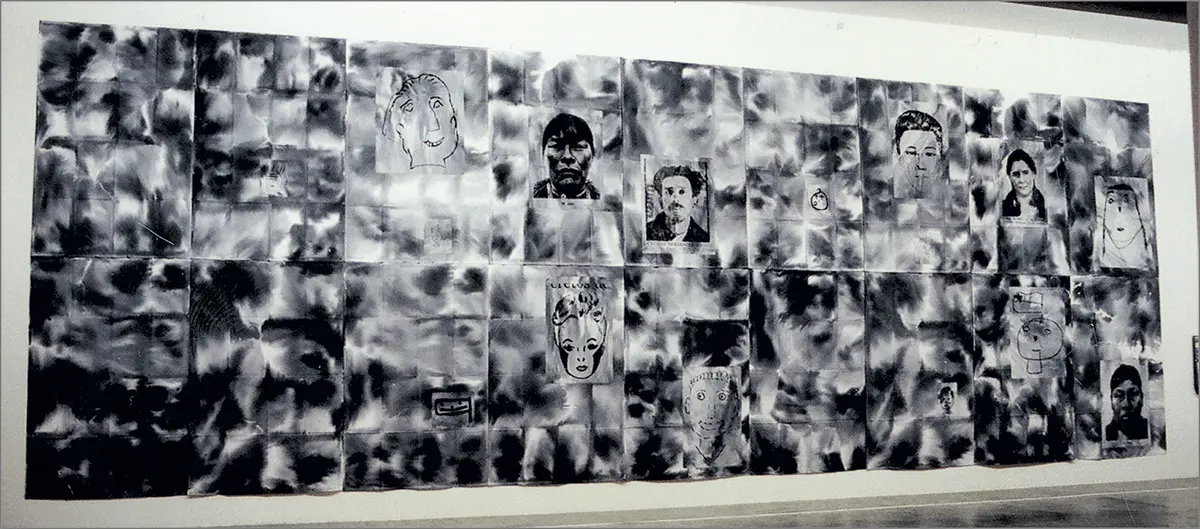
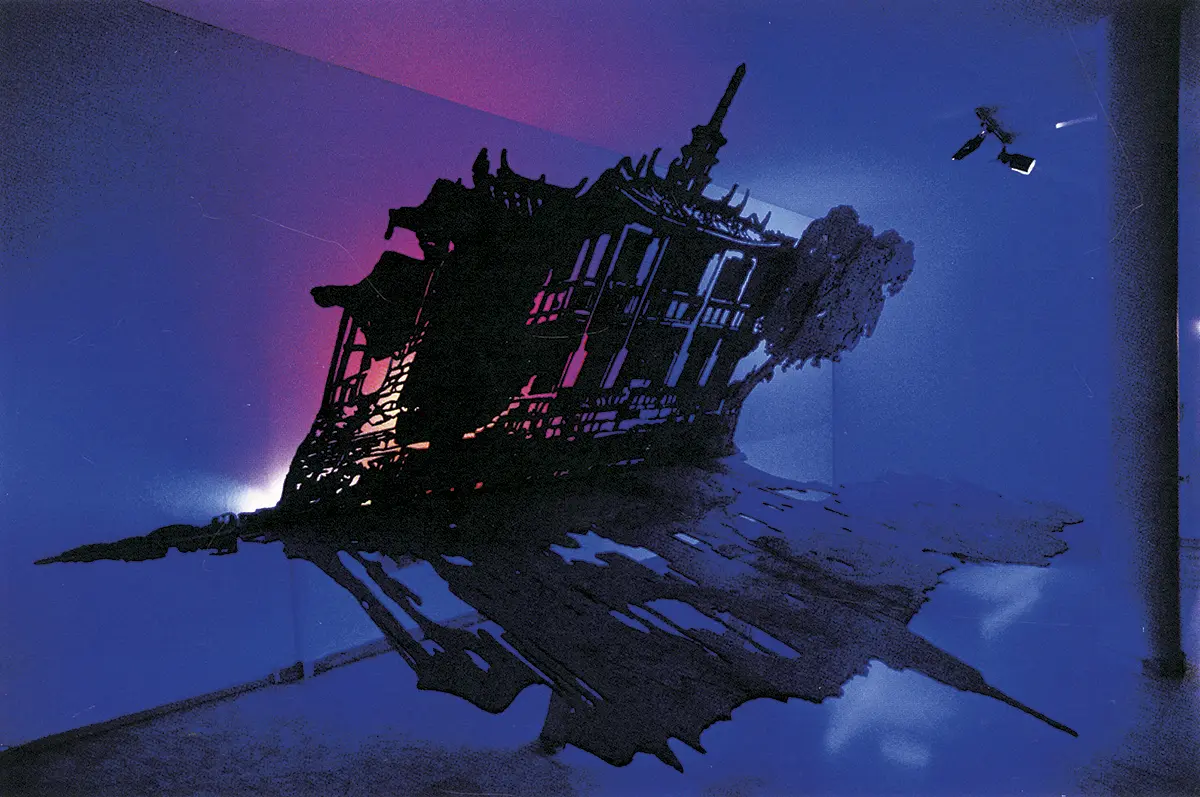
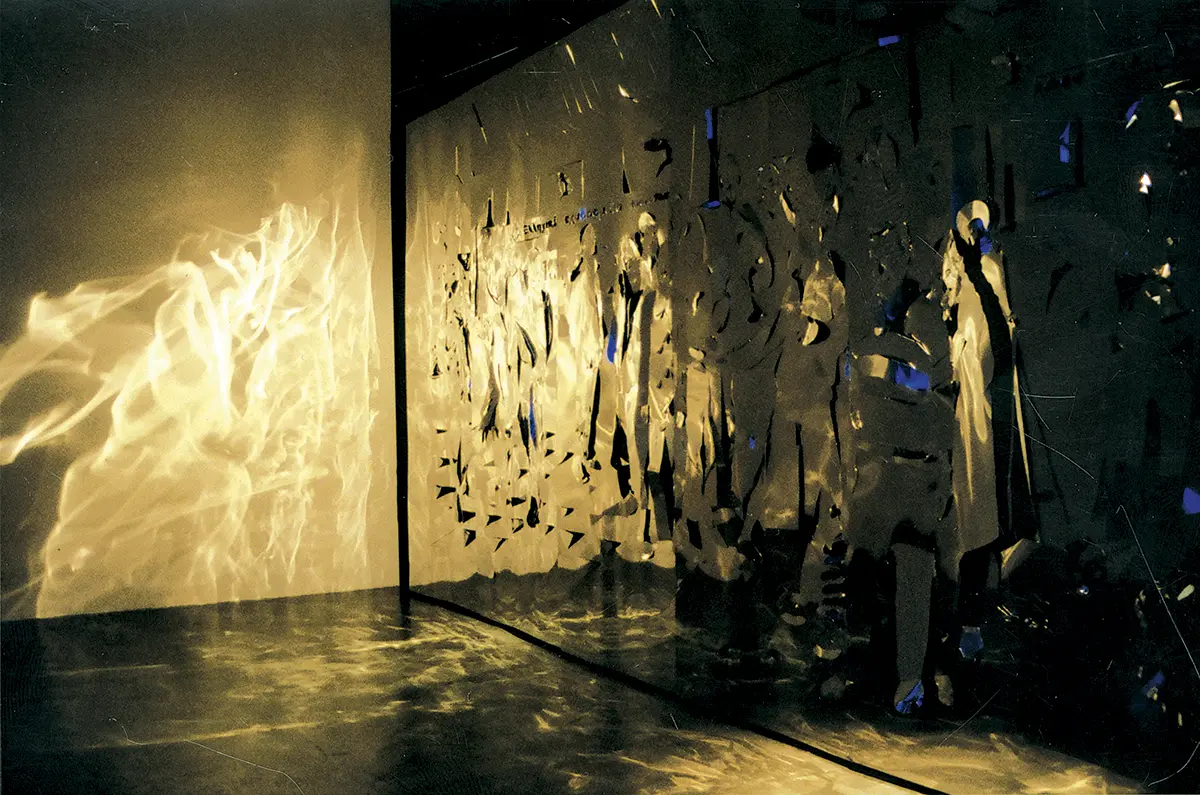
There were other forms dealing with the topic: the airmail painting by Dittborn, involving painting, photography, and collage, on an enormous canvas folded into fragments, so as to fit into envelopes. The traveling Pope was alluded to by the reconstruction of his silhouette, made by troops of the Brazilian army on a beach of Rio and photographed from above by the Polish artist Piotr Uklanky; or the computer images by the Croatian Zlakto Kopljar recording part of his Series K. The artist was photographed and filmed kneeling reverently at different sites in New York. The interactive installation by the Greek artist Harris Kondosphyris also touched on the topic of globalization in aspects related to communication or the lack of it in the current world. In a dark space, a construction alluding to Chinese shadow plays confronted a great panel of reflective stainless steel worked in relief and incised with hundreds of characters on an anonymous street. The pagoda was transformed into a phantasmagoria that gave forth soft scents and whispered an incomprehensible language. The spectator was reflected on the steel panel, virtually inserted into the problem of lack of communication.
The ecological concern was another focal point. We found it in the extraordinary photographs by the Canadian Edward Burtynsky who recorded stages of the construction of China’s huge hydroelectric project of the Three Gorges. The whole project was “a metaphor of our existence in the modern era,”6 and an accusation of the perverse relationship between the wish to live with more comforts and the pillaging of nature. Less philosophical, although beautiful as an installation, was the proposal by Brazilian Chelpa Ferro, already presented in the Havana Biennial. A sizeable amount of dry branches of a shrub known in Brazil as fava were arranged as flags on a wall. The branches vibrated with the action of fans we could not see but were able to hear, and that added to the noise made by the seeds of the dry sheaths. The public participated by activating the fans from many electric switches on the floor in front of the installation. The noise generated was suggestive of nature.
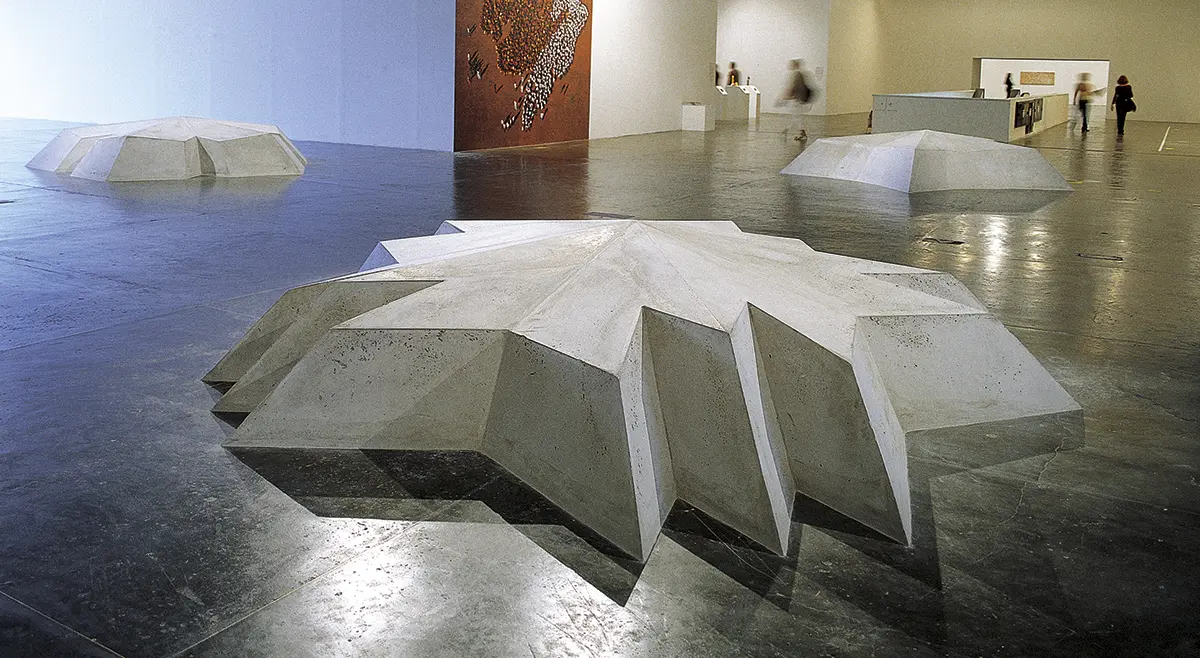
Artists concerned with the conflicts of power and war were not lacking. I will mention only three: Juan Fernando Herrán, Colombian: Patrick Hamilton, from Chile, and Fernando Sánchez Castillo, sent by Spain. Three big pieces in cast concrete were Herran’s presentation. They were at the same time abstract geometric works and metaphors of the strongholds of the colonial period. Hard, overwhelming, and almost threatening, they clearly alluded to the conflict the country is undergoing. Hamilton uses photography as a highly sophisticated tool to present images combining saturated colors, artifacts such as plow disks or knives duplicated in a spectacular form whose brilliant blades lodge fragments of other, also photographic, scenes. Those chosen for this series referred to the conflict in Afghanistan or in Iraq, and to the Guantanamo base. The Spanish artist declared that “art may speak metaphorically to make us change our stand vis-a-vis the structures of history.”7 His excellent video showed the vicissitudes of a great brass bust, dislodged from its original context and subjected to the most varied treatments by numerous groups of characters: it was dragged through paths and roads, alternatively stoned or decorated, buried and rescued from the sea. There were subtle references to Buñuel and Almodóvar in a beautifully built discourse.
Among national representations, there were at least thirteen videos. Nearly another thirteen were exhibited by non-Brazilian artists. Apart from those already mentioned, we must highlight Les balayeurs du désert, by the Chinese-English artist (residing in Luxembourg), Su-Mei Tse. In a long sequence, the street sweepers of Paris, distributed across an immense desert-like surface, try to heap mounds of sand. It brings to mind the Spanish saying: “Like plowing in the sea.” It is also necessary to be critical of the exhibitionist and eschatological film showing the Bulgarian Rassim being circumcised in an operating room. The artist has every right to wish to come closer to the multicultural reality of his country, even through self-imposed ritual mutilation. But he is confusing the private with the public sphere. The presence of this video was an abrupt assault despite the several antecedents it has in the field of Body Art.
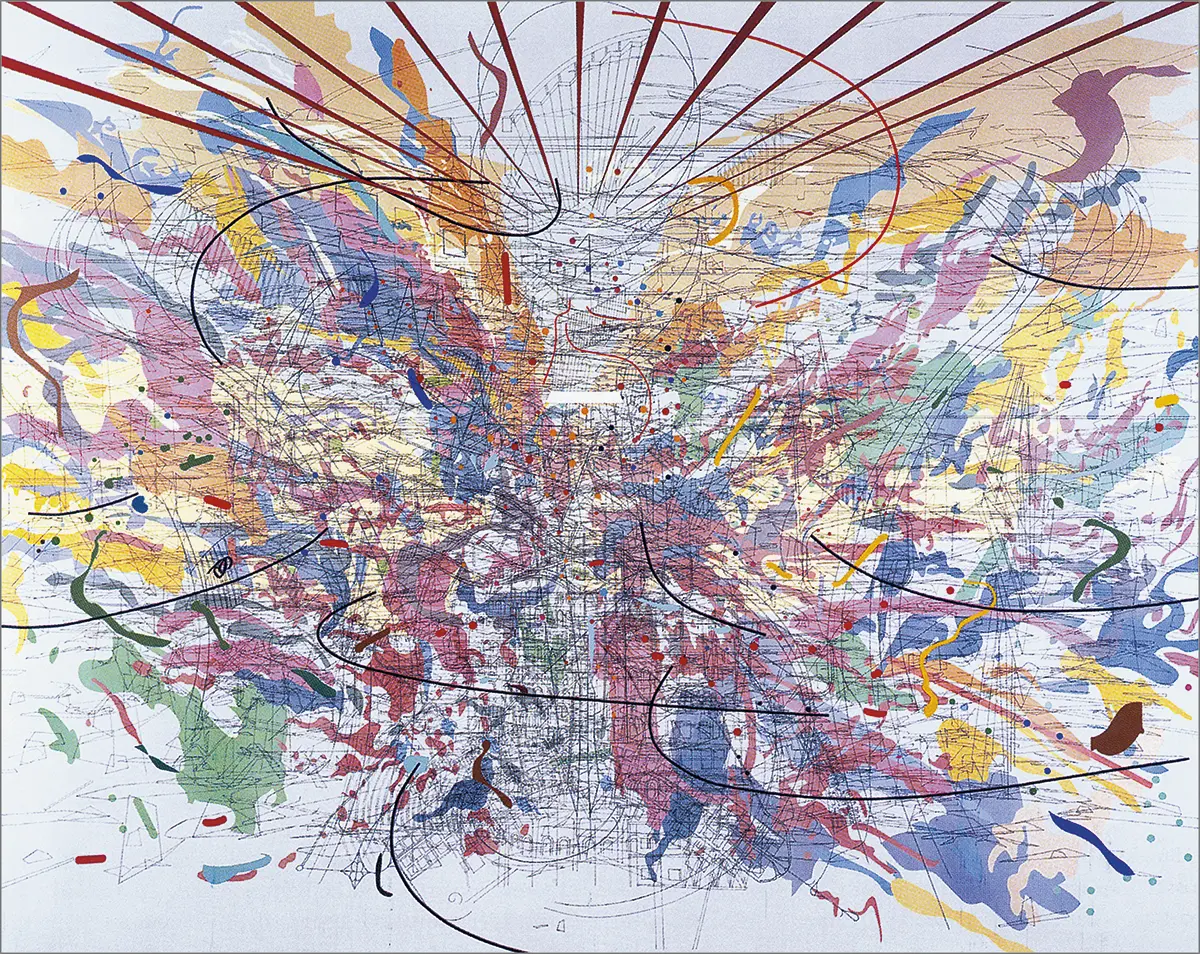
A score of participants were represented with painting, and most of them were invited by the Biennial. The works of Brazilian Beatriz Milhazes in acrylic on canvas were supported by ornaments, in the strictest sense of the term. Arabesques, circles, iterative geometric patterns, and schematic flowers unfolded into a wise color mix. Voices from Siberia, the set of works by the Japanese, Shin Miyazaki, takes us exactly to the antipodes. Several of his two-dimensional works had strong textures, and a three-dimensional piece was made of burnt logs. The former were encaustic paintings made in near-black pigments on thick jute. These solemn paintings reminded us of meditation, and naked beauty in the search for the absolute. Another contrast was the explosive energy of the drawings and canvases by the Ethiopian-American Julie Mehretu. Her meticulously controlled spots, sprinklings, color, and graphics transmitted a fierce image of violence and disintegration. “The stadium, the coliseum, the amphitheater are perfect metaphoric spaces, clearly designed to lodge a great mass of people in a highly democratic, civilized, and functional way. It is also in those same spaces that we perceive the underground currents of the most complete chaos, of the violence and disorder.”8 The artist works with drawings reminiscent of architectural blueprints, elements of advertising, or comics that are later covered by layers of semi-opaque latex. In the end, they become delicate silhouettes that are barely seen within a mass of strokes overlaid in a very beautiful graphic and chromatic palimpsest.
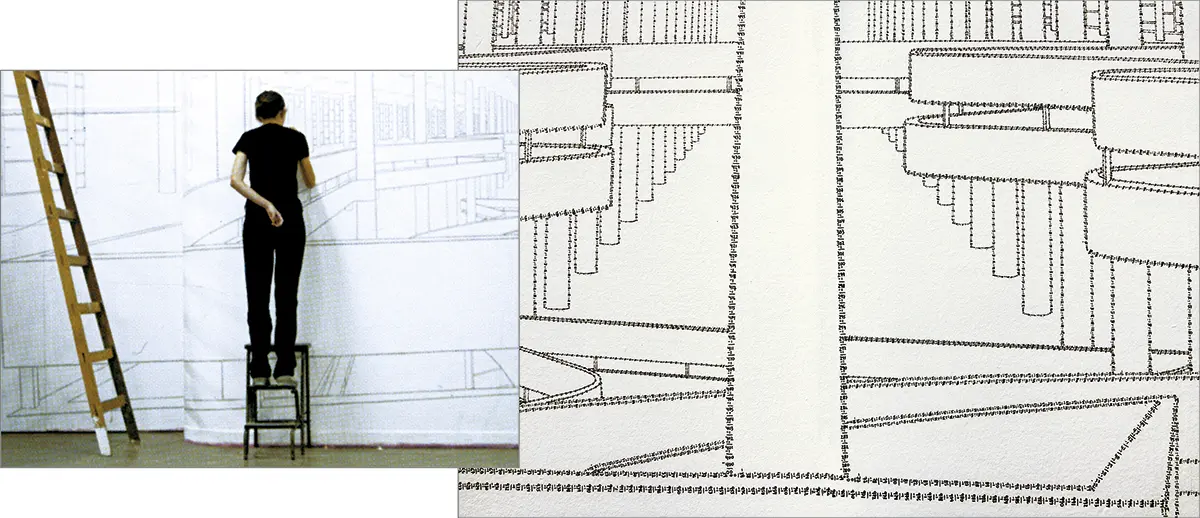
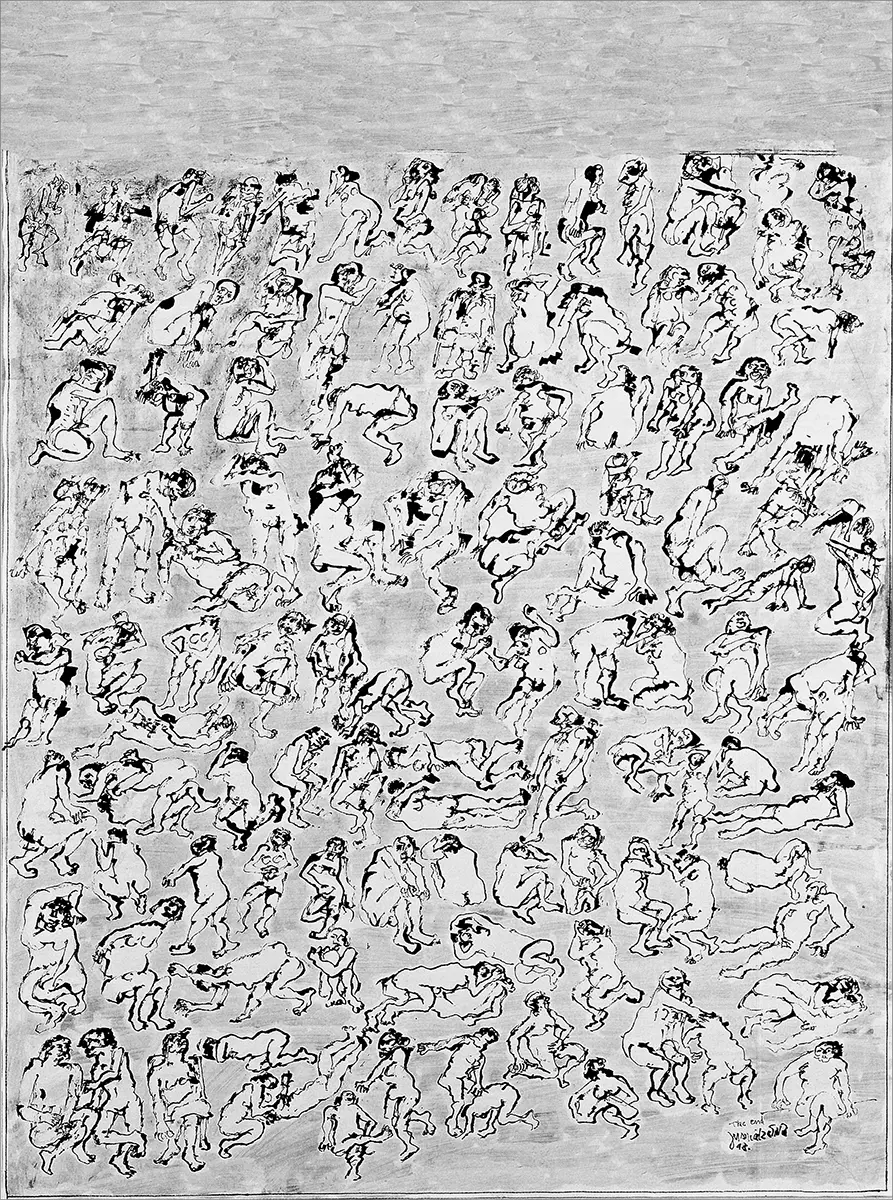
Two other works in the category of two-dimensional works were the wall painted by the São Paolo artist Paulo Climachauska, and elements of the series Body Maze, by the Venezuelan Juan Calzadilla. Supported by a team of several young artists, the first one drew on one of the closed walls of the second floor, the image of the skyline of the Oscar Niemeyer building and the Biennial Pavilion. The similarity was quite impressive and the false strokes were in fact thousands of figures carefully aligned to assemble the spectacular image that duplicated the space. Calzadilla was declared an integral artist. His theoretical and critical contribution is one of the most important in Venezuelan letters as are his drawings, understood as calligraphic writing. Hundreds of small naked human bodies filled the support planes and generated a compact weft, as of printed page open to be read with more than one interpretation.
Professor Nelson Aguilar, curator of the Brazilian representative, Ivens Machado, considered the artist’s installation as “an oracle that should be consulted by the surrounding works.”9 The installation was made up of hundreds of logs, 12 centimeters in diameter and more than a meter long, heaped in a sinuous configuration with several holes or cavities. Some were sharpened, others broken. The parallel sought with the building was not apparent, nor was the dialogue with nearby works: an enormous silver globe by Bruno Peinado and the already mentioned suspended VW and the planisphere of sweets.
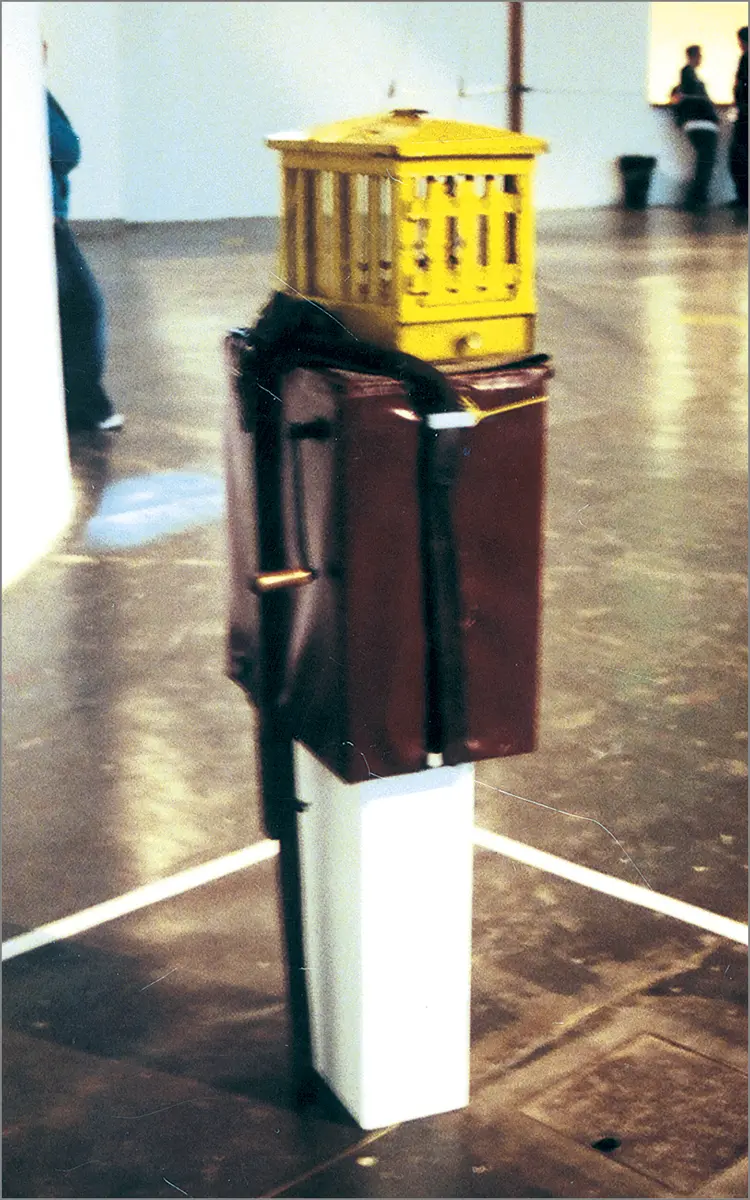
Portugal presented an installation/performance that was stuffed in the central space of the ramp. Sculptor Rui Chafes and the dancer and choreographer Vera Mantero collaborated. Two very high metallic seats, similar to the contraptions of ski slopes, welcomed the dancer’s naked body for a one-hour performance. Her skin was entirely decorated with drawings that evoked the ritual ornamentation of the hands and feet of brides in certain Arab countries. The action was recorded on a video shown near the seating. The organ grinder also acted as a performer -with a parrot that gave out colorful little papers with atrocious phrases- “installed” in the Biennial by the Brazilian Rosana Palazyan, as an artistic strategy to “...grant visibility to what is submerged in opacity.”10
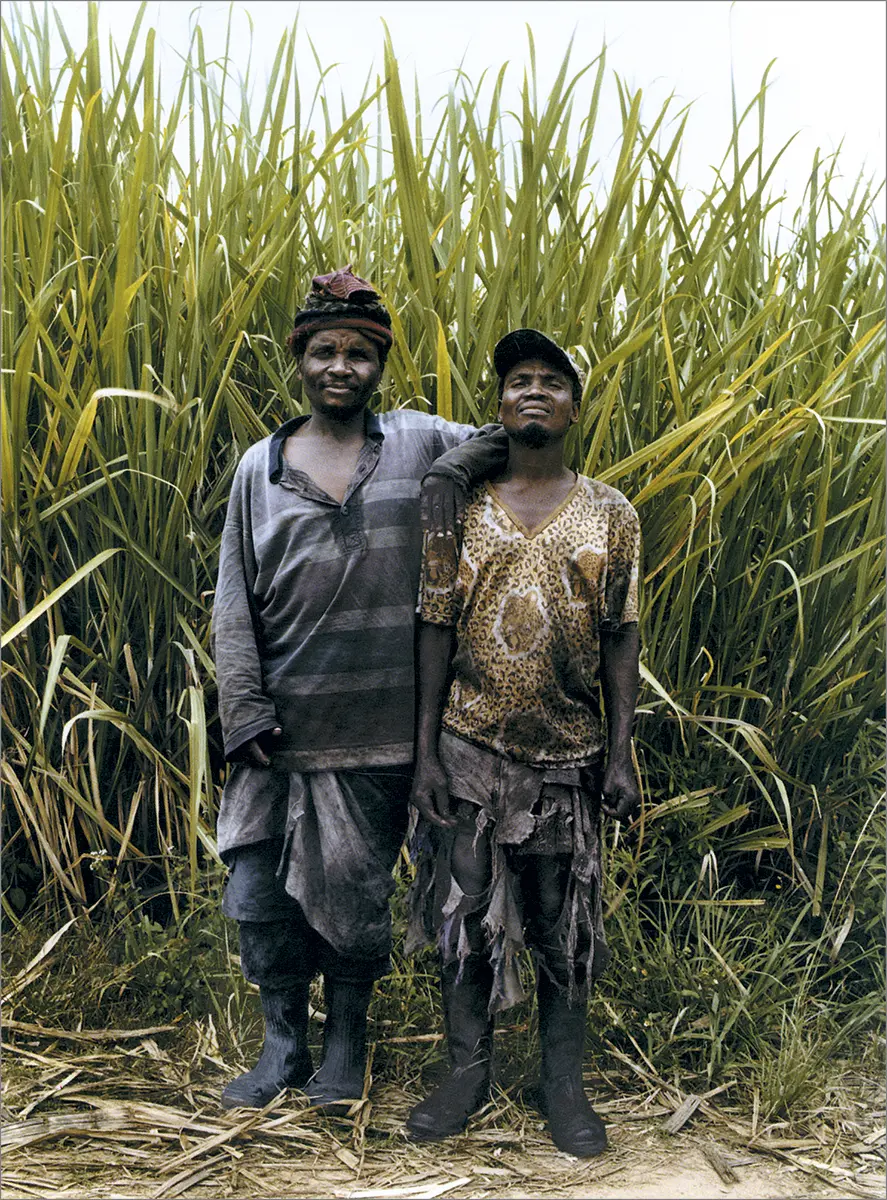
Perhaps the abovementioned words serve to qualify the set of photographs sent by seven photographers from several African countries who were special guests. Most were portraits, and the most beautiful, those that portray images of the South African harvest, were those captured by Zwelethu Mthethwa’s lens.
In summary, we will have to continue waiting for another São Paulo Biennial in the hope that, as a whole, they are more thrilling.
NOTES
1. Alfons Hug, The Biennial as a Free Territory, exhibition catalog of the 26th São Paulo Biennial, September 26–December 19, 2004, p. 23.
2. Jose Roca, guest artist catalog of the 26th São Paulo Biennial, September 26–December 19, 2004, p. 118.
3. Luiz Camillo Osorio, “Barrio: proceso y experiencia,” guest artist catalogue, p. 266.
4. Abelardo Mena, guest artist catalogue, p. 120.
5. The artist proposed a work that exploded and was not accepted by the Biennial for security reasons. It is the work in the outline of the catalog.
6. The artist, quoted by curator Marcus Schubert, guest artist catalog, p. 76.
7. Fernando Sánchez Castillo, national representative catalog of the 26th São Paulo Biennial, p. 130.
8. Julie Mehretu, quoted in the text of the guest artist catalog, p. 156.
9. Nelson Aguilar, catalog of National Representations, p. 96.
10. Paulo Herkenhoff, guest artist catalogue, p. 182.
* Photos by León Birbragher.
MARIA ELVIRA IRIARTE
Ph D. in Art History and MFA. She teaches art history at the School of Fine Arts, Finis Terrae University, Santiago de Chile.