Alejandro Mazon’s recent show at George Billis Gallery has expanded his recognizable aesthetic motifs and themes in myriad ways. His new work has extended his signature use of wood as the foundation on which he applies his diverse media. For now, Mazon has opted for vintage wallpaper as a surface for his artistic explorations; but the type of paper that he uses was produced between 1890 and 1950. These surfaces are thus more than just background, however; and their readymade decorative motifs from Japanese and French sources formally and conceptually complicate his works consequently producing results that are as poetic as they are cerebral.
Whereas Mazon’s previous paintings on wood are evocative of a more historical style via attention to minutiae and almost graphic-like handling of line, the new works are anchored in a tension between wallpaper and surface marks that also coalesces a disparity of formal elements: foreground/background, planarity/recession, and text/image. These dialectical palpitations create a contemporary sensibility while remaining steadfast in the formal style that is discerned as Mazonesque if you will. Mazon also has an uncanny way of working with areas beyond the picture plane while making these same areas feel as if they are part of pictorial space. He employs the frame, or what appears to be conventional spatial delineation such as the edges of the work that morph into sculpture and back into painting before one’s eyes. To paraphrase the late Derrida, Mazon equally exploits both the eregon, or what resides in the picture, and the parergon which is the frame. For Mazon subsumes the frame as a pictorial trope: it becomes part of the field of painting, albeit that it exists outside of it. The more disparate the better; and this ontology of painting can be detected in other painters such as Howard Hodgkin and Robert Ryman. Yet whereas the latter remains entrenched in abstraction and the former is representational to a degree, Mazon uses the frame as a narrative device. This can be detected in the mixed-media work titled The Yellow Goat (2004), for example.
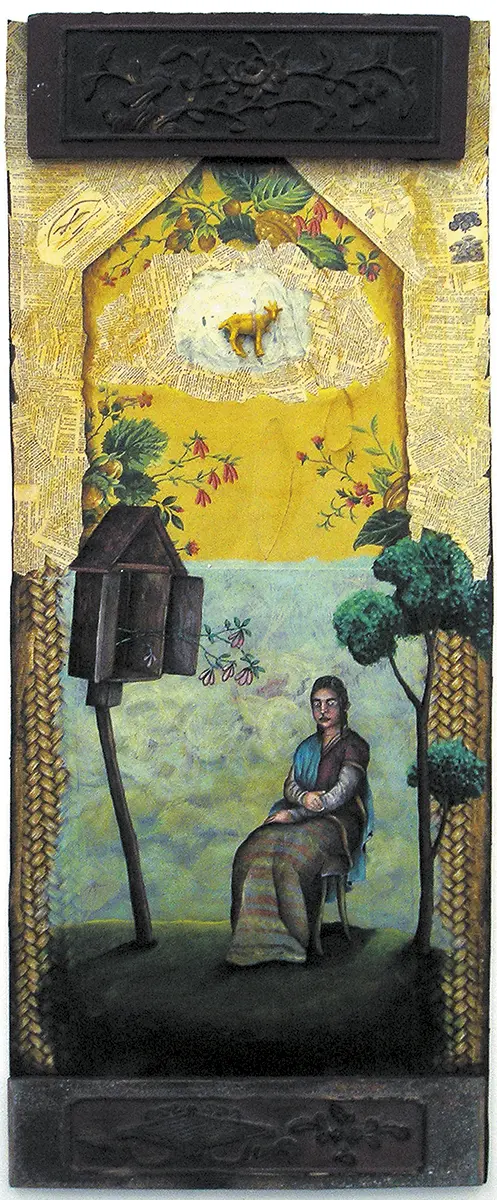
This work conjoins a whole array of source material: from retablos and ex-votos to a kind of New Image painting, The Yellow Goat is delineated by three-dimensional objects affixed at the top and bottom that concomitantly undermines as well as underscores its structure as painting. The objects, however, are more than ornamentation; for Mazon’s materiality is pregnant with meaning. Although he sets his figure(s) in a landscape, the wood and its decorative motif carved on it serve as a kind of visual pun to remind us that the picture is in fact both illusion and reality. The conflation of the two rests on collapsing the signifier of readymade pieces of wood that bracket the painting with the signified painted landscape within them. In short, Mazon is foregrounding a more conceptual spin on painting as he manipulates form to the level of meaning. Rather than form as only obtaining signification as representation, The Yellow Goat is simultaneously two- and three-dimensional: it is both a window onto a truncated landscape as it’s the truncated wood obtained from that landscape. What we see, then, is both the tree and the forest. The maneuver here is not only what other painters have done in order to supersede the boundaries of the medium. Witness Lady with a Squirrel (2004); is a mixed-media work that freely culls from the past via its inclusion of Genre pictures, portraiture, and history painting.
The work depicts a woman in a three-quarter profile with a furred pet looking rather glum. Yet the picture is nuanced with a checkerboard background as well as paint that drips from the woman’s black dress onto the frame. In general, the painting is akin to Dutch Baroque pictures: the background of yellow and reddish-orange squares is a parody of the black and white diamonds found in Vermeer and other 17th-century painters. The device of placing the figure right up to the picture plane also cites this era. The only thing missing in this reference is tromp l’ôeil. But Mazon has perversely included dripping, black pigment; a penumbral passage that is more at home in pure abstraction rather than in representational art. What is now fooling the eye, however, is not some hyperrealistic representation, but a phenomenological tactility of the painting’s presence. It is via these sorts of subtle tropes and semiotic contortions that Mazon is the most effective; he shifts from what appears to be a historicist painting to a type of painting that ends up being beside itself.
RAÚL ZAMUDIO TAYLOR