
Swiss existential analyst Ludwig Binswanger analyzed the essence of
being by dividing it into three parts: the world of things (Umwelt), the
world of relations (Mitwelt), and the world of self-relations (Eigenwelt).1 Jennifer
Allora and Guillermo Calzadilla manage to combine in their works all three. For
the past nine years, Allora & Calzadilla, currently living in San Juan,
Puerto Rico, have been jointly creating complex conceptual works of art steeped
in history, politics, science, and even economics. Moreover, their works are
deeply intertwined with the context in which they are created and/or exhibited.
It is as if the artists consider their works inextricably bound to “place” as a
social and historical signifier. Whether “place” is defined in terms of
geography, or even in terms of time, its importance in each work adds layers of
meaning to what in some cases, maybe a simple object such as a bell, a palm
tree, or a carpet. Extending the collaborative nature of their art-making
process, this artist duo more than often offers their works up for social
interaction. This engagement with the public evolves as a natural progression
of their process of production.
Coming into maturity in the late 1990s, Allora & Calzadilla’s body of work does not focus on any one medium or style. They have appropriated objects and painstakingly created others; they have worked with the latest high-tech devices and have also made works with only a pencil; their works have gone from still image photography to video to even a film by instruction. In their work, like those of many artists of their generation, the idea searches for form, instead of the other way around. Unlike some collaborative artist teams, these artists only produce work together, not individually or in parallel. When asked about their artistic collaboration, Jennifer Allora mentions “that ever-shifting space between two people." She adds: “It is a very political space with an ever-present possibility for disagreement.”2 It is perhaps by embracing this “disagreement,” this conflict that these artists successfully create between themselves a collaborative spirit that eventually spins out into their works and onto the participating public. Viewers become agents of sorts, perhaps even conspirators through their participation by setting the works in motion: it could be by simply ringing a bell, walking on top of a work, inventing or playing a game, or participating as a director in the production of a movie. In their entire body of work, consisting of sculpture, drawing, photography, and video these artists have always emphasized their interest in floor works, and in this text, I will discuss four.
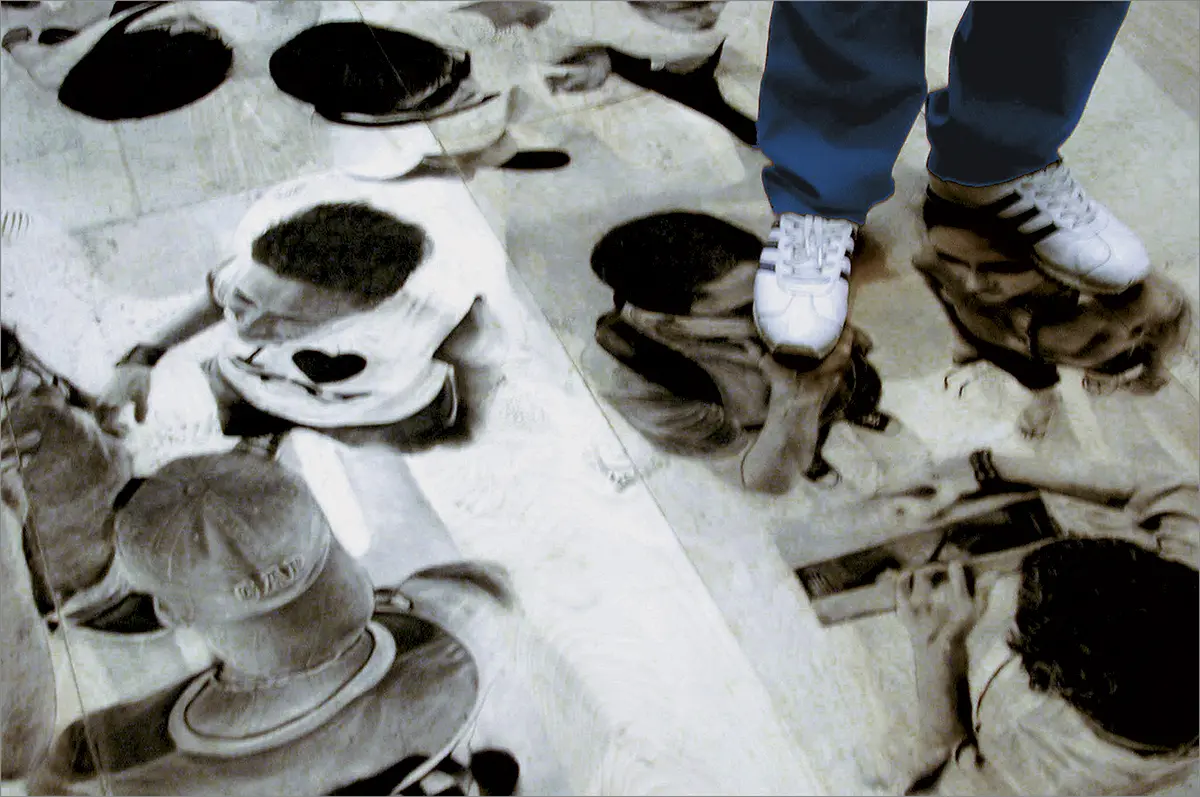
Their first major project dealing with floors, Charcoal Floor was presented at the São Paulo Biennial in 1998, and most recently in the Walker Art Center’s exhibition How Latitudes Become Forms. It consists of an exquisitely rendered charcoal floor drawing on wooden panels depicting a large group of young people dancing. They are shown from above looking down as if the viewers were walking on a glass ceiling over their foreshortened moving heads. The viewers are invited to walk over this un-fixed charcoal drawing and as they do so, the drawing slowly smudges, flattens, and becomes less differentiated. Through steady contact with the public, the figures slowly undergo a sort of homogenizing. In a way, these works recall Robert Rauschenberg’s Erased de Kooning Drawing (1953), but instead of being an alteration of a past action, and one controlled only by the artist, Allora & Calzadilla postpone the action on the work and instead, it is delegated to the viewer.
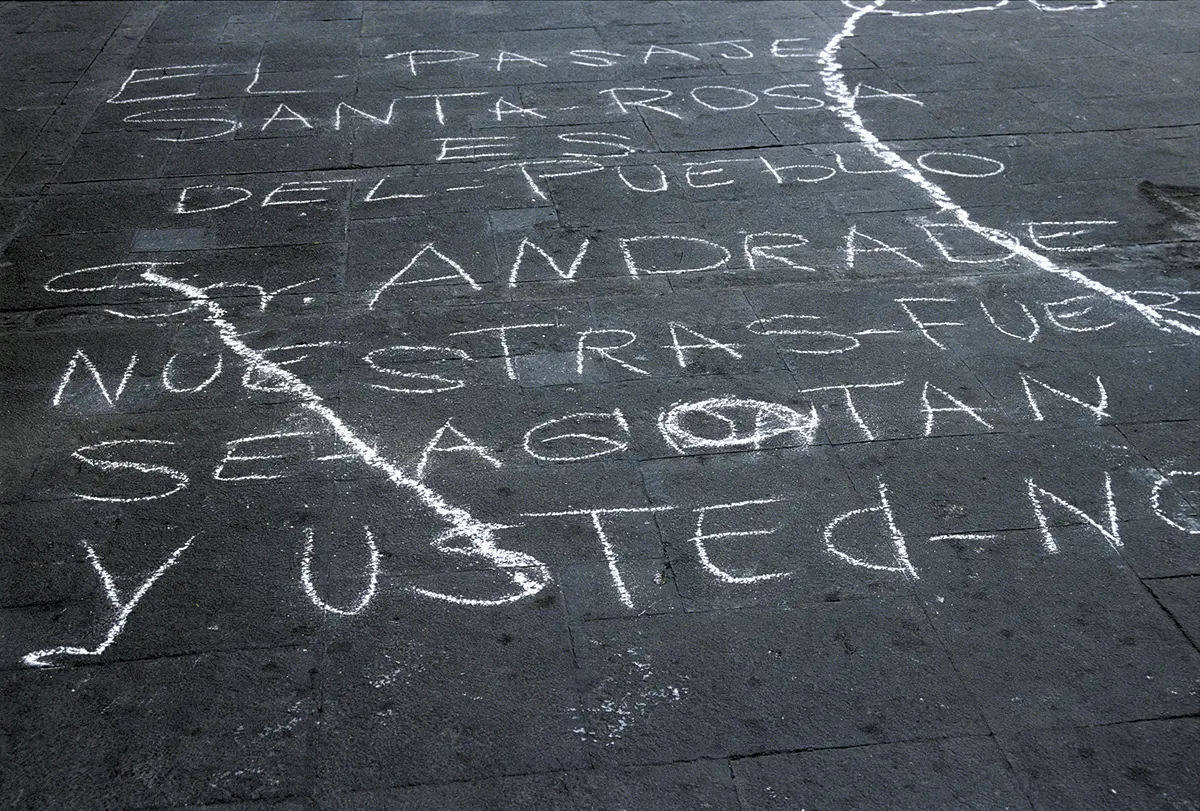
Allora & Calzadilla’s next floor work Chalks (2000) not only requires viewer participation, but it further relinquishes control to the spectator, converting the works into platforms for interpersonal relations. Presented so far in New York, Lima, and Boston, this work consists of twenty-four monumental pieces of chalk, identical in form to those used by schoolchildren, but measuring five feet in height by ten inches in diameter. These structures are molded to look like perfect cylinders, pristine in their hard-edged whiteness and gleam, at first resembling minimalist sculptures in and of themselves. The artists then strategically place them on a plaza, street, or public arena and offer them up for public intervention. As stated by the artists: “This work offers viewers the potential for communication.”3 The viewer may decide to participate, or not; and if he/she does, the work presents many variables: Should the chalks be broken down and its pieces used individually? Should the entire chalk be carried by a few people and communicate collective thoughts? Chalks is coincidentally very similar in form to Robert Morris’s 1961 Columns, which was once described as “less an ordained experience than a catalyst for one, less a presence than a conduit for allowing viewers to come to know themselves through art.” Furthermore, his work was discussed (like Chalks) as “a proposition about art, and its status is continually in question; in order to be art, it has to be accepted as part of a social contract that depends on a collaboration with viewers.”4
At this point, one must stop and consider relational aesthetics and the work of Allora & Calzadilla. The importance of works of this nature lies in their social dimension and the potential for interaction with others. What is underlined in a work like this is its social aspect, whether caused in the process of making the object or as a result of a participant’s contact with the object. Nicolas Bourriaud describes artists who work in the relational realm as those who do not belittle form, but at the same time, they “relativize” the importance of form in the exhibition protocol.5 This goes right to the crux of Chalks, whose forms are severely altered, if not completely destroyed, as a result of viewer interaction. The exquisiteness of the chalks as objects is not denied, in fact, it is exalted, but its value as a work of art lies in its potential to produce meaningful interchange, communication, action, and protest; in other words, as it serves as a catalyst for social interactivity.
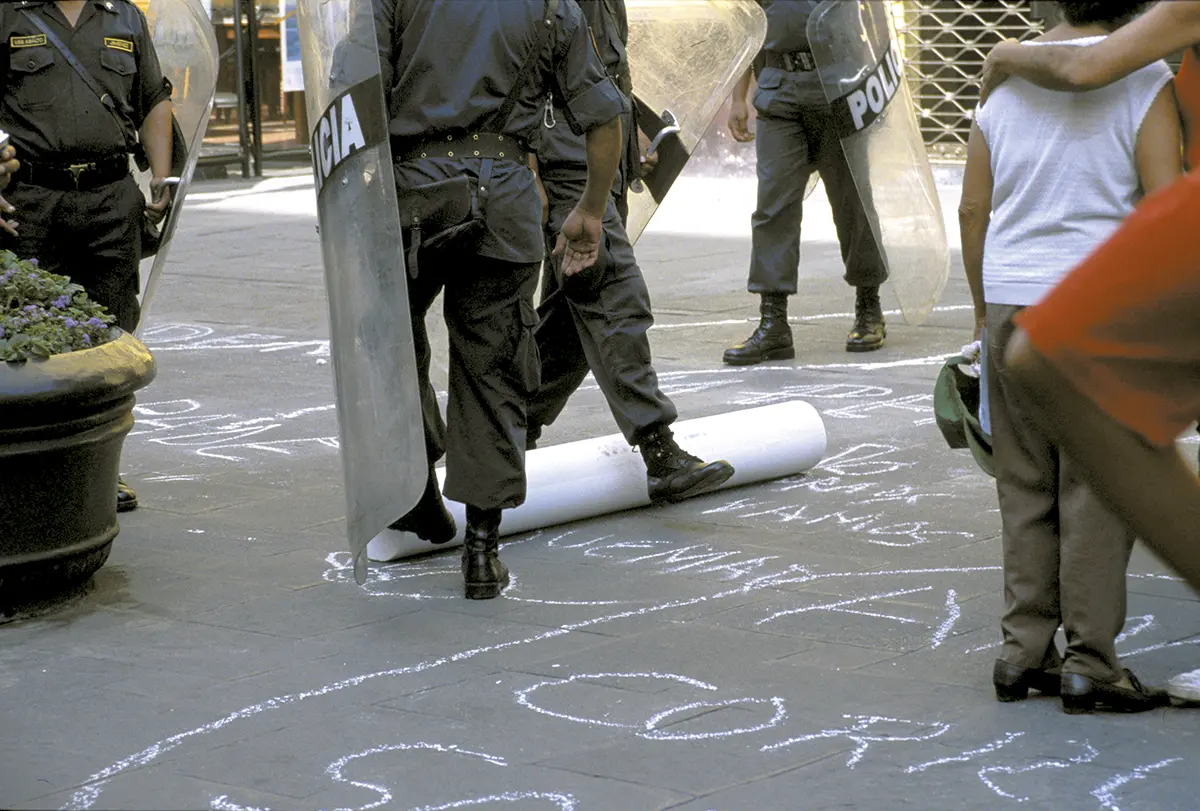
Chalks literally marks the ground, but also marks context. As the work unfolds, either on New York’s Fifth Avenue during Museum Mile Day or on the Boston Common, the multifaceted nature of the work is apparent as the participants start writing with them. Each manifestation of this work serves equally as multiple public billboards, classified ads, declaration of love, and even as a political manifesto, much in the same democratic spirit of street or graffiti art. On a government plaza in Lima, Perú in 2002, for example, the work took on a controversial political character that caused a revolt and brought the city’s riot force to the main plaza to stop the participants. A sanitation crew then hosed the writing down and confiscated the remaining chalks. It is important to note that Chalks was selected for the Havana Biennial of 2000, and subsequently censored. In a way, the performative nature of this work could allow for its absence from Havana and its inability to exist in this context, to be part of the life and history of this work.
In Chalks, as in most of Allora & Calzdilla’s works, the artists pre-determine the site of the work. The placement of this work in a specific site by the artists is as important to the work as any other aspect. The work’s relationship to the context and its relevant associations to the form has become intrinsic to the content of the work of art. As stated by Salah Hassan and Olu Oguibe, a “crucial element or tendency in conceptual art is the preeminence of framing, whereby the placement of the work of art and the consequent context become more important to its meaning, and significance than its form or its aesthetic qualities.”6 Here is where the artists serve as social instigators. The artists choose a place, or one can even say a place calls out to the artist as a charged environment for this work. This platform creates an undertone that converts this work from minimalistic sculptures into tools for subversion. Chalks automatically become public domain; these objects are at once, a minimalist sculpture, a performance, and a public work of art.
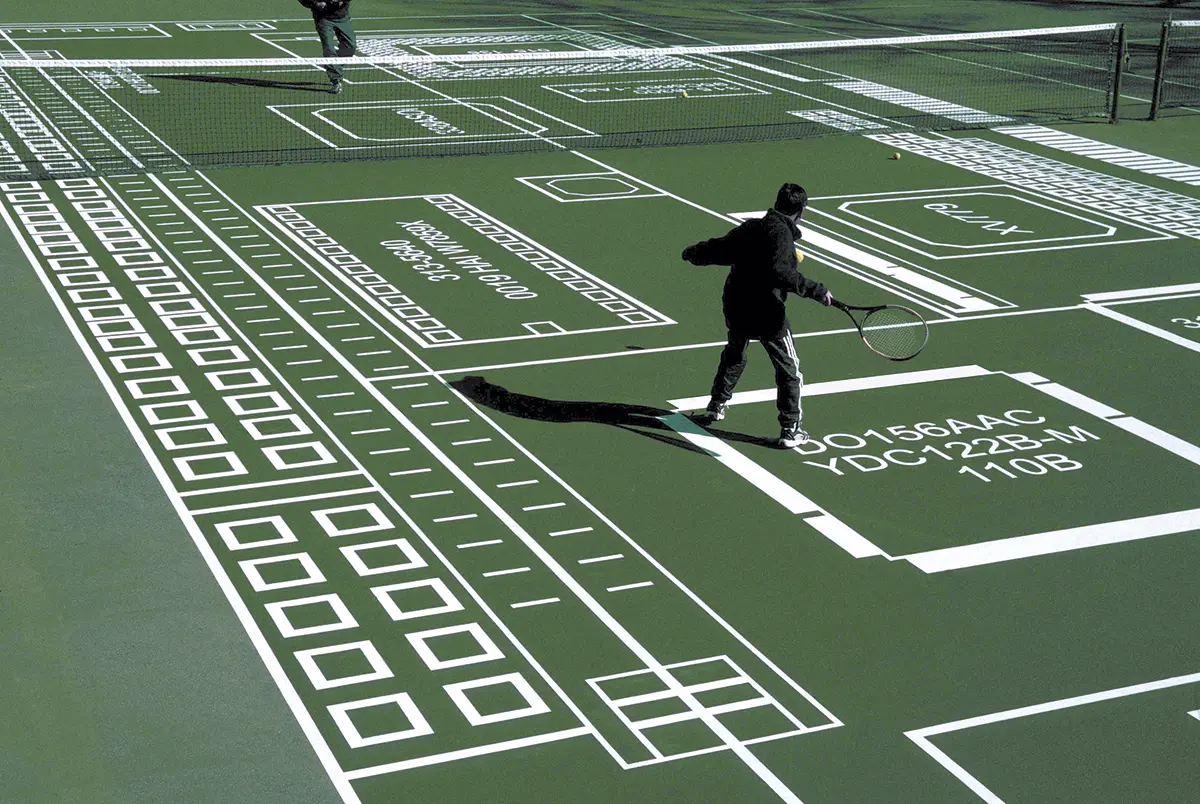
In 2001, while the artists lived in Cambridge Massachusetts, they produced Tennis Board, another outdoor floor piece. The artists translated and adapted the interior design of a micro-chip circuit board to create a pattern on an existing tennis court. With the paint used to produce the lines on a tennis court, the artists added lines, rectangles, squares, and seemingly random letters, to form a beautiful pattern in green and white on which players would be challenged to play and re-invent new rules to the game. In this work, the artists play on shifting hi-tech to low-tech as they “embed” this chip design onto the concrete surface of the court. Once again they explore the private/public dimension of art as they engage in both individual and collective action.
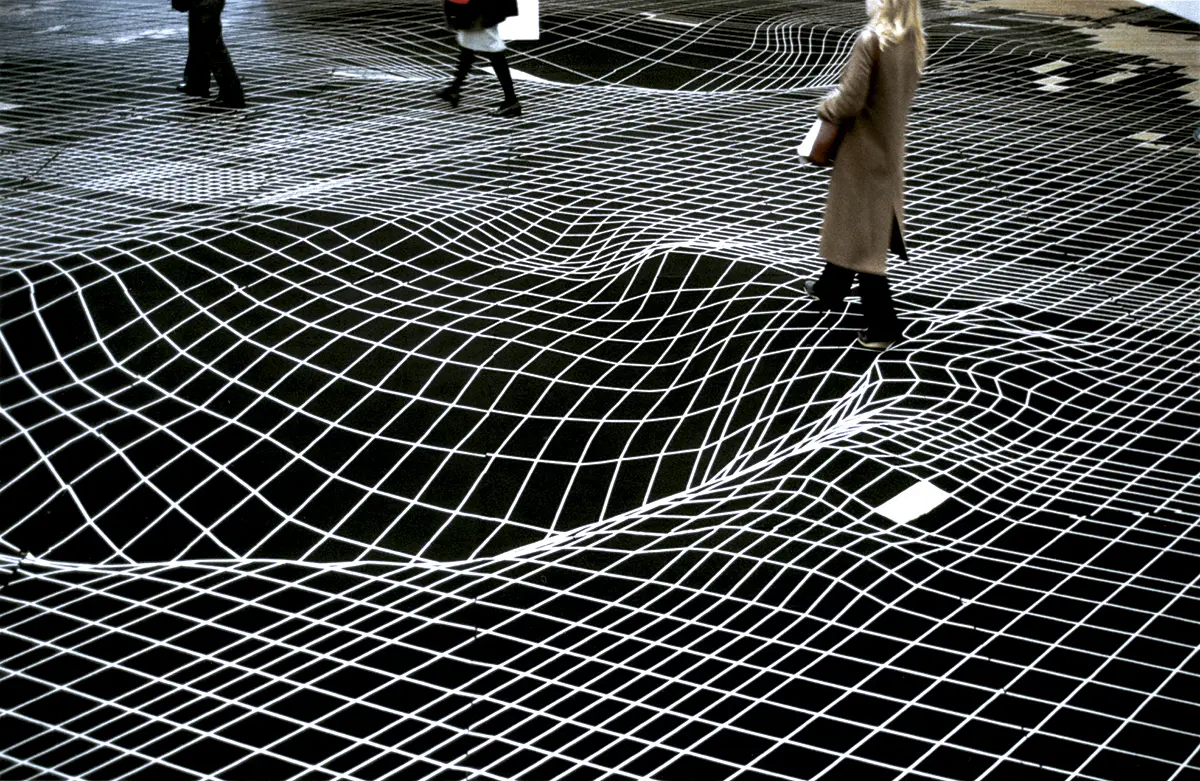
In October 2003, Allora & Calzadilla participated in Commonwealth, a group exhibition at the Tate Modern that also included Thomas Hirschhorn, Carsten Holler, and Gabriel Orozco, and focused on the collaborative aspects of each of their works. Allora & Calzadilla presented, among other works, a floor piece titled Landmark, a monumental carpet with a geometric design created by inlays and incisions made in felt. This work, on a one-to-one scale, is a two-dimensional rendering of a bombing field in Vieques, a small island off Puerto Rico and until recently used as a military practice site. Carpet-bombing actually refers to a common type of test bombing performed by the United States military on this island. The work’s title plays around with the term landmark as an indicator of reclaiming space and marking territory. It brings with it questions such as why territories are marked, by whom, how they are protected and why, why something is designated as a “landmark,” and what values come into play. In Jennifer Allora’s own words, “Landmark is a working concept we use to elaborate how land is differentiated from other land through the way it is being or has been marked: economically, culturally, politically, etc. These processes of landmarking are what constitute and define the changing status of the land.”7 At first glance, this monumental work is a clean, geometric pattern enveloping a vast area of space, but as the viewer’s relationship to the work becomes more intimate, the work begins to reveal its subversive political nature. In the same subversive tone as other works by these artists, Landmark masks deeply political subjects in a lyrical, preciously rendered work of art.
In "PRO-Active TEST-ing," an interview performed by Sophie McKinlay of the Tate Modern, even the title clearly indicates political action; when asked whether the artists considered themselves political activists, Guillermo Calzadilla answered: “What we are interested in as artists is creating a state of crisis for the very terminology (political artist, or commonwealth, landmark, etc.) and what it means, by a necessary extension and complication of its meaning, understanding, and use... We believe that this should not be relegated exclusively to marches, but should concern and be applied to all fields of knowledge. This propulsion of terminology into crisis happens through a state of permanent questioning. We believe that art has much to offer in this task, in its potential to provoke the public into a space of individual questioning about a particular subject, preconceived notions of truth, forms of representation, participation, identification, etc... At that point, it is up to each individual to decide if this self-questioning will play itself out at a political level, at a union level, at an aesthetic level, at a cultural or sexual level, and so on.”8 Upon closer inspection, the viewer may notice that Landmark’s inlaid pieces are not fixed to the floor. He/she may notice that the pieces can be lifted, moved, changed, and maybe even taken from the work. This gesture, this open-endedness is very telling as once more, Jennifer Allora and Guillermo Calzadilla offer choices to the viewers. As in all their works, they problematize the experience of viewing art, producing the possibility of restructuring and redefining form, as well as thought.
Jennifer Allora (b. Philadelphia, 1974) and Guillermo Calzadilla (b. Havana, 1971) have participated in numerous solo and group exhibitions in prestigious institutions: Institute of Contemporary Art (ICA), Boston; ARC-Musée d’art Moderne de la Ville de Paris; Walker Art Center, Minneapolis, MN; Contemporary Arts Center, Houston; The Moore Space, Miami. In (date) they participated in the III Bienal Iberoamericana in Lima, Peru, and in (date) the VII Bienal de la Habana, Havana. Most recently, they won the Korea Foundation Award at the Kwanju Biennial in Gwanjiu, Korea. Next year, Allora & Calzadilla will participate in inSITE in San Diego-Tijuana the Moscow Biennial (Dialectics Of Hope); and the Reykjavik Art Festival (Work Time/Life Time/Material Time). In 2001, Jennifer Allora studied obtained her Master’s in Science from the Massachusetts Institute of Technology in Boston after studying in the Whitney Independent Study Program, in New York, and the University of Richmond. Guillermo Calzadilla studied at the Escuela de Artes Plásticas in San Juan, Puerto Rico.
NOTES
1. David Shapiro, “Art as Collaboration, Toward a Theory of Pluralist Aesthetics, 1950-1980,” Artistic Collaboration in the Twentieth Century, ed. Cynthia Jaffee McCabe (Washington, D.C.: Smithsonian Institution Press, 1984), p.49.
2. Jennifer Allora, interviewed by Sophie McKinlay in, “Jennifer Allora and Guillermo Calzadilla, PRO-active TEST-ing,” Common Wealth, ed. Jessica Morgan (London: Tate Publishing, 2003), p. 88.
3. The artists in a personal conversation with the author, summer 2003.
4. Robert C. Hobbs, “Rewriting History, Artistic Collaboration Since 1960,” McCabe, Artistic Collaboration, p. 72.
5. Nicolas Bourriaud, Relational Aesthetics, (Paris: Les presses du reel, 2002), p. 25.
6. Salah M. Hassan and Olu Oguibe, Authentic/Ex-centric, Conceptualism in Contemporary African Art (Ithaca, New York: Forum for African Arts, Inc.), p. 11.
7. Allora, McKinlay interview, p. 85
8. Calzadilla, McKinlay interview, p. 89.
SILVIA KARMAN CUBINA
Director of The Moore Space in Miami and independent curator.