Allégories was the title of a 12-painting show presented by Carmelo Niño (Venezuela, 1951) at Espace Meyer Zafra, in Paris. These 2003 and 2004 works by someone who is already part of his country’s Art History, were in different formats, but a single concept animated them. Since he first appeared in the local scene, with his early individual exhibitions at the Centro de Bellas Artes in Maracaibo, his native city and the place of his formative period, Niño has distinguished himself as an excellent figurative painter.
His characters and scenes have always been submerged in strange atmospheres, atmospheres that are charged with a magical realism, and are sometimes mislabeled surrealist. Critics have often interpreted them as characteristic of and in reference to the peculiarities of the cultural and popular context of his native city. In any case, it can be said that Niño posits a tragic feeling about his themes. His family scenes, characteristic of previous periods, seemed filled with a certain bucolic, joyful air, but a careful study revealed in them the representation of a terror-filled world, a world threatened by unknown higher forces. These scenes are inhabited by characters, almost always children trapped in a hallucinatory universe of flying umbrellas, empty bird cages, menacing tables and chairs, a whole pictorial paraphernalia presented, both at the formal and the thematic level, as a necessary synthesis of extreme tensions between the urgency of that which must be said visually and the fascination of revealing an occult meaning.
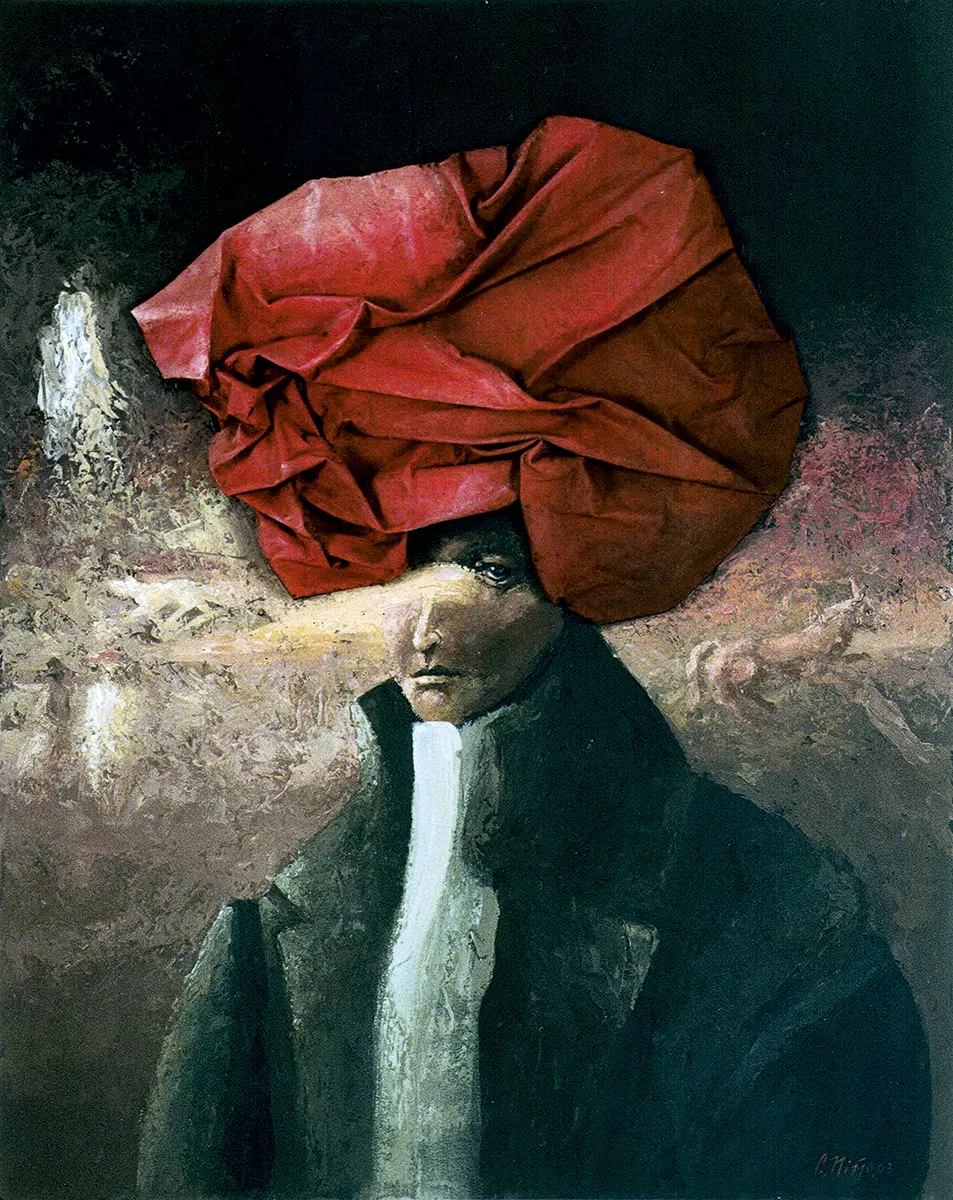
In a process of overcoming the everyday contingency of his themes and turning the landscape into yet another character of the painting, Niño, fascinated by the revelation of a given character in the foreground, begins a series that evokes a feeling of perfection. He assumes the risk and the challenge of abandoning the poetic subtlety of earlier periods, in order to plunge into the exploration of different formal elements, giving preeminence to collage formulated in pieces of cloth attached to the canvas, which folds to cover the character’s body or forms a turban around character’s the head. Niño’s enigmatic atmospheres are not lost or evaded in this series. The menacing landscape that functions as a background for this central figure, however, behaves as yet another character that helps the figure to reflect on its human condition. Formally, this difference is made evident by the sensorial opposition between the strong matter density that envelops the character, be it through a heavy brushstroke or a heavy collage, and the sfumato-like, almost abstract brushstroke that characterizes the background landscape. Niño’s technique is committed to the idea of representing figuratively the expression of a feeling.
The twelve pieces presented here exemplify the new path taken by Carmelo Niño’s work. While his pictorial markings are still recognizable, the turn has been sharp. It allows pictorial matter to gain here its own independence. The artist expresses a universe that is an allegory of itself; he burrows into the pictorial matter and explores its manifold possibilities in order to reveal and contradict the figure. A character, a still life, a harlequin, and a sunset on the beach, are allegories of a reality that exists in his imagination. Niño, as Carlos Silva writes in his introduction to the catalog, creates works that transcend their original meaning. They are testimonies of a present in which we seek to renew the visual and intellectual fields in order to reappraise painting and push it to the limits of its plastic energy.
BÉLGICA RODRÍGUEZ