
Following a tradition dating back to the 1940s, the 39th National Artists Salon was held in Bogotá. This time around the art was exhibited in different spaces, such as the Modern Art Museum, the Santa Fe de Bogotá Gallery, and the Art Museum at the National University. The Colonial Art Museum hosted a video installation by José Alejandro Restrepo; María Teresa Hincapié presented a performance at Mapa Teatro; Pedro Gómez Egaña presented his work in several Bogotá streets; and Grupo Nómada, faithful to its name, moved around the city. The distribution of works around several environments attracted a greater number of visitors compared to previous years, and it made exploring the Salon an easier and friendlier experience. It was evident that the interest in art went beyond big cities since a large number of participants came from the provinces. It was thus possible to acquire a varied, albeit uneven, panoramic perspective; the presence of several truly impressive works attests to an important and vital level of artistic activity.
The efforts to promote the Salon and bring it to a wide audience were notable. Several galleries offered shows as part of the event, which remains, alongside the Luis Caballero Awards and the Bogotá Biennial, one of the country’s most important. The state-owned TV network programmed specials about contemporary art. There were also—matching the character of many of the works that employed strongly interdisciplinary languages—guided tours with architects, psychoanalysts, historians, and other specialists. The Ministry of Culture, in cooperation with the British agency Visiting Artists, brought several curators in order to promote Colombian art and establish links between artists and various international events.

An academic forum titled “Sentidos en tránsito” (which can be translated both as “Meanings in Transit” and as “Senses in Transit”) was held parallel to the exhibitions and included foreign experts such as Karin Stengel, director of the Kassel documentary archives; Ana María Guash, art critic and art history professor at the University of Barcelona; Guadalupe Álvarez, art historian and critic from the University of Havana; Rosa María Ravera, aesthetics and semiotics professor at the University of Buenos Aires; Agustín Pérez Rubio, art critic and curator at the Museum of Contemporary Art of Castilla and León; Jorge Carvalho from Brazil; curator José Ignacio Roca, chief of temporary exhibits and museology at the Luis Ángel Arango Library; and Víctor Manuel Rodríguez, a doctoral candidate in visual and cultural studies at the University of Rochester. They shared the forum with artists like Alexander Apóstol, from Venezuela, and Elías Heim and José Alejandro Restrepo, from Colombia. In this way, the activities related to the 39th National Salon fulfilled a didactic function and served as a space for networking and debate.
The jury awarded works by Óscar Muñoz and Adriana Arenas; honorary mentions went to Miguel Ángel Rojas, María Teresa Hincapié, the Mapa Teatro collective, Milena Bonilla, and Adolfo Cifuentes.
In one of her lectures, Ana María Guash alluded to conditions of contemporary art that facilitate a reading of the works exhibited in this Salon. One of her points was that today’s art has moved away from aesthetics and closer to social problems, becoming at times a critical art that is very close to documentary. Guash also pointed out that there is now a greater interest in life than in knowledge, and a tendency to seek refuge in the body, in subjectivity, in quotidian events, and subjective experiences of several orders. This contact with the social and with everyday life is achieved through the pointing out of events that are often banal but become the detonators of complex facts where the characteristics and contradictions of the contemporary world are displayed. In the words of this Spanish critic, for today’s artists, “depth resides on the surface.”
This condition of the contemporary work of art brings to mind Susan Buck’s book The Dialectic of the Gaze. Walter Benjamin and the Passagenwerk project, in which the author claims that the notes Benjamin took for his Passagenwerk project, which promised to develop a synthesis of his thought, can be understood as “footnotes to the world outside the text.”1 This condition is equally applicable to those contemporary works of art that, as I have said, point out aspects of the world we live in. Contemporary artists do not attempt to effect a transformation of the world with their works; unlike the avant-garde, they do not want to redeem us or direct us to the Promised Land. Those two ideals are the utopian project of a certain idealistic avant-garde that is already a thing of the past. The role of today’s artists is more modest, but no less effective or necessary. Today’s artists limit themselves to pointing things out. Their images or their acts are merely the commentary that brings to the fore, through a sensible act, a condition of the world, a condition of the culture and of society, and this characteristic is shared by many works at the Salon. I will refer to some of them in the lines that follow.
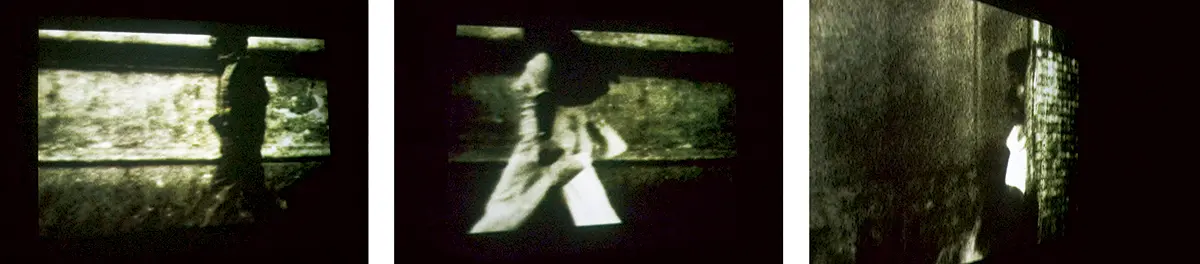
Miguel Ángel Rojas and Óscar Muñoz, two of the most experienced artists at the Salon, presented pieces that look back at their respective bodies of work. Rojas’s video, Golpe en el ojo, was one of the most complete works exhibited. Miguel Ángel Rojas is perhaps the first Colombian artist to carry out a subjective investigation in art. That subjective element is revisited in this suggestive and touching video, which refers back to one of the most significant moments in the development of the artist’s oeuvre: his photographs inside the Faenza theater in 1979. These are black-and-white documentary images showing, in the shadows, different characters in the audience of an all-day movie theater frequented by cruising gay males. As explorations with a video camera, these photographs lose their static quality; the congealed moment comes alive and ceases to be a memory, becoming instead an action that occurs in the present tense. As we hear the audio from the movie projected on a screen, the camera focuses on the details of the theater’s beautiful architecture, recreating the atmosphere inside; it zooms in on the characters, transforming the images into a kind of film sequence. An interesting effect is that the image acquires a quality resembling Miguel Ángel Rojas’s drawings and prints of the 1970s. After this sequence, a 2002 shot is inserted. In this section of the video, the camera and terribly heart-rending music2 seem to caress, crawling through the theater’s red chairs to end on a phallic-shaped staircase. After such a heartfelt, intimate encounter with the place, where the image is given a reddish atmosphere, the camera moves back and captures another black-and-white image: the figure of a solitary person in the audience. Focus, lighting, and the loneliness of the character all seem to indicate that twenty years later things have changed significantly. This piece is deeply committed to Miguel Ángel Rojas’s subjective gaze, finding the entirety of its meaning in that exploration and reversion to the other, as he points out the changes that occurred since the 1970s—a decade that is already part of our history—in that subjective journey. Miguel Ángel Rojas’s pointing out is imbued with a touching affective tone that retains its relationship with that old condition of art being the expression of feelings.
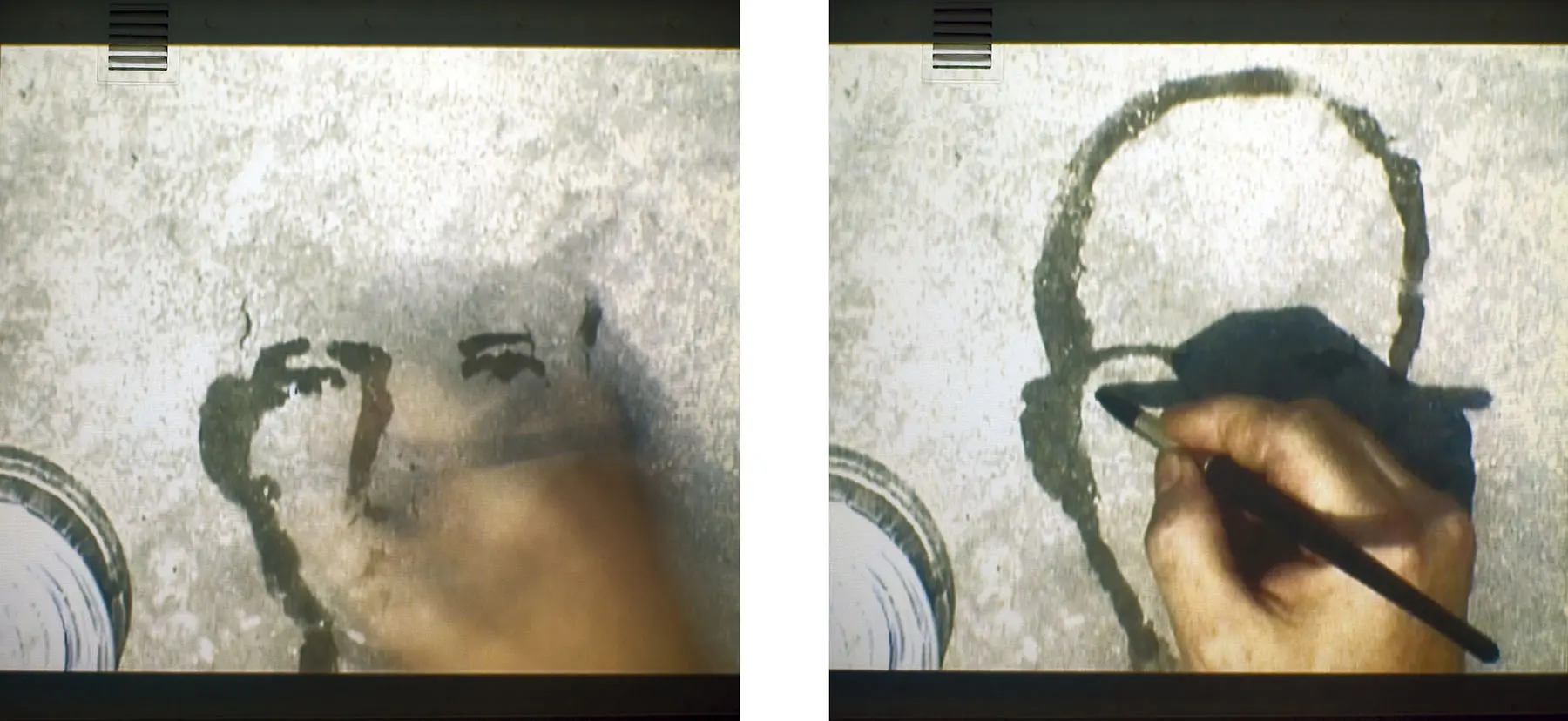
Óscar Muñoz’s Retrato is a video that shows how the artist draws, with a brush, a face that can be his, on a porous material that absorbs ink quickly, so that as he finishes the figure the initial lines have already disappeared. In this way, when a portion of the drawing has vanished, the line starts again, generating an impossible image, an attempt at drawing that repeats itself to infinity. This piece harks back to the vanishing drawings that the Cali artist created using the viewer’s breath, in Aliento, and coal dust, as in his series of the Narcisos. His comments highlight the act of drawing in the drawing itself, which has been a constant in his work.
Adriana Arenas received an award for a new version of La fábrica de oro y piedras preciosas, a video installation that recreates the lights in a discotheque as they gyrate in front of a TV screen, in which we can read, in English, the lyrics of vallenato songs. This language switch is very effective, altering as it does the meaning of the elements to refer to the many Colombians who emigrate and leave behind their values and their culture, in the illusory search for a new and better horizon.
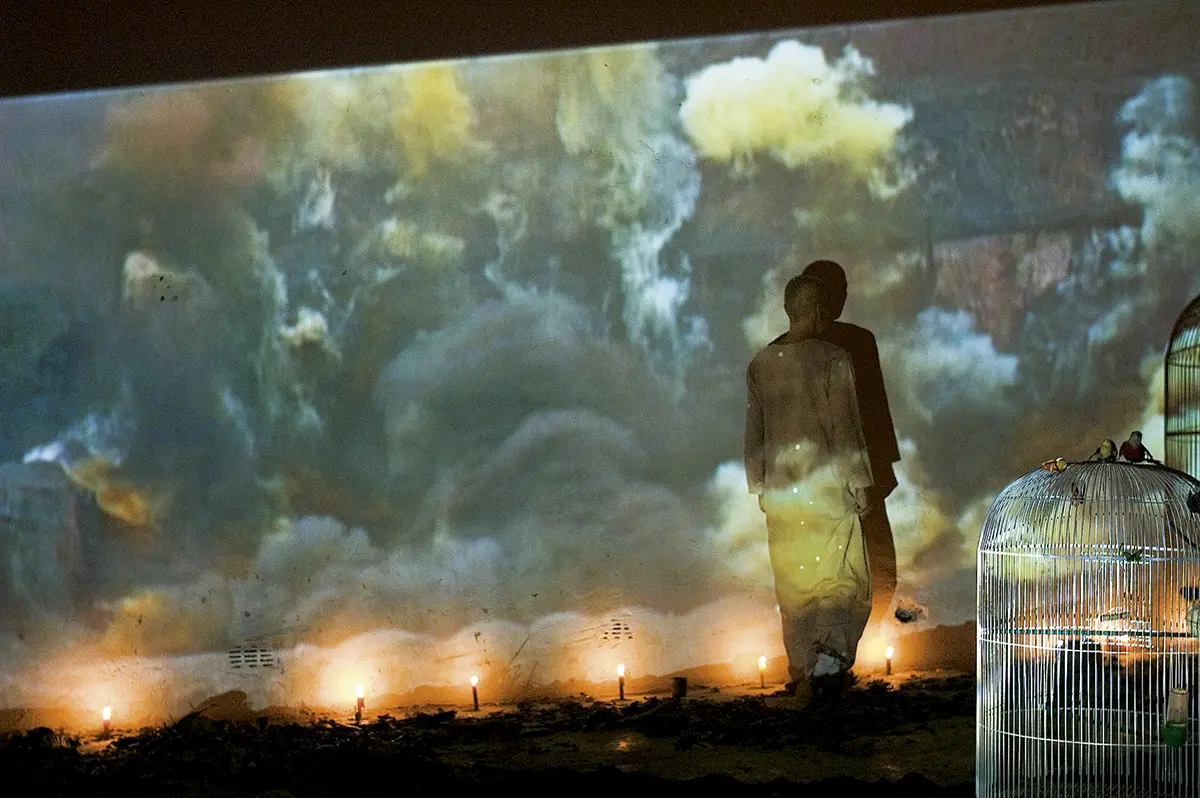
Another forceful piece was María Teresa Hincapié’s performance, El tiempo se mueve despacio, executed over periods of twenty-four and twelve hours. On this occasion, María Teresa Hincapié used, as an integral part of her action, live music by Santiago Zuluaga3 and a projection of images from Baraka, a Ron Fricke movie that through a variety of sequences explores the mechanistic character and the speed of modern life, images that contrast with those of landscapes and of the ancestral, sacred rites of several Oriental societies. The sacred and the profane, issues that have been at the core of her art, are thus brought to the foreground. In this action, María Teresa Hincapié’s movements are minimal, yet her presence is undeniably strong. This presence points out, in a forceful way, the meaningless cruelty, dehumanization, and massing of the world. The artist remains almost still in front of the images. “And unknowingly we remain quiet, still, isolated, in a loneliness that nevertheless does know, that is there to teach us,” we read in a text written by María Teresa Hincapié precisely for this piece. Throughout the performance, there are moments of great beauty and force, for instance when the shadow of the artist is projected on a landscape or when, in a kind of prayer, her arms join the raised arms of a multitude. There are also moments of coarseness, as when her figure remains perfectly still during a sequence of images that show little chickens handled as objects of mass production, or when she stops before an endless line of airplanes or a street traversed by speeding cars. Her still body is in itself a commentary, “a footnote,” to the world outside. Her committed attitude becomes a silent note that unveils the condition of the contemporary world. Her position regarding art and the world has been one of resistance, and her action reaches beyond art to become an attitude towards life that in her performance work is genuinely affecting. Thanks to its great force, this performance was one of the most memorable works in the Salon.
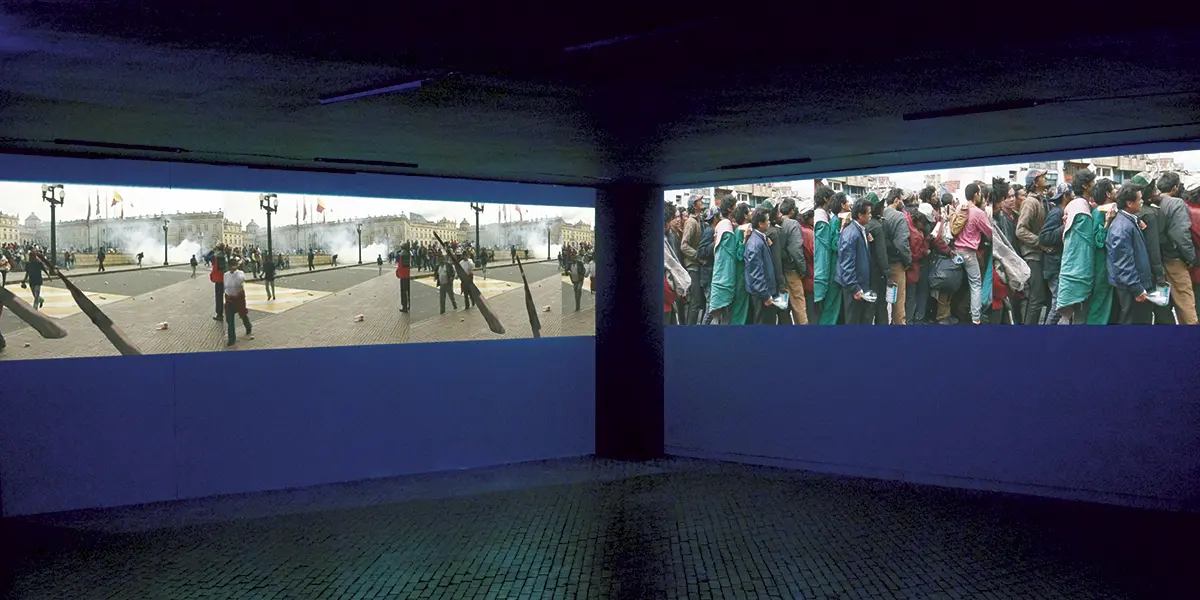
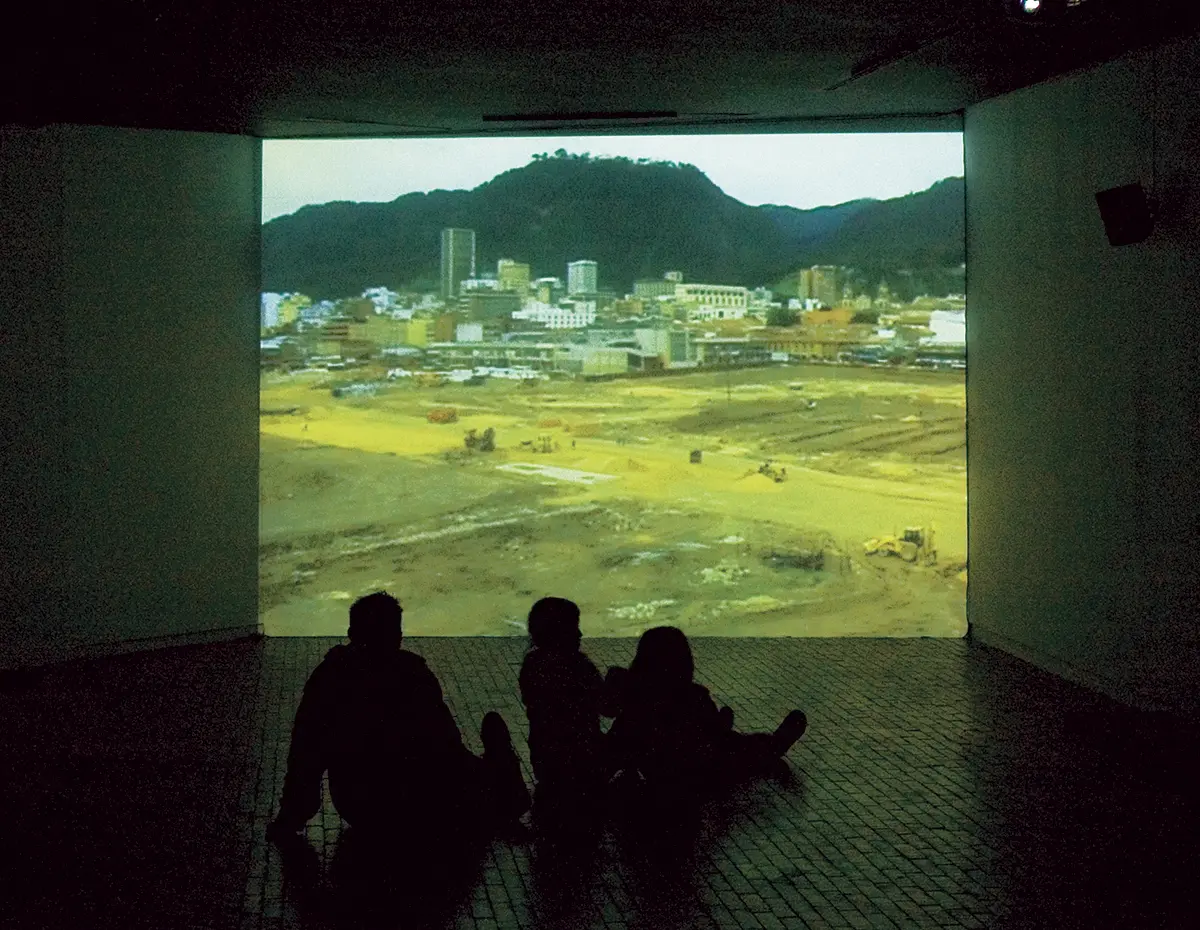
A theme that recurred throughout the show was that of the city. The Mapa Teatro group, headed by Rolf and Heidi Abderhalden with the participation of Luis Maldonado, José Ignacio Rincón, and Rolando Vargas, presented two video installations titled la limpieza de los establos de Augías. This piece originated in a project titled Prometeo, created with the Office of the Mayor of the city of Bogotá when the Santa Inés neighborhood, better known as El Cartucho, home to a large community of so-called marginals, was torn down. The activities of Mapa Teatro with the people of El Cartucho sought to trace the collective memory of one of Bogotá’s most traditional neighborhoods through oral histories about the life and experiences of its inhabitants, registered in video. The idea of memory is also essential to the piece presented for the Salon. Memory is “spatialized” in two locations, Parque Centenario, formerly El Cartucho, where a series of television receivers were placed on the wall that surrounds the new construction, showing, in a loop, the neighborhood memory through the narratives collected for the older project, while at the Museum of Modern Art, people can see live images of what is happening at Parque Centenario. The monitors at the museum show people in real-time, walking by the park and coming close to watch the videos; another projection shows, also in real-time, the progress of the new construction. This placement creates a tension between what occurs in the museum and what occurs in the city, between the memory of a lost past and the action of machines as they create a new, “progressive” face for the city. Both projects adapt myth in order to point out a social circumstance in the city. The dark, sometimes painful past of the people of El Cartucho is paved over by the vast expanse of a soberly designed park. Mapa Teatro inscribes, with the stories that break through to this new urban space, the memory of a disappeared past. Their intervention attaches itself, like a footnote, to the city and its memory.
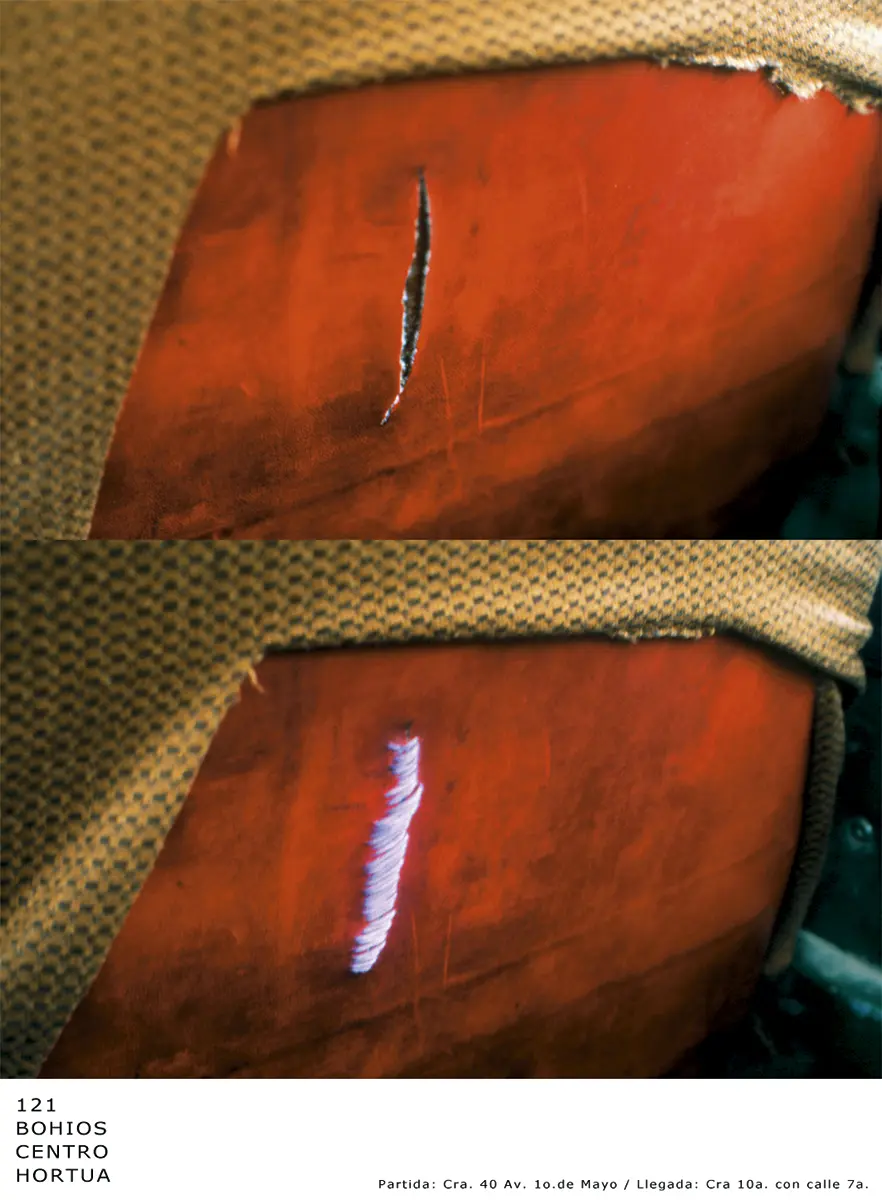
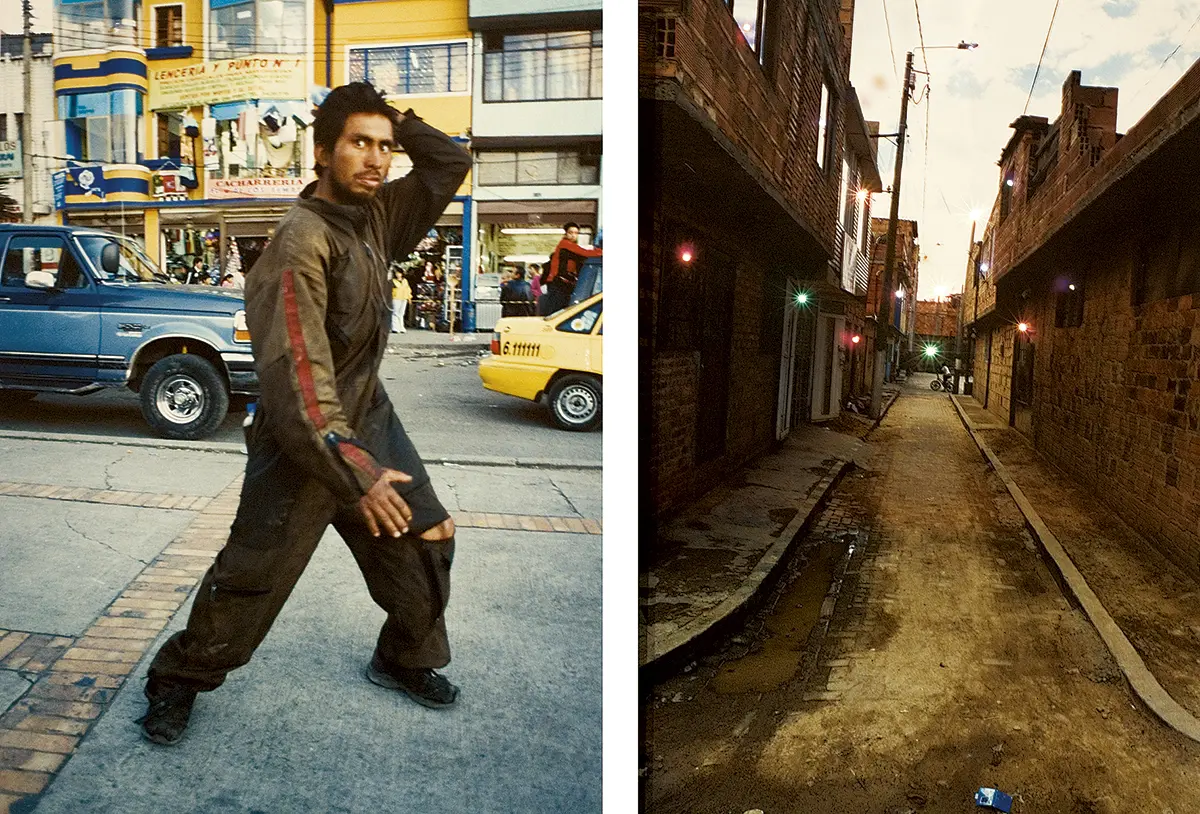
La vida es una pasarela, a photographic work by Jaime Ávila, also points to social problems generated in the city. Ávila had a number of homeless people pose for his pictures. The viewer could also read a guide that details the experience of photographing these characters and a brief biography of each of them. Narrative and image bring us face to face with the human drama of hundreds of people. Ávila’s commentary accompanies the images, expressing in a very direct way feelings of rage and impotence awakened by the reality of his “catwalk models.” A dense and conflicted semblance of the city is also present in a new version of Cal y canto, by Clemencia Echeverri, a video installation that presents sequences of a breakfast offered by the mayor’s office to the inhabitants of El Cartucho. In this new version, simpler in its mise en scène,4 the focus is on place in stretching the images’ time and in following the objects that circulate in the meeting: knives, guns, and bottles of glue (used as a narcotic) move slowly across the projection. Handled at this slow speed, the objects become signs by which Echeverri’s pointing out the circumstance of her characters is made even more explicit. Yet another face of the city is revealed in José Fredy Serna’s photographic register, an on-site piece titled Dos muros. On the back of a building, beyond which are the shanty towns of Medellín, the artist reproduces the impressive texture of the urban landscape that expands as a background for the city. The precarious constructions become the tight texture of a dense city with a huge population comprising displaced citizens in particular. Also on the urban path is Milena Bonilla’s Plano transitorio. This piece is a bus tour the artist made of a large section of the city, following different routes; in this mode of transportation, it is common to find that the back seats have been cut open. In her journey, the artist carefully repaired these “wounds” with fine, delicate stitches that created a drawing. In order to differentiate each route she used threads of different colors; thus, some trajectories are characterized by blue thread, other by pink, green, or yellow. Next to the photographs the artist displayed a map where the different routes have been traced with thread of their corresponding color, using the corresponding kind of stitch. In a subtle and quiet way, this delicate work points out and “repairs” the acts of vandalism and violence that are so common in a city like Bogotá.
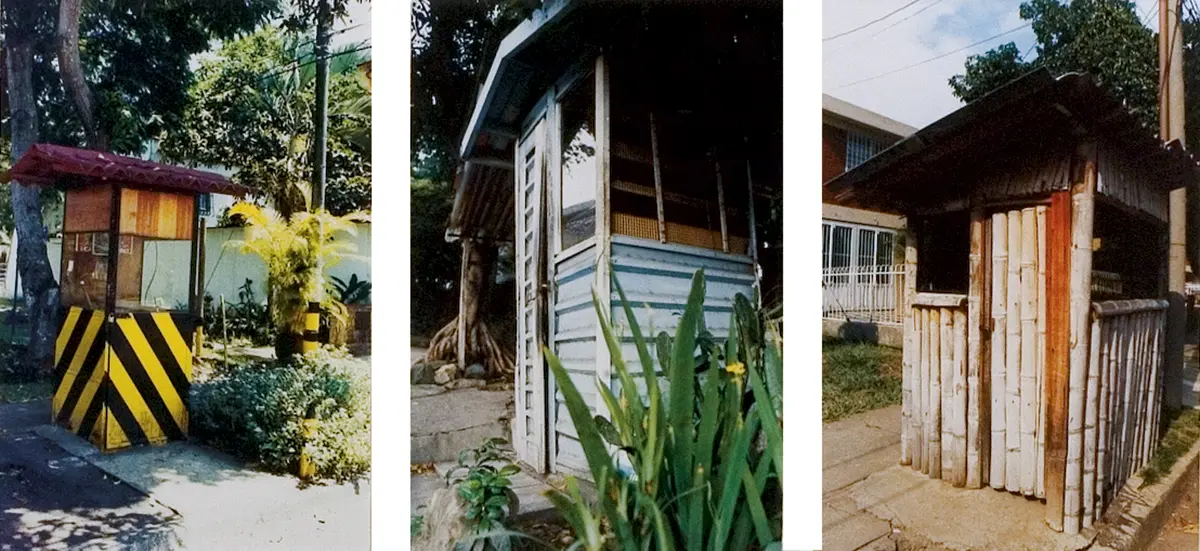
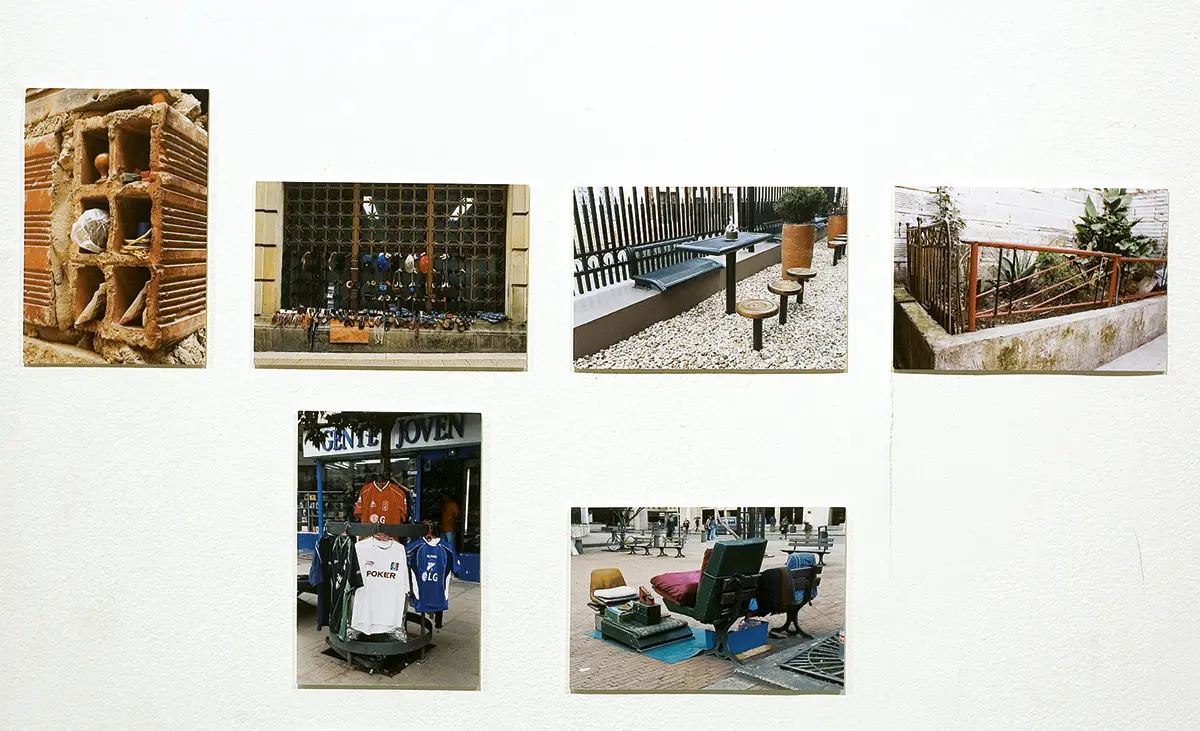
As I mentioned before, for a large number of artists “depth is on the surface,” and many of them use photography to point out aspects of urban life related to taste and to different socio-cultural conditions. To this group belongs Alberto Baraya, who presented, in Una taxonomía para los herbarios de plantas artificiales, done in the manner of the illustrations for the botanical expedition, an impeccable series of photographs of plastic flowers that are used to decorate interior spaces. This piece also points out elements of the scientific paradigm: next to the photographs there was a complete archive documenting the origin and characteristics of these plants. The Bricollage collective—Pablo Adame, Sandra Mayorga, and Carolina Salazar—showed a series of documentary photographs that reveal the ingenuity of people who, lacking resources, use the oddest objects to build furniture, make tools, and decorate; humor, creativity, and sometimes sheer extravagance are present in these images, where objects tend not to be what they seem. Ángela María Baena also works in documentary photography, depicting the alterations suffered by watchmen booths in the city of Cali; these are strictly regulated in terms of their construction and appearance and yet they are very different from each other, according to the neighborhood and the needs of their users. María Isabel Rueda presented a series of photographs of young people wearing t-shirts with the picture of Che Guevara. This almost-mythical figure of the Cuban Revolution is remembered as an anti-imperialist symbol, but in this age of “mechanical reproduction” he is a revolutionary hero whose visage is reproduced throughout consumer society; he is, as the title of this piece had it, Lo uno y lo otro, one thing and the other at once.
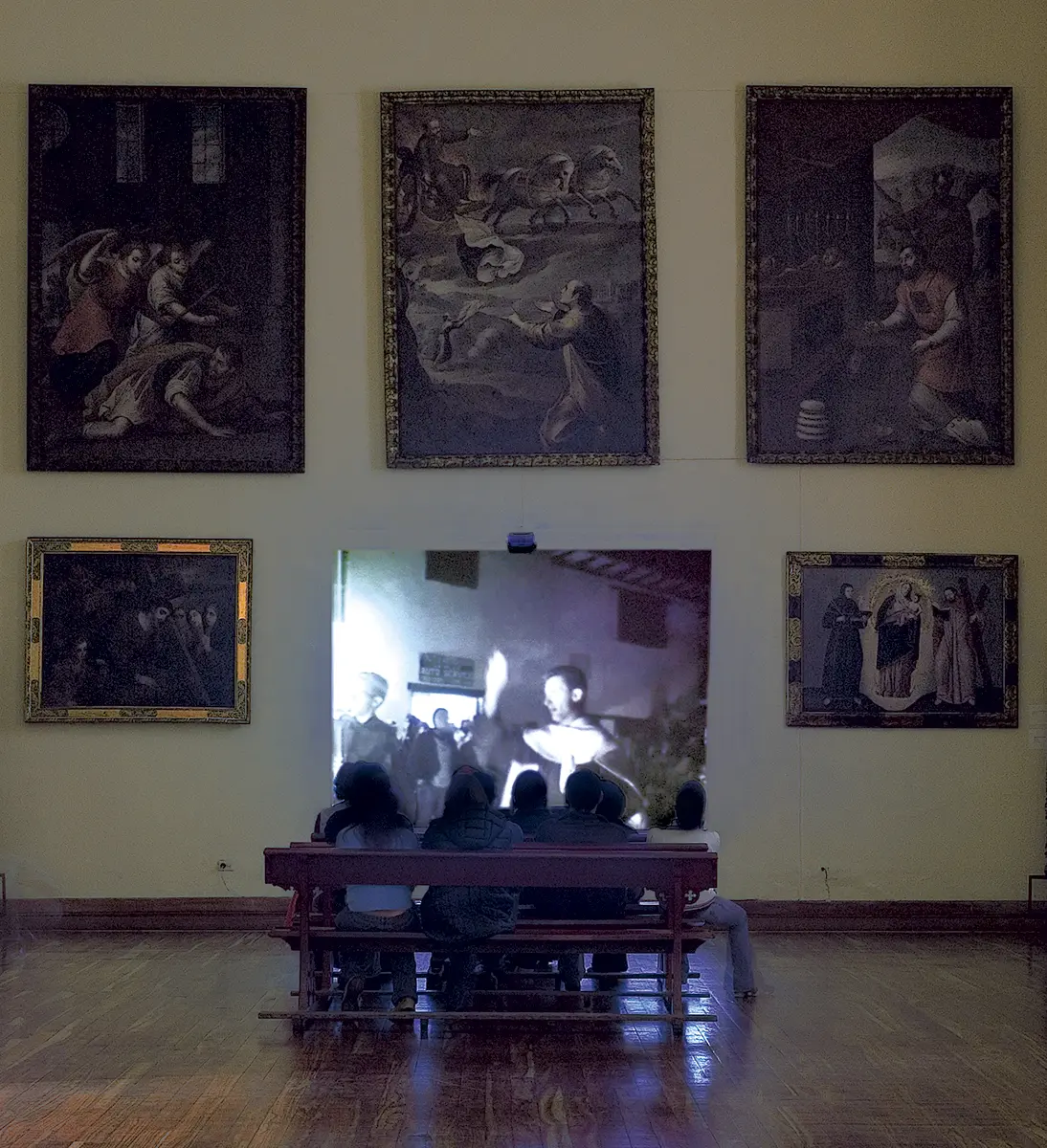
José Alejandro Restrepo’s Santoral presented a series of fragments taken from newscasts and other TV shows that illustrate the mistreatment and torture to which the body is subjected, be it due to a guilt-inducing Catholic education, or as an act of “purification” for the Holy Week celebration, or in other religious festivities. Still, others mistreat their bodies as a spectacle. By presenting this video at the Colonial Art Museum, filled with religious images that allude to self-flagellation specifically, the meaning of the images is reinforced. The crudity of some of these images makes their reception difficult.
Contemporary artists are urban beings. Their gaze, deeper and more perceptive than that of common men and women, is trained on life, on everyday experiences. Their actions are often subtle and quiet, at times filled with humor and irony, at times at a more transcendental pitch, and confront us with the shape of the world in which we live. The importance of this salon resides in the potential we have to meet, to identify with those meditations, with those acts of pointing out that takes place in the different works. The contemporary work of art appears before us as an event in need of deciphering, an open event, and that very openness reveals the world, in all its aspects and its horrors. Today’s art, through its many media, gives us an awareness of the place we inhabit.
NOTES
1. Susan Buck, La dialéctica de la mirada. Walter Benjamin y el proyecto de los Pasajes, (Madrid: Visor, 1995).
2. Miguel Ángel Rojas took a Vivaldi piece, inverted it, and worked on it to create a tremendously sad sound that is as creaking as it is melancholic.
3. Santiago Zuluaga, a composer who graduated from Universidad Javeriana, is the son of María Teresa Hincapié and has accompanied her in other performances.
4. At the Museum of Modern Art of Bogotá in 2002 and later at the Eafit Hall in Medellín, this installation was presented on screens that constituted the sculptoric body. See Arte en Colombia 99.
*All images illustrating this article are photographs by José Tomás Giraldo.
MARTA RODRÍGUEZ
Proffesor at the Arts Faculty of Universidad Nacional
de Colombia, Bogotá.