
The social jokes produced by Guatemalan artist Darío Escobar in his works are so serious that, instead of triggering our sense of humor, they provoke thought in the mind and conscience of the public. By reconfiguring objects in order to displace their original identity, Escobar achieves a conceptual mode through subtlety and irony. His synthesis is loaded with symbolisms and meanings that offer relevant critiques of the contemporary social environment. Escobar’s ingenuity is uncommon in the context of Latin American art, particularly in Central America, where insubordination and rebelliousness toward consumerist society have perverted the conceptual art movement. Such insurrections have driven many artists to create superficial, often immature works that, lacking in subtlety, easily fall into mediocrity and triteness. His little McDonald’s cups with elaborate baroque decorations in gold inlay, and the soldier that replaces the ballerina in his music box, are some examples that have introduced Escobar’s voice to the art world. His voice, shaped both by his philosophy studies and the social context in which he grew up, can denounce the global consumerism that is doing away with the roots of Latin America’s cultures: indigenous peoples eating hamburgers with fries and ketchup, sporting a paint of Nike shoes, while their land is turned into shopping malls. Escobar is a cultural fertilizer, both for the viewer’s conscience and for the current development of conceptual art.
In his first individual exhibition in the United States, presented by the Karpio + Facchini gallery in the Wynwood Art District, Escobar takes a step —and a large one— in an unexpected direction. I don’t mean to suggest that Escobar is a predictable artist; on the contrary, he never ceases to astound. OUT! is the title of the show, an arbitrary shout that refers, beyond its literal meaning, to the referee’s call in baseball, basketball, volleyball, and soccer games when the ball leaves the field. And this is precisely how, presenting 13 works (11 intervened objects and two groups of paintings on canvas,) Escobar takes this exhibition outside its playing field; accustomed perhaps to the way in which he has used objects to create metaphors and spaces for almost-literal readings, the artist chooses productions that allow multiple readings within a world of illusions. His reconfiguration of objects remains the same: Escobar uses ready-made to absorb his viewers and turn them into his accomplices in the aesthetic manipulations that help undo the notion that lies behind the object, in this case, the concept of the game.
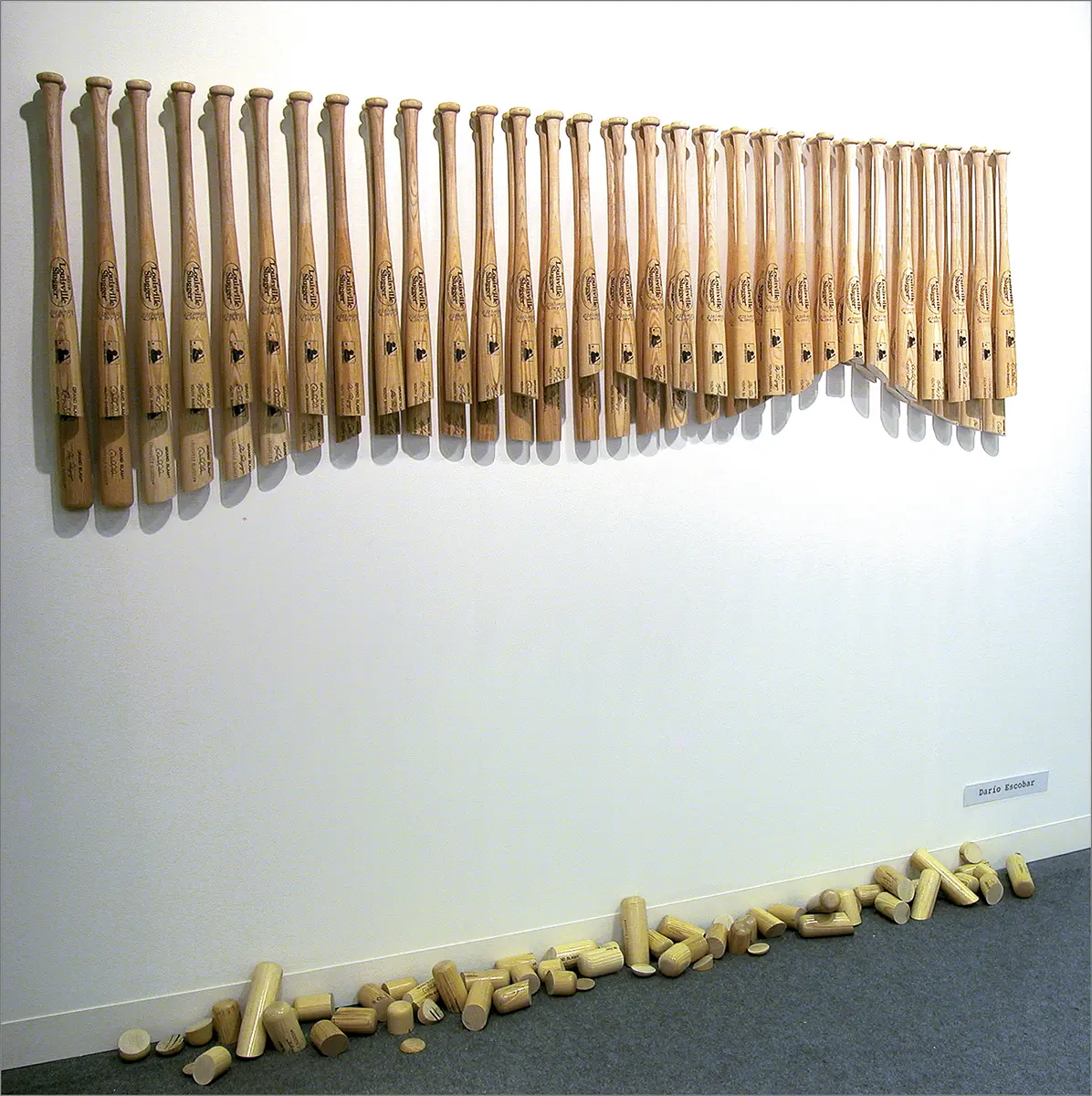
Inside OUT!, we find ourselves, rather like Alice in Wonderland, in a world of absurd instructions, filled with games that are impossible to win —games that are impossible to even play. By reconfiguring the concept of the game, Escobar's mission as a referee is clear: he gives the orders, and the possibility of winning simply doesn’t exist. The artist distances toys and games from their goals and invites us to experiment with an impossible childhood (although, in principle, the games of basketball and soccer have always been for adults.) In his world, topspins do not spin, skateboards do not roll. Kicking his soccer balls is impossible, and the nets in his basketball rings become a labyrinth with no exit.
His series of topspins —two groups with five tops each— are mutant artifacts that form molecular compositions when joined by a metal rod. The skateboard with glowing green wheels has been devoid of its purpose by being dislocated into five parts joined together with hinges. These hinges make the piece flexible, and function as a prosthesis that would fix the broken structure but can only be a mediocre consolation since they obstruct the necessary freedom it would need to once again work as a vehicle of any kind.
More than 100 soccer balls are sewn to each other to form a single, colossal ball that hangs, deflated, from a wall, proclaiming in silence its useless existence and the hopelessness of its current condition. A similar ball is on the floor, holding in its flaccidity a normal-size ball that has been plated, which gives it an appearance of cheap futurism. The polarity between the deflated giant ball and the silver ball is a path to reflection: it would seem that technology —represented by the silver ball, which resembles a bullet— ends up deflating the splendor of the soccer subculture.
A soccer shirt with red marks left by balls in its front becomes a kind of shroud of Turin. The shirt is presented as a sacred object thanks to the story it tells a story of winners and losers, with the wearer of the shirt becoming a kamikaze capable of anything in order to achieve triumph and die in a blaze of glory, his ego satisfied with his crowning as a victorious hero. What’s ironic is that inside the world created by Darío Escobar, there are no winners. Does this mean that we all lose before the game has even begun? Or, from a more positive point of view, could it be that in a world without competition, we are all winners?
There are two interpretations of basketball rings in the show: one with baroque carvings as ornaments —a kind of silver filigree, characteristic of previous works by the artist— which transform the ring into a sort of trophy made to seduce the viewer and to intimidate the player with its luxurious indiscretion. The other ring is conjoined: two rings are attached to one another by a shared net, which holds prisoner two basketball balls, like flies trapped in a spider web. The hope of scoring is thus defeated, trapped by a trickster net that defies the concept in physics that states that everything that goes up must come down.
A similar provocation against physics is found in Escobar’s simulacrum of an abacus in ruins. His use of space in this work betrays the artist’s education in architecture. Each metal rods are inverted vertically, creating a building of about four meters in height. Traversing the rods, which are at a certain distance from each other, there are deflated plastic balls, paralyzed by perforations that make it impossible for them to move in any way. The structure itself simulates an abacus, a historical instrument the current function of which is to introduce children to the concept of mathematics. The abacus has been separated from its function, becoming sterile, without producing any additions or subtractions.
Escobar interrupts logic and pushes rules and pragmatism out of the playing field. His games contemplate social semiotics, inviting us to enter a world where the dominant mode is to be outside the ordinary —a world where being OUT! means being IN, a word used to acknowledge an elite, a selected minority of those who belong and are part of an exclusive social space. Once again Escobar’s sarcasm invites us to become his accomplices, and we opt for jumping into the same hole into which this rabbit has jumped, to arrive, through a different route, to the same place where Escobar is always taking us to the end: the place of insubordination.
CARINA GALLEGOS