
Tension: For weeks the word and sentiment linger in one’s body and mind after visiting the Edgard de Souza exhibition on view until November 14, 2004, at the Pinacoteca do Estado de São Paulo, one of São Paulo’s most striking exhibition spaces. A Voluta e outros trabalhos was curated by artist and independent curator Adriano Pedrosa and is de Souza’s second panoramic exhibit in Brazil, the first held in 2002 at the Museu de Arte da Pampulha (MAP) in Belo Horizonte, also under the keen eye of Pedrosa. The Pinacoteca version shows approximately 30 works produced between 1989 and 2004, from sculptures, objects, and floor and wall pieces, to several photographs distributed in the majestic octagonal space at the heart of the building and its annex.
The visitor enters the monumental site and heads over the central metallic bridge, at the end of which, out of the corner of one’s eye to the right, a pearly-cream-colored anamorphic object on the bare brick wall announces the entrance into de Souza’s domain. The strategically placed wall piece is the first in a series of similar works that impart a Batallian sense of bodily excesses in what I consider an inquisitive dialogue with surrealist notions of basesse and the informe.
The series of Gotas, or drops, and untitled wall pieces produced over the years are particularly interesting in their discrete yet powerful presence as a unit, connecting all works in the exhibit formally and metaphorically. The wood and lacquer drops give in to their sensual and sinuous form and their installation at varying heights on the walls suggests the body-like nature of the anthropomorphized exhibition space, leaking fluids from fissures in the gently tensing structure.
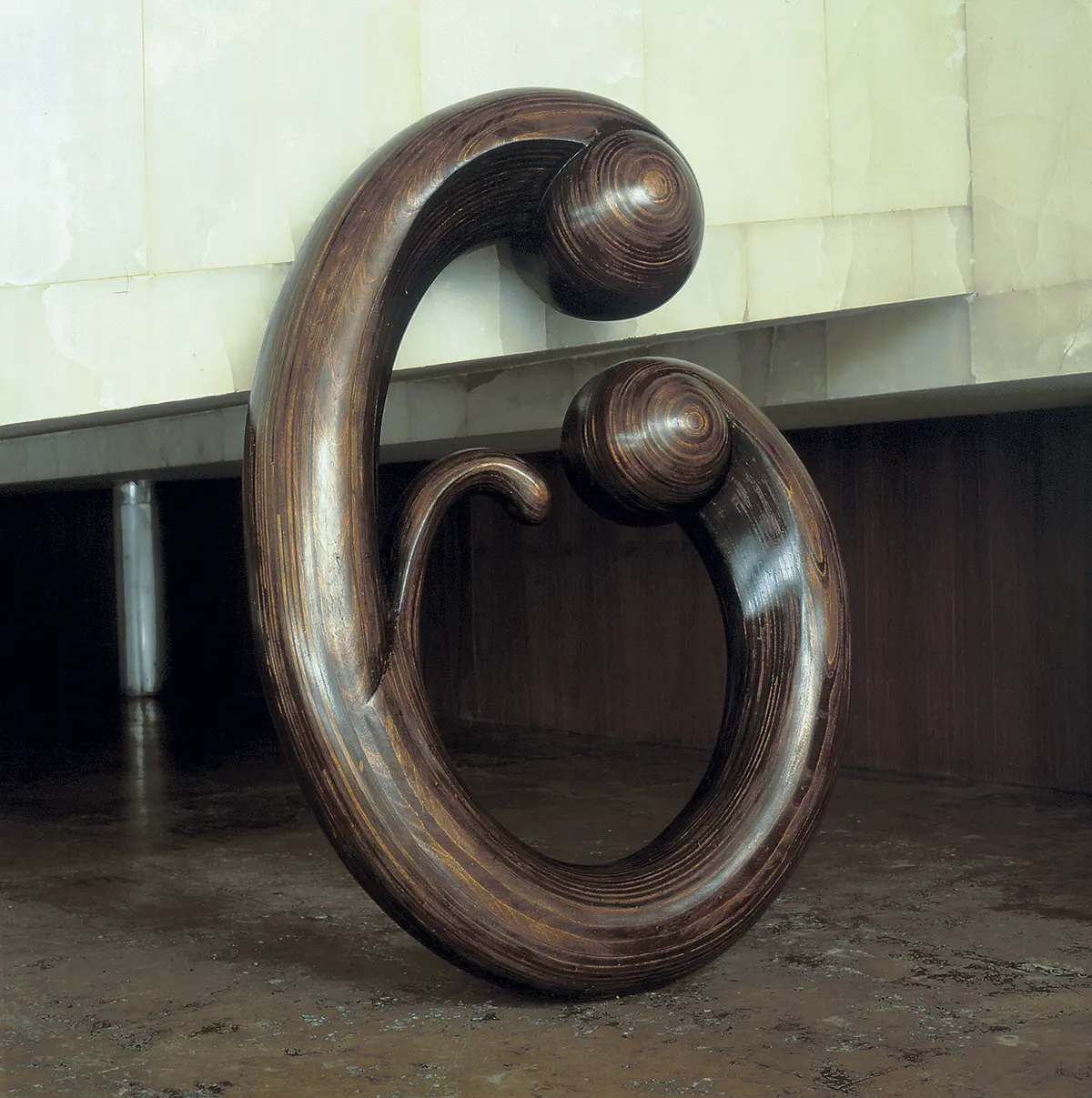
Voluta (1989) sets the tone of the show. The sensual dark wood curves and spirals convey art deco; however, there is no denying their bodily nature in this context. Organic and sexual, Voluta, a magnified pubic hair, sets the precedent for the oozing drips, both formally and conceptually; it is placed on the opposite side of the room to Coelhinhos (1997), a couple of rabbit-hair pillows in a vitrine, which evoke Meret Oppenheim’s 1936 Object (Fur Breakfast), and draw the spectator deeply into the psychoanalytic fetishized feast that the show stimulates.
De Souza’s investigation and evocation of the senses, memory, and notions of identity is compelling since at a glance we are confronted with the familiarity that his works evoke, be it an accurately sculpted body as in his bronzes, a giant wooden and gold-leafed orange (Laranja, 1990), or a duck head with a pierced bill (Pato c/ Piercing, 2001). But as soon as the eye is given enough time to see and assimilate, the feeling conveyed is one of estrangement, conjuring the uncanny.
Traditionally, sculpture functioned as a form of recognizing and claiming the divine, and immortalizing the subject in the world of the living, which suggests the subject’s death and/or its physical unavailability to the viewer. De Souza’s bronzes are almost classically Greek in nature; although headless, they miss the disciplined clarity of an Apollonian man and an identity. These classically beautiful bodies (modeled on the artist’s own) conjure meaningful disarray and create tension; the male body is the “other,” and erratic in a domain where bodily fluids ooze and traditional body politics is estranged and convulsive. There is no trace of a specific identity and the male figures, at times individual and at others morphed into their double, always seem to be about to split at the seams and spill into their surroundings; the surface is tensed to its limits.
A Voluta e outros trabalhos is a disciplined and tightly bound show, yet laced with ambiguity, the uncanny and throbbing raw sexuality painfully waiting to be physically projected into its surroundings. Visually coherent, the distribution of works in the two designated areas allows both a formal and conceptual dialogue between each other and their environment.
De Souza, like many current Brazilian names in the art circuit, is a Fine Arts graduate of Fundação Armando Álvares Penteado (FAAP). He participated in the 1991 and 1997 Panorama at MAM-SP, was in the 24th Bienal de São Paulo in 1998, and has exhibited widely abroad where he had solo exhibitions in Madrid, New York, and Amsterdam, to name a few.
CAMILA BELCHIOR