
Distinguished in general for the
monumentality and conceptual thickness of his painting, Venezuelan artist
Eugenio Espinoza executes a turn towards the private in Tequeños, an exhibition at the Museo de la Estampa y el Diseño
Carlos Cruz-Diez and curated by Susana Benko. The show gathers a series of
works on small wooden tablets, in which the artist recreates, nostalgically,
moments of his own career. Works, environments, and characters that are
intimately associated with his own creative explorations acquire a
psycho-poetic dimension and shed new light on the circumstances of their
emergence.
In their tiny scale, these pieces allude humorously to the tequeño, a soft snack made with wheat flour with a cheese filling, commonly used as an accompaniment for drinking on social occasions. More than just alluding to the local cuisine, Espinoza’s “pictorial tequeños” work as a kind of substitute homeland. The artist’s homesick gaze is trained not only on a past spanning three decades but on his current circumstance as a resident in Florida, USA for several years, a long period during which he had not shown his work in his native country.
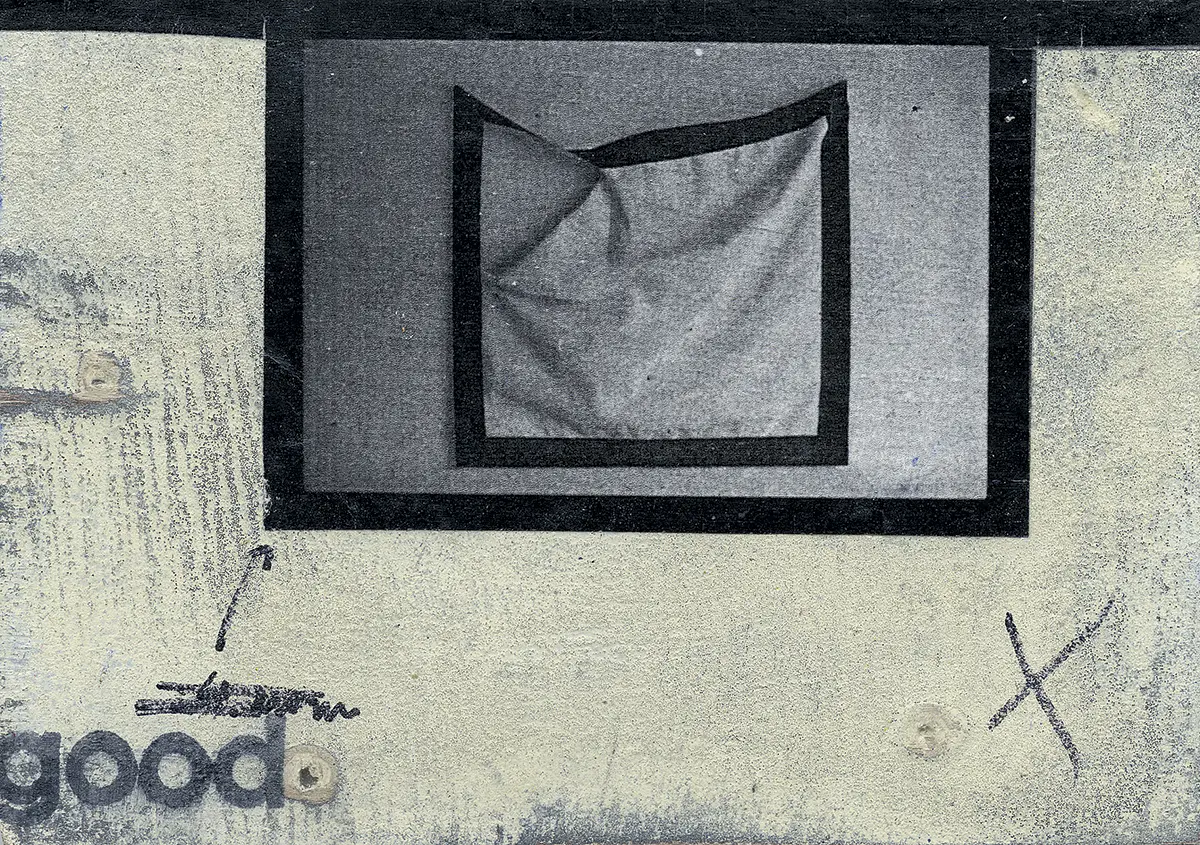
In art, as in high cuisine, ingredients are mixed to create an outcome that is pleasurable both to the palate and to the eyes. Following his own recipe, Espinoza’s tequeños are made with fragments of his artistic biography, skillfully arranged through photocopied images, texts, and brushstrokes. Their center is filled with allusions to his Impenetrable (1972,) as well as to the series Karakana (1985,) Paramout Picture (1988,) Autoabstracción (Self-abstraction, 1991), Línea Blanca (White Line, 1995), and Corozopando (1998.)
In his tequeños, as in the series just mentioned, there is a contradiction between geometry and gesture, rationality and anarchy. The expressive resource of a tense oscillation of antithetical forces is deployed to sustain the expectant vitality of the whole proposal. Containment and violence, drives that owe the respective fixity to the grid and the blob, are the protagonists of a duel of sensibilities in conflict.
Always unsatisfied with canonical judgments, Espinoza promotes the coexistence of diverging notions, from the most extreme subjectivity to an extreme intellectual sophistication. Similarly, he takes advantage of the ambiguity effect generated by the alternated use of mechanical reproduction techniques and artisanal procedures. The transition from photocopy to painting and collage violates a whole constellation of principles associated with the craft, skill, and originality of the work of art.
Something else that needs to be highlighted in the pieces reviewed here is Espinoza’s evocation of the Reveronian legacy, especially regarding the pitiless whiteness that atomizes all visible bodies. In Espinoza’s case, whiteness is an erasure on the basis of which an attempt is launched to rebuild the landscape of memory, where some events are left exposed to the gaze while others remain hidden from view. The meaning of this quest covers wide sections of the pictorial surface, eventually eroded by holes, tracings, annotations, and cracks.
Adjectives such as good, best, better..., textual motifs strategically disseminated, in English, throughout the series, constitute a reaffirmation of creative criteria or solutions in a moment of critical and affective lucidity. Persistent, self-critical, with a sharp sense of humor, Espinoza comes back to his main obsessions. This is, in consequence, a synthesis; a kind of inventory of satisfactory experiences and emotions, where the main achievements of an artistic credo are incarnated.
FÉLIX SUAZO