Gabriel Orozco: Extension of Reflection, recently on view at the Hirshhorn Museum, featuring 34 of the artist’s color photographs made from 1989 to 2003. Taken in Mexico, Brazil, New York, India, and elsewhere, the photographs reflect Orozco’s preoccupation with spheres, circles, and voids; with rules and games; and, as Mia Fineman writes in her catalog essay, with “the enchanting oddness of everyday objects."1 But there is also a melancholic aspect to the exhibition where the absence—of people and of fixed and/or stable places—is an undeniable presence.
Breath on Piano (1993) records the fading mark of air left by a person who exhaled on the shiny black surface of a piano. No person is present, and soon his or her trace will also be gone. Cemetery (View IV) (2002) echoes this theme. On a trip to Timbuktu, Orozco stumbled upon a cemetery in the desert, old but still active, where round terra-cotta pots are used as grave markers and as receptacles for offerings. The pots, positioned in the sand among the trees and shrubbery, give the appearance of a lost city of which only ruins remain. Footprints in the sand indicate the recent presence of visitors, but because sand has begun to cover the prints, they seem to signal disappearance as much as, if not more than, the persistence of life. In Sleeping Dog (1990), a chance sighting eloquently reminds viewers of life’s vulnerabilities. At first glance, the pictured dog appears, startlingly, to be dead. Only the title reveals the dog’s sleeping state, but even then, the image remains disorienting: How could a dog be lying asleep on a nearly vertical pile of rocks?
But part of the appeal of Orozco’s work is that a sense of play and gentle humor often counters the melancholy. The image from which the exhibition takes its title, Extension of Reflection (1992), demonstrates how Orozco negotiates both sides of this equation. The photograph documents an action. After a rainstorm, Orozco was out riding his bicycle. Witnessing how other bike riders cautiously avoided the storm’s lingering puddles, he decided to ride through them. The photograph records the two puddles he rode through, as well as the circle his wet tire tracks formed on the asphalt. Looking at the image, the viewer is invited to imagine Orozco, or some other interlocutor, riding a bicycle around in circles—an unambiguously silly gesture. However, the playfulness is multifaceted. Riding a bicycle in circles may in and of itself be silly, but the humor of the act is enhanced by the way it conjures up Robert Rauschenberg and John Cage’s Automobile Tire Print (1953). In making Tire Print, Rauschenberg applied black paint to the tire of an old Model A Ford while his friend, the composer John Cage, drove the car over 20 sheets of paper. At the time, the gesture was understood as both farcical and profound: in a single goofy gesture, Rauschenberg and Cage provided a serious commentary on the then-existing model of the artist as a lone individual toiling away in his or her studio. Yet simultaneous with the playful side of Extension of Reflection, there is also a more wistful aspect to the photograph. Like the breath on the piano, and unlike Rauschenberg and Cage’s painted tire print, Orozco’s tire print drawing is transient and will soon dry in the sun and disappear.
Known more for his sculptural work and performative interventions than for his photographic production, Orozco began taking photographs as a form of visual note-taking and as a way to document the ephemeral arrangements of found objects, he made while wandering city streets. “Photography is more than a window for me; photography is more like a space that tries to capture situations. It’s notational. I use the camera like drawing,” is how Orozco once explained it.2 This point is important to remember, but easy to forget in the context of the Hirshhorn exhibition, which contained only photographs. Still, certain photographs—such as Extension of Reflection—are unable to shed evidence of their past lives as notational devices, and indeed, the images that most retain this residue are especially satisfying.
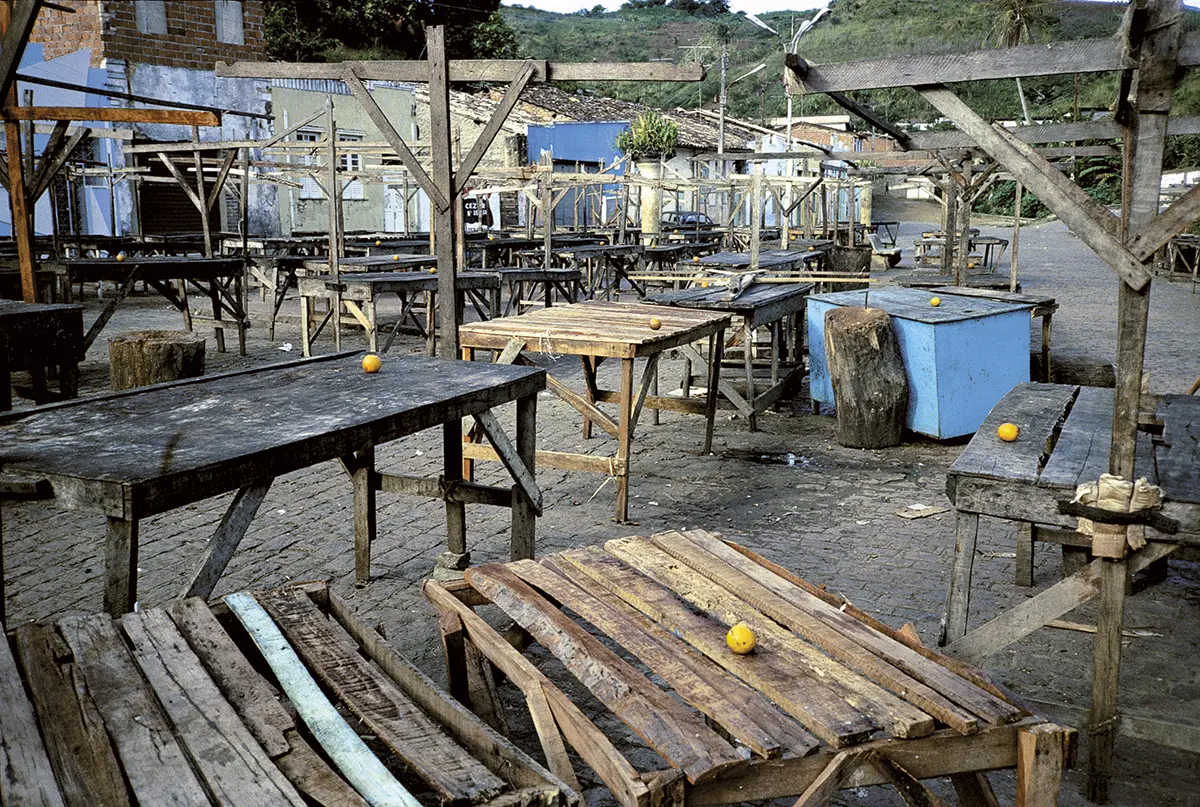
Extension of Reflection is one example, and Crazy Tourist (1991) provides another. The photograph documents an intervention Orozco made at an abandoned street market in a small Brazilian town. After hours, Orozco went to the market and arranged single oranges in an almost linear perspectival recession along the axes of empty tables. The careful distribution of oranges reflects the context-specificity of the market, where some form of distribution and/or exchange characterizes most interaction. In this image, however, the flow of exchange has been halted by the emptiness of the space and the isolation of the oranges—each one carefully and individually positioned, they are now endowed with a special value. The photograph’s resonance resides in the fact that it documents this intervention, Orozco’s personal act of making the every day special.
As a companion to the exhibition, Hirshhorn and Steidl co-published the first major text devoted exclusively to Orozco’s photographic work. Essays by Phyllis Rosenzweig and Mia Fineman present in-depth analyses of Orozco’s photographs, exploring their meaning, production, and reception with somewhat limited reference to his sculptural, installation, and performance pieces.3 With regard to the catalogue, as well as to the exhibition as a whole this fact remains both a positive and a negative: Orozco’s photographs clearly deserve sustained scholarly attention. Nevertheless, as Rosenzweig and Fineman themselves point out, to divorce Orozco’s photographic production completely from his interventionist performances or his modest yet effective transgressions of public space risks reducing the meaning and complexity of his work. When constructed as being created by a photographic auteur, the ephemeral quality of Orozco’s work is made permanent and its dislocative quality is securely anchored. In other words, missing from this exhibition was a sense of the diversity, fluidity, and permeability of the medium that so strongly characterizes Orozco’s production. Rosenzweig and Fineman thoughtfully acknowledge the quandary of this situation; finding an answer to the predicament, however, proves a more challenging task.
NOTES
1. Mia Fineman, “The Cypress in the Orchard,” Gabriel Orozco: Photographs (Washington and Gottingen: The Hirshhorn Museum and Sculpture Garden and Steidl Publishers, 2004), p 16.
2. The artist in an interview with PBS, Art:21 (http://www.pbs.org/art21/artists/orozco)
3. Phyllis Rosenzweig is curator of works on paper at the Hirshhorn Museum and Mia Fineman is research associate in the Department of Photography at the Metropolitan Museum of Art.
TERRI WEISSMAN