
A curious phenomenon can occasionally be observed in the Miami Art Museum’s Special Projects room. It is a sort of Bermuda Triangle where artists with a significant body of work seem to struggle against an unknown force that seems to condition and unify the majority of the shows in this space.
It is perhaps that the interest in a museum’s didactic tradition acts (without being fully understood) in a clear and logical manner to impose the same limitations on the artist’s project.
Such clarity and logic, for lack of better names, constitute a permanent operational method in the institutional language of museums, and of all other institutions that enter into an uncontrollable contact with reality. However, their methods themselves are already a part of the aesthetic preoccupations of the new tendencies in art.
A large part of contemporary artists investigate and find inspiration in scientific or botanical methodology, in order to group and archive innumerable objects, codes, symbols, or organic bodies.
Maybe the reason for embracing such methods is not as much the need to understand reality but to fuse with it, or, if that proves impossible, to play a game of cat and mouse with it.
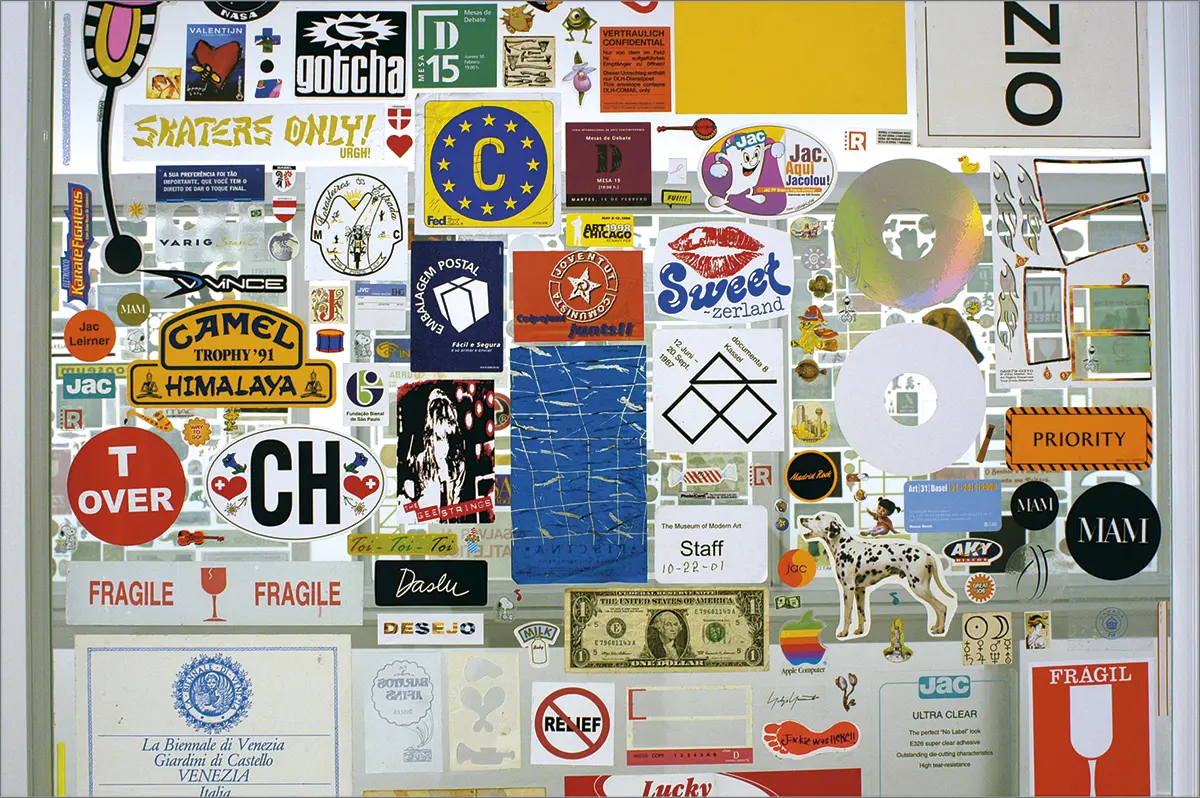
Jac Leirner presents his installation Adhesive 44 at MAM. In recent times, his interest in stickers and decals has driven Leirner to create installations filled with many stickers on automobile glass.
Jac Leirner builds true support for an idea by accumulating objects of relative importance such as devalued bank notes, cigar boxes, plastic or paper bags, and accessories taken from airplanes.
The verb “to accumulate” is what defines the development of his work.
It was Arman who in the late 1950s introduced the concept of accumulation to painting and sculpture, as a new creative expression. Leirner, however, gives accumulation a different, more literal element, adding the discipline, passion, and cunning of collectionism.
The public already used to the inimitable work of this Brazilian artist will feel a strange sensation upon entering this space. An elegant aluminum construction, on which a series of windows move, occupies the center of the large room. There, viewers are invited to become voyeurs of the most common and trivial stickers; the majority belong to register, packaging, and promotion systems in private industries. Other represent brands for the youth market, such as shoe or clothing brands, and in some cases, references to the world of pop music.
Some stickers record the artist's passage through museums or international art fairs.
When it comes to sensations, this installation offers an excellent opportunity to be astonished, and to wander around mesmerized by the large number of stickers collected by the artist for twenty years. But the sensations multiply just like the images presented, to end passively in hyperbolic reflections that one, in truth, does not want to understand, since stickers, like comics, exist to be enjoyed and forgotten and enjoyed again.
Adhesive 44 seems to violently break with the laconic body of Jac Leirner’s previous installations, works of longing and solitude, like the unending many-colored quilt woven by the abandoned lover in the movie “Like Water for Chocolate.”
In earlier works by Leirner, solitude is luxuriant, critical, and blasphemous. Also, it rises in arms against an ancestral bureaucracy. The surprise of seeing her new installation bombards our memory with remembrances that are fresh despite the passage of time.
Seeing Adhesive 44 is remembering Duchamp’s Large Glass; while we are hypnotized and saturated by the splendor of the new installation’s predictable transparency. But while the Large Glass is filled with so many secret keys and such complex symbolism that Octavio Paz needed to write a long book to explain them, Jac Leirner’s installation remains clear of symbolisms and difficult interpretations.
This sort of penetrable object, with two horizontal parallel planes built with movable windows on whose glass panes a deranged collection of stickers agglutinates, rests on an aluminum structure, solidly built along the whole gallery, where the invariable viewer discovers on both sides the new mirage of impostor symbols.
One could wonder what is the meaning of all these stickers, but that would be the wrong question to ask; in the end, who cares about their meaning. Meanings abound all over the place, but there is something not quite right with them; perhaps they mean too much!
Ever since Picasso applied collage to his paintings, artists haven’t ceased to “discover” new collages, and it has become an interesting tradition since as new techniques and new materials are invented, they are in no way reattached to the tradition.
The landscape of this aluminum structure functions as a support for the images’ festive and gothic discourse. In truth, Jac Leirner’s structure is a very simple one —but its simplicity dominates the space at MAM with great precision, and transforms the room into a heretofore unknown space.
Besides the many objects related to her international travels or the famous devalued bank notes, with which she has worked before, a constant can be found in Leirner’s art, a very special and forceful quality related to the sharp relationship between the work and the museum space, which seems to increase as the artist progressively penetrates institutional spaces.
She demonstrates how any unnoticed, mass-produced object (like the astonishing metal thread used to unpack cigarette packs) possesses potentially all the force necessary for a monumental sculpture or installation.
Jac Leirner both suffers and benefits from one of the contemporary world’s greatest syndromes, to collect and classify useless objects (despite the ecological drama.)
EUGENIO ESPINOZA