
Three large-format works installed in the yard of the Palacio de Clavijero in Morelia, Michoacán, welcome the visitor to Retro... perspectiva, an exhibition of works by sculptor Javier Marín.
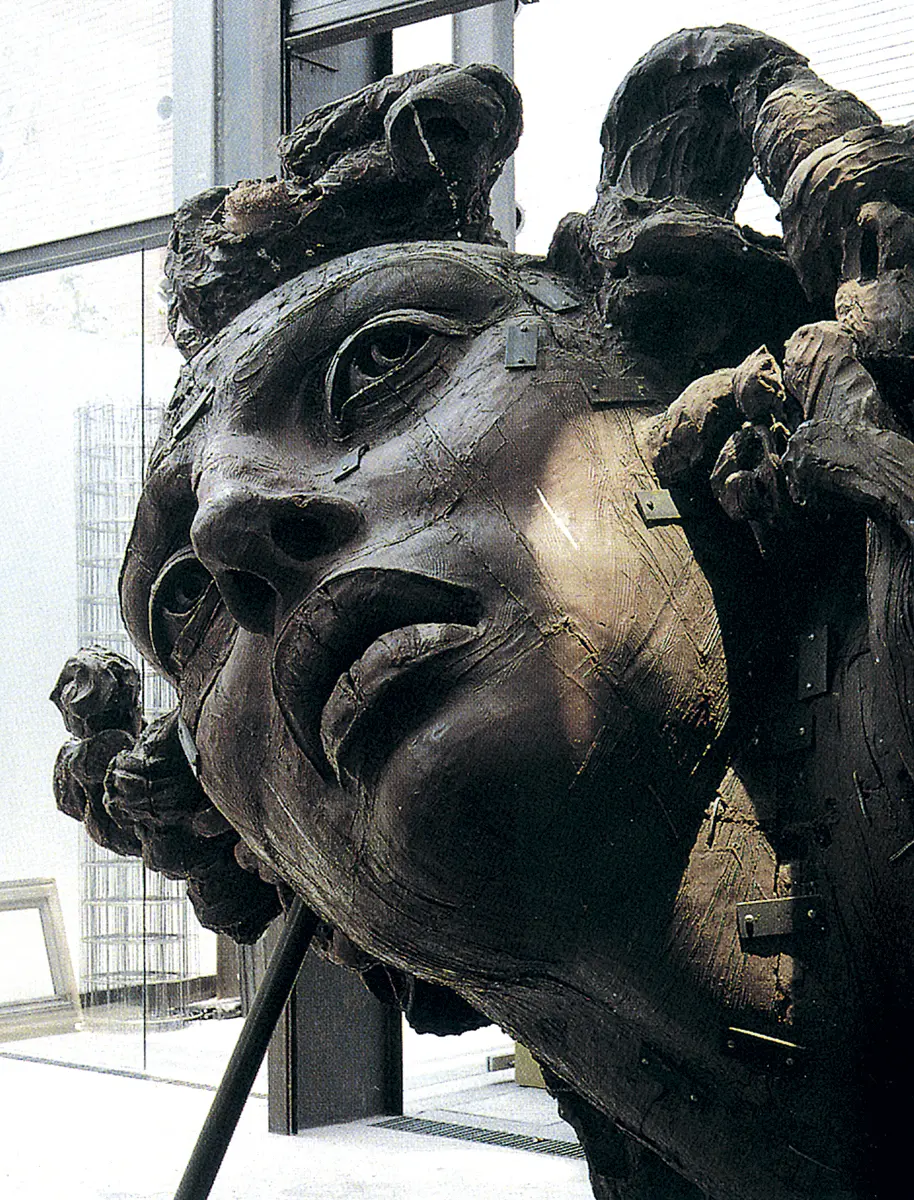
This anthology show, which brought together works from the last decade by the artist who last year presented his creations at the Sala San Tomasso in the Campo Degli Santi Giovanni e Paolo, on the occasion of the Venice Biennale, 50th edition, comprised more than one hundred sculptures. Some of them, like his bronze Cabeza de mujer (Woman’s Head, 2003), were arranged on the first floor of the Baroque-period building, erected in the mid-seventeenth century, and were framed by the harmonious arched pink marble passageway. The remaining pieces were exhibited on the upper floor, in a large hall that was making its debut as an exhibition space precisely with these works by the Michoacán-born, Mexico City-based artist.
In both quantitative and qualitative terms, the sculptures included in the show, under the curatorship of Eduardo Mier y Terán, gave an accurate account of Marín’s artistic proposition, which is characterized by a tenacious exploration of the human figure. Thus, throughout the exhibition, we found heads, busts, torsos, and a kind of full-body statuary, all of them in small, medium, and large formats, and arranged on pedestals or in the form of installations.
Among the latter, the highlights were a circular group titled Hombrecitos y mujercitas (Little Men and Little Women, 2000), consisting of ten sculptures with a height of around 80 cm. each, and the hanging series Mujeres y hombres suspendidos (Suspende Men and Women, 1996), comprising four pieces, each over 250 cm. tall.
Besides proving Marín’s craftsmanship and the evolution of his sculptoric language in recent years, the show offered a glimpse into his interest in the materials used. In this connection, we can mention his use of natural elements—amaranth seeds—and their combination with synthetic substances—polyester resin—as well as his recourse to bronze, wax, wire, and iron sheets.
To the plethora of reclining, erect, supine, and crouching figures; figures holding their heads; figures with their arms hanging to their sides or bent towards the back, the fingers twisted or pointing in different directions, all of them full of grimaces and gestures, the artist added other figures that were attached to the walls and filled as well with suggestive creativity. Such was the case of Hombre positivo-negativo (1998), a bronze diptych of great expressive force, and Relieve cuadrado (Square Relief, 2003), comprising ten polyester resin boards that resemble an aesthetic exercise in dissection.
Undoubtedly, one of the most interesting aspects of Retro... perspective was the fact that many of the sculptures shown were workshop copies or works in progress that by virtue of being recuperated and recontextualized by their author, acquired new meanings and identities. In the words of Marín himself: “I always saw them as shadows or ghosts of the other pieces, but, suddenly, by force of my seeing them every day, those shadows gained strength and acquired a life of their own. . . . Today I look backward into the past and review my work... I look backward in order to work forwards.”
The exhibition enabled the viewer to glimpse, under a new light, elements of the most private creative activity of this builder of powerful, disquieting anatomies tinged with echoes of Mannerism yet, in terms of their form and content, are entirely contemporary.
ARGELIA CASTILLO