Memory is a frequent topic of exploration in contemporary art. It can play at being pure fantasy, or it can attempt to show fragments of reality that are filtered through unknown or forgotten images.
In From the Inside, María Elvira Escallón posits an emotional encounter with the space where she worked until it suffered partial destruction after a terrorist attack with high-powered explosives. Despite the ample coverage of this event in the Bogotá press, despite the multiplicity of registers, Escallón unveils for us a world of previously unseen images that offer dramatic testimony of the horror. There aren’t any characters, only their traces shown through eleven photographs amplified to a life-size scale. The scale drives the viewer to get involved directly with the work, which acts as the wordless register of a space where only traces are left of those who inhabited it at the time of the attack, traces left on the soot created by the fire. These photographs reveal the movements, the desperate gestures of people trying to flee the flames, and also the missing objects since their mark was also imprinted on the walls.
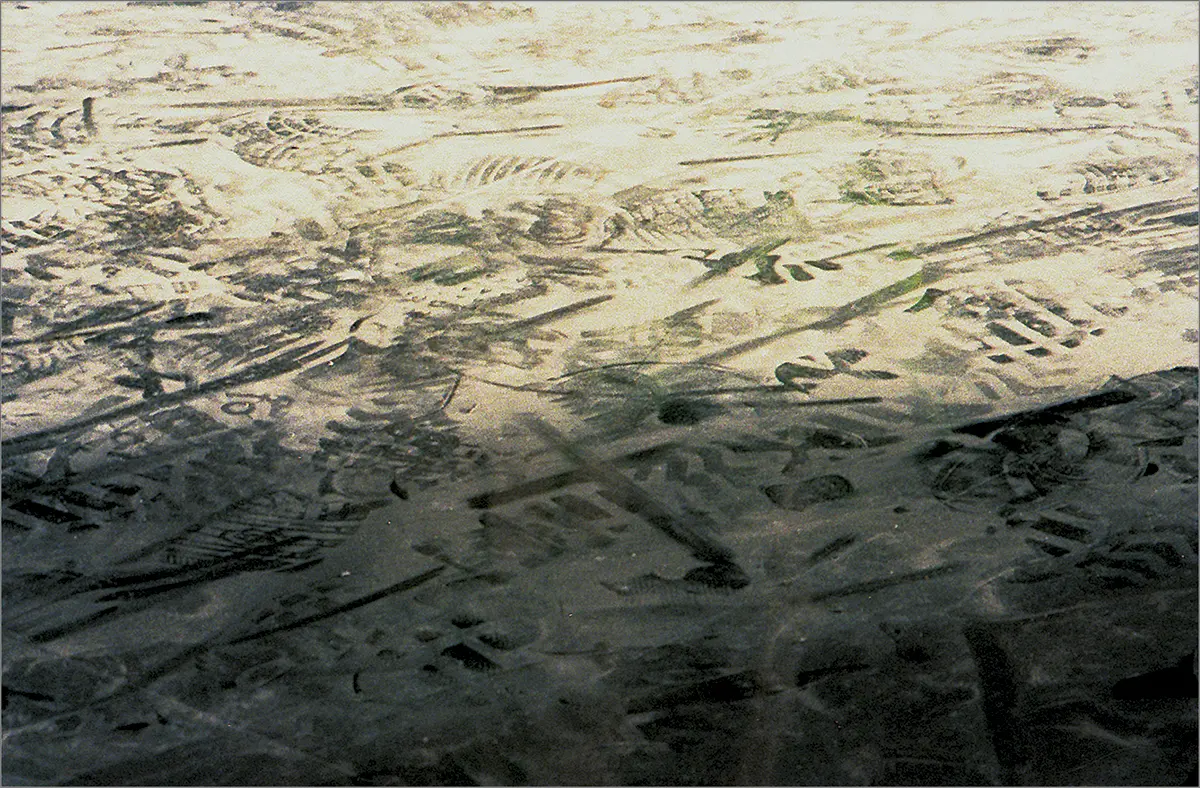
This presence of people and objects that are absent from their place becomes a testimony of the events. They are a document, they preserve memory by building it, not as a simple referent of the past, but seeking to sensitize the viewer to what happened, giving testimony and bringing it to bear on the present. They go beyond the immediate and become images that stay with those who see them. They are also the result of the artist's own experience in contact with the destruction, her recognition of signs found on everyday surfaces such as doors, staircases, and walls. To identify those places, to register those traces, is to attest to the fear and impotence of those who were there; it is to go beyond the material destruction.
Escalllón photographs are accompanied by a real-time video, 12 hours long; it begins in the dark, at 5:40 am, and ends also in the dark, at 6:40 pm. It has not been edited and is projected at a 1 to 1 scale. It consists of a single shot of the wall of the main mess hall, where we can see the outline of the missing objects. Light slowly enters the place, and incessant sounds indicate the movement of the streets, filled with the usual city noises. A still, immutable time inside, variable only in terms of light; am agitated, flowing time outside.
Special mention needs to be made of the space chosen for the show. It is an old theater, the Olympia, vacant today and on the verge of demolition and transformation into an office building. This exhibition is the last event in the theater, an imposing structure nevertheless stripped of its function. A white, ghostly environment, a precise container for the world of destruction shown in the photographs and video.
With this new show, Alcuadrado stays faithful to its intention of transforming spaces. Any location in the city is apt to be discovered, valuing the city’s heterogeneity. The space of art is not static; it can be mutable, and flexible, and Alcuadrado, in this show, reveals once again its ability to reinvent spaces for art.
IVONNE PINI