
Ruvén Afanador’s exhibition of thirty-six photographs at Throckmorton Fine Art draws from his newly published book entitled Sombra (Merrell Holberton, 2004). In this suite of images, Afanador’s main objective is to capture the feminine aura of male beauty. His subjects include dancers—some stretching and pointing while wearing ballet slippers or a tutu—and fashion models—many of them often elaborately coiffed or decorated, offering a divine, yet mystical sense of glamour. Intermixed here and there are various images, such as sumptuous plates of prepared food, a succulent bunch of grapes, and rich, ripe vegetables, emphasizing that the ensemble of pictures is most definitely about desire and consumption.
Afanador is certainly not the first to examine male erotic beauty. Many photographers, from Baron Wilhelm von Gloeden to Robert Mapplethorpe, have produced amazing bodies of work along similar lines. By comparison to Mapplethorpe, however, Afanador’s nudes do not appear so cold and distant, and the eroticism is not heavily concentrated on the phallus, but is more concerned with the playfulness and the handsome features of the sitter. Afanador’s work has much more in common with von Gloeden’s affectionate portraits of young men from the late nineteenth and early twentieth centuries, as well as other masters from the early history of photography. References to Eugène Durieu’s nudes, Nadar’s informal portrait style, and Man Ray’s exploration of darkroom techniques readily come to mind.
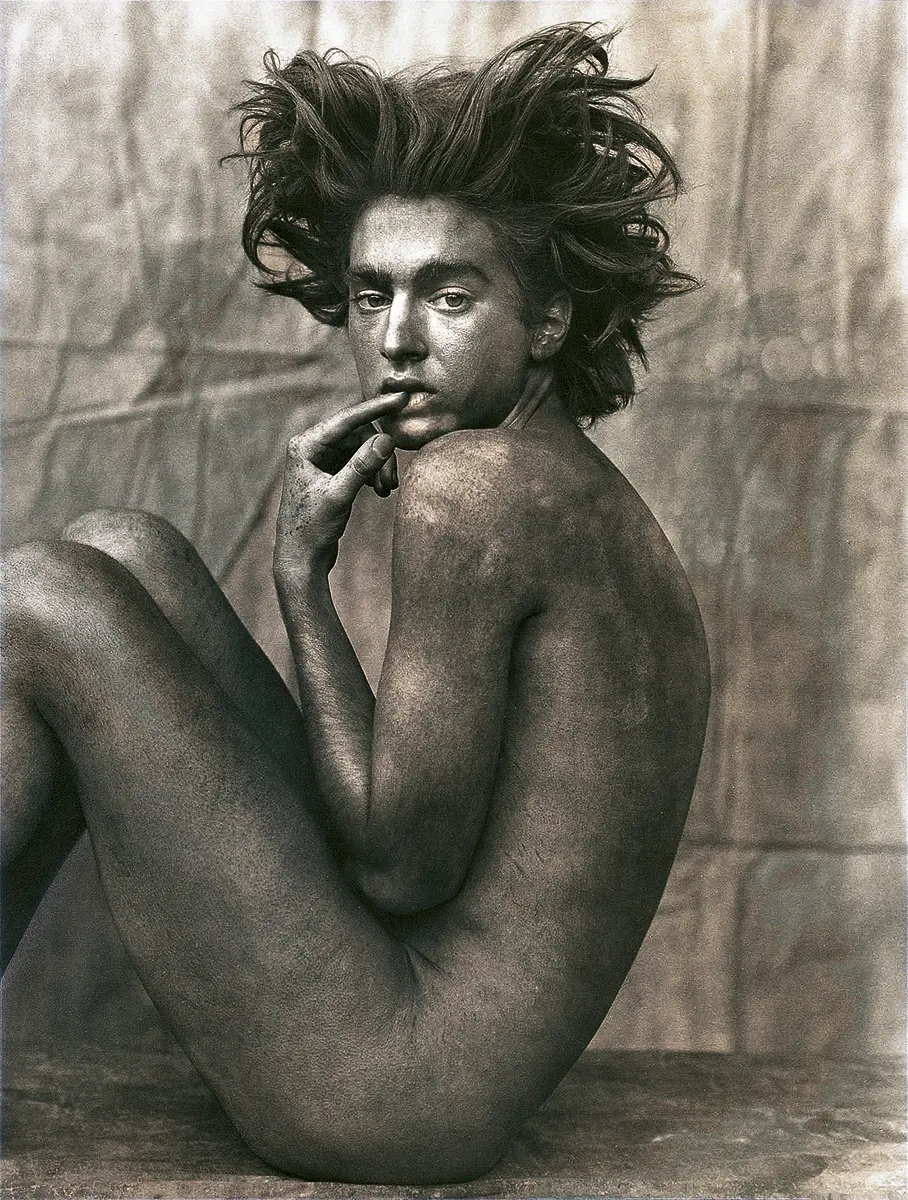
For Sombra, which means shadow, Afanador has drawn from old photographic manuals to produce a series of black-and-white solarized prints, a process that literally reverses light and dark tones—or light and shadow—creating a striking, even somewhat surreal effect. In addition, Afanador’s photographs have been printed in different metallic tones, such as gold and copper, and some were bleached before the tone was added. The result is that many of the surfaces of his photographs reveal a sense of lavishness and add to the seductive look of the male subjects.
Afanador chose the title Sombra not only for the technical reasons of solarization but also as a means to evoke the cultural folklore of his native Colombia. Some Colombians use the term “shadow” to mean photograph, and when Afanador photographs someone, he says: “I feel I am taking a shadow of their soul, the shadow being my perception of them.” Afanador understands that in some cultures having one’s photograph taken is like having one’s spirit removed, and with this in mind, he strives to draw upon the essence of his sitter’s soul and enliven it with his own artistic vision. Afanador also strives to focus his viewer’s attention on the figure himself by consistently using the same simple, unadorned, nondistracting backdrop behind the sitter.
In 2000 Afanador received the award for Best Photographer at the Trophée de la Mode in Paris and has worked for such notable clients as Vogue, Vanity Fair, Elle, and Esquire. Although Afanador has achieved immense success as a commercial photographer and his technical skill is highly impressive, many of his images have a strong relationship with high art as well, evoking the paintings of such old masters as Caravaggio. For example, a crouching young man with his hair raised and blown about holds his finger innocently close to his mouth, expressing a slight decadence in his overall naiveté, which brings to mind Caravaggio’s portraits of young men. In general, Afanador’s fetishistic photographs that makeup Sombraºare most enlightening, and convey femininity and masculinity, eroticism, and athleticism, past and present, extravagance and simplicity, and sometimes even a sense of camp that is tempered by the photographer’s technical and artistic mastery.
CRAIG HOUSER