In the face of an oft-alluded crisis of representation and the supposed death of all perceptual phenomena thanks to the contemporary world’s visual apotheosis, the most recent exhibition of works by Brazilian artist Vik Muniz (São Paulo, 1961) at Telefónica Foundation, Madrid, wants to recapture the viewer’s attention with an aesthetic proposal that finds his most immediate referents in the popular culture imaginary and its highest-performing icons. One of the artist’s fundamental goals in this new proposal seems to be to see from a different perspective and under a weird notion of time, perhaps more closely related to the modern ideal of contemplation. Here Muniz boasts great virtuosity and forces wandering dilettantes to fix their gaze upon that which they believe to have understood at a glance.
This exhibition, comprising fifty-three pieces grouped in series according to the material used and the formal solutions offered for the final articulation of the image, is a symptomatic review of some of the issues that have been part of the heated theoretical debate demanded by postmodern reflections. Seen in this way, issues such as representation and its limits, reality, and its reflection, the furtive relationship between the original and its copy, travestism and the blurred borders between traditional artistic genres, as well as the question of that which is taken as true and that which is simulated, have a place in the iconographic trajectory proposed by Vik Muniz in this anthological show.
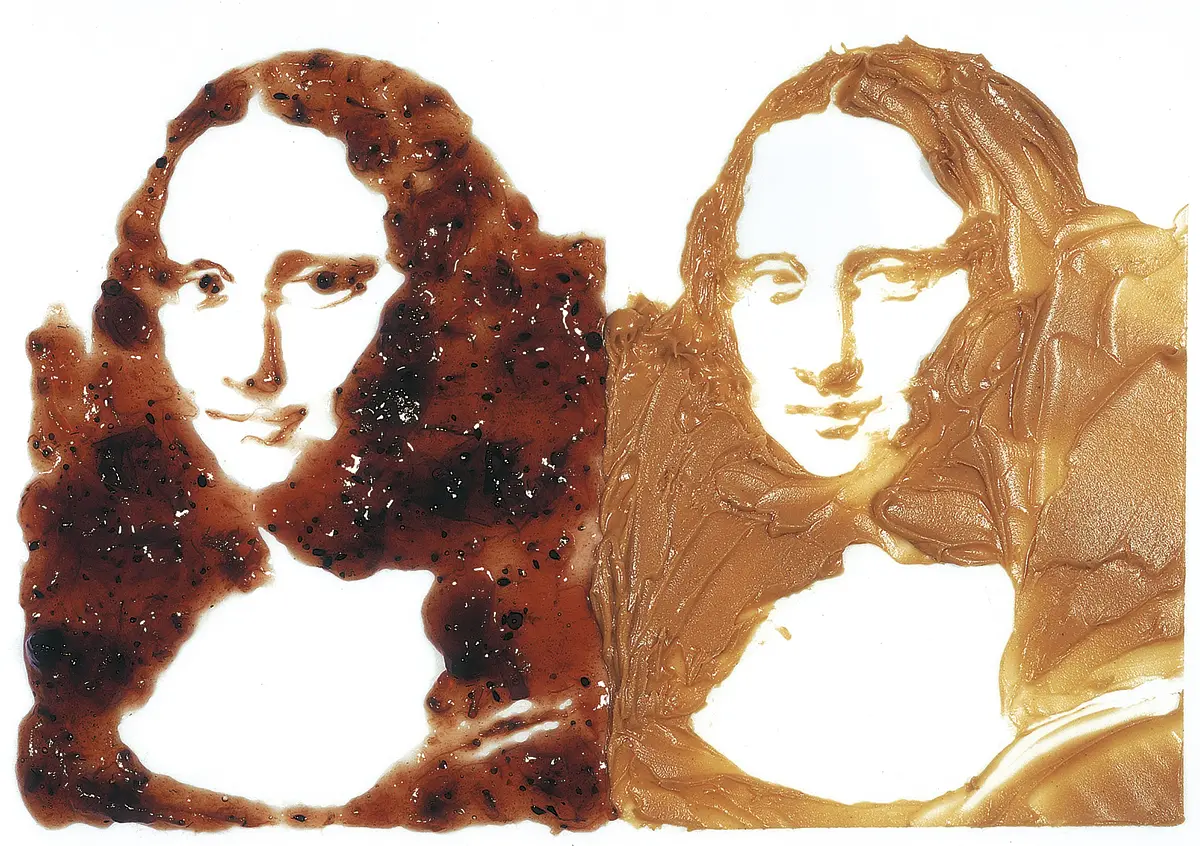
At the base of each of the works displayed here are Muniz’s traps for the retina and the constant game of deceiving the gaze. Muniz knows the hurry and frivolity of contemporary culture, and the short attention span that comes as a consequence of the perennial bombardment of indiscriminate information; this is precisely why he expertly designs visual tricks to force the viewer to stop before the work and attempt to untangle —if at all possible— the architecture of its deception. For that, he uses as his expressive means resources of the most varied origin and nature: food items and small industrial objects that, arranged in specific ways and after a measured process of observation, form a recognizable outline. Only in this way do we come to realize that the object we initially and after a quick glance thought was strictly pictorial, is in truth a giant collection of fragments created using chocolate, syrup, sugar, thread, dust, pins, wire, and multiple plastic objects that are later photographed in order to mask the process of their construction. In this way the artist poses a challenge to the intelligence of his audience, attempting to achieve a greater degree of participation, even if this is only possible through a de-constructive observation, often very entertaining.
The process’ final result does not place Muniz’s proposal in the territory of the ephemeral, as has happened to many artists who use such noble materials in their work. By using photography and the end medium, it remains as a trace and as artwork, as a copy or original of a previous piece. Thus yet another one of the artist’s traps and perverse games. Muniz gives himself the right to control, direct, and construct a new image on the basis of fragments or full quotes from registers already supported by the mechanisms of validation and prestige. Among the icons manipulated by the artist: are a portrait of Sigmund Freud, Las Meninas, one of Jackson Pollock’s drip paintings, Tiananmen Square, a famous piece by Courbet (reworked,) and the Mona Lisa. First, we discover a certain illusionism that makes us suspicious of the image’s authenticity by revealing in it a distortion resulting from external agents of the very process of elaboration, which is hidden from view. The icon, heretofore marked by materials that are typical of the universe of art, acquires a more physical sense by materializing into such everyday elements (not devoid of symbolic weight) as sugar and chocolate. A rather clear metaphor for the vulgarization and cannibalism of contemporary culture.
Meanwhile, the current anthological exhibition at Telefónica Foundation, which journeyed previously through the CGAC in Santiago de Compostela and the Dublin Museum of Modern Art, is an undoubtedly excellent opportunity to become acquainted with poetics that claims for art and its viewers the lost condition of enjoyment. Starting with the irony it deploys in its use of the language of advertising, and its intelligent manipulation of icons that are transformed into splendid metaphors, Vik Muniz’s representational, effectist game becomes a testimony of what the culture of the recent decades has been and continues to be.
ISSA MARÍA BENÍTEZ