
The Visual Arts
Biennial of the Central American Isthmus, an international juried exhibition
that has taken place in different capitals of the region since 1998, was held
in Panama for the first time in November 2004. Its presentation at the Museo de
Arte Contemporáneo was significant for Panama’s intellectual milieu inasmuch as
it offered artists and observers the possibility to consider local art within a
regional context, in addition to promoting an exchange between young artists
from six countries that, in spite of their geographic proximity, have
traditionally maintained only limited communication in the cultural sphere.
Initially established as a painting competition, since 2000 the Biennial has
broadened its scope to allow the participation of artworks created in any
conventional or contemporary medium. The exhibition of works by 36 Central
American artists that opened in Panama included drawings, paintings on canvas
and on metal panels, traditional and digital photographs, sculptures,
installations, videos, and interactive pieces. In spite of the variety, and in
some cases, incongruence—in terms of styles, media, and themes-inherent in
such an exhibition, the opportunity to consider art from a range of backgrounds
in one show can lead to significant conclusions.
The exhibition proved that Conceptualism is still alive and well among Central American artists, many of whom seem to seek a balance between activism and creativity. Although there were exceptions, the presence of artworks with social and political content was noteworthy, especially among the participants from Nicaragua, Honduras, El Salvador, and Guatemala, countries that—in contrast to Costa Rica and Panama—have suffered through long decades of war and violence. Political themes were prevalent in the insinuations of torture and disappearances by Honduran artist Jayro Bardales; the interventions in the “revolutionary Nicaraguan public space” by Ernesto Salmerón; and in Guatemalan artist Michael Benedict Barnoya’s interactive game entitled Arma-desarma (Arm-Disarm)1 that provided the opportunity to rebuild Central America with the cube-shaped blocks of a puzzle. For the viewer, the sociopolitical nature of the greater part of the exhibition inevitably generated a sense of discomfort, as well as a bitter taste regarding the difficult situation in which so many Central Americans carry on with their daily lives. In a parallel vein, the Biennial also included ironic references to the role of the church and its promise of salvation, as in the holy and unholy water presented by Andrés Carranza of Costa Rica, and the piece entitled Cristo-Sprite by Salvadorian artist Eduardo Chang. There were jabs at the United States and its colonialist role, which has been the cause of much resentment in the region, as evidenced in the work of Rodrigo Pacheles from Costa Rica with his Carta para una visa (Letter for a Visa), a disturbing video of a tattoo in progress; his compatriot Ricardo Avila’s ridiculous toilet in honor of President Bush; and Guatemalan Rodolfo Walsh’s photographic proof of the limited freedom available in the “land of the free.” It is heartening that the artists in Central America are slowly emerging from the cultural periphery that has long characterized the region and, in spite of the general psychological severity, are achieving a more contemporary level in their creative endeavors that allows them to project relevant themes.
The organization of the Central American Biennial constitutes an admirable example of the manner in which several countries can work together to achieve successful cultural exchange. In addition to collaborating on the preparation of the rules and the concept of the Biennial, each country serves as host to the event, on a rotational basis, with the economic help of the organizing entities and private foundations in each of the Central American nations. In spite of the fact that it forms part of the Central American isthmus, Belize has never participated in the Biennial, which is regrettable but not surprising considering the limited ties between this English-speaking nation and its neighbors of Spanish heritage. Another unusual fact is the manner in which the artists who participate in the Biennial are selected. They are chosen by way of local biennials in all the nations, except Honduras and Panama, where the selection process is coordinated by gallery directors and/or ad hoc committees. The regulations also vary from country to country. For example, in Panama, unlike the other countries, artists who wish to participate must have previously won a national or international prize and, if they are selected, have the extraordinary obligation to donate one of their works of art to the sponsoring foundation.
The works chosen for the Fourth Central American Biennial were well distributed in Panama’s Museum of Contemporary Art, where small, behind-the-scenes spaces were cleverly employed for the exhibition. Considering the varied nature of the artworks and the need for the many videos to have their own darkened rooms, Carmen Alemán, the organizer of the Biennial in Panama, in collaboration with the other Central American curators, achieved a commendable installation of the exhibition. The International Jury in charge of choosing the prizes in this Biennial included the Colombian critic and curator Ana María Escallón; Enrique García Gutiérrez who holds a Chair in Art History at the University of Puerto Rico; and the well-known Argentine artist Rogelio Polesello. The judges awarded three prizes to: Donna Conlon (Panama), Regina Aguilar (Honduras), and Oscar Raul Rivas (Nicaragua); Walter Iraheta (El Salvador), Hugo Ochoa (Honduras), Mira Valencia (Panama), and Veronica Vides (El Salvador) received Honorable Mentions.
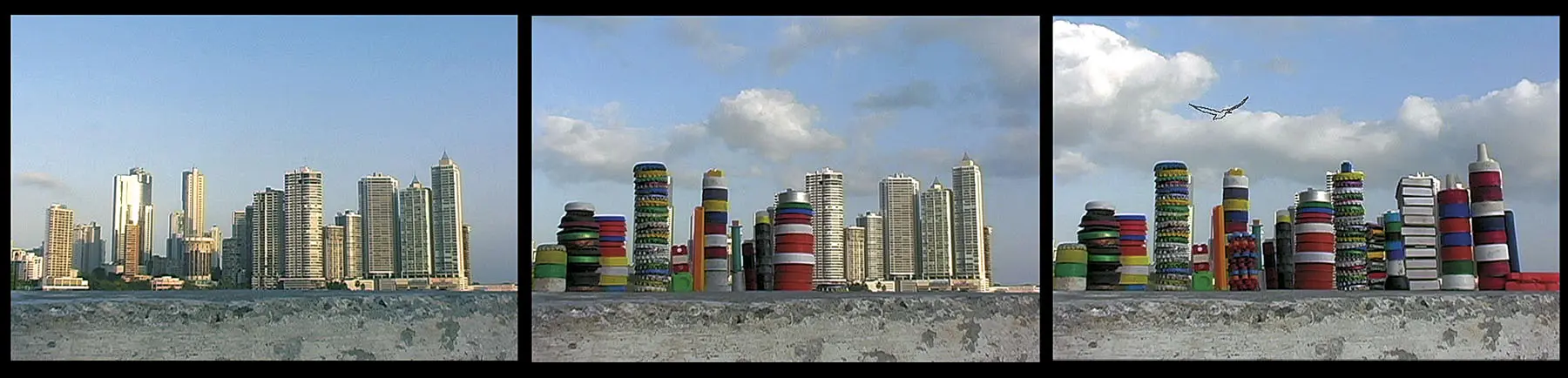
The first prize winner, Donna Conlon, presented two videos entitled Todo arreglado (All in Order) and Espectros urbanos (Urban Spectra), in which she remained faithful to her interest in working with found or recycled objects to make statements about Man’s relationship to the environment. In Todo arreglado, the artist’s hand places garbage in unusual places, “decorating” the city by inserting plastic bags in trees or fences, and glass bottles, plastic caps, forks, spoons, and straws in small holes or public spaces where they seem to fit perfectly. The movements are accompanied by the sound the items make when they are positioned, with the noise of urban traffic in the background. Conlon makes a social and ecological statement with humor and a sense of esthetics and, above all, with an alluring simplicity that enthralls the viewer. There is a similar feeling in Espectros urbanos, which begins with a view of the Paitilla Peninsula in Panama City, an area full of high-rise buildings in incredible proximity to each other. During the video, the buildings are slowly covered, piece by piece and in variable rhythms, by small towers of discarded metal bottle caps or matchboxes. The objects appear one over the other until the buildings are replaced in our visual plane, between the sea and the sky, by accumulations of orderly garbage. At the end, the silhouette of a marine bird flies over this “real” image, emitting an empty cry.
Of the two video-installations presented by Regina Aguilar, Central America Now was the most impressive. In a small room with a sofa and a side table with a glass and an ashtray, a flat screen displayed video cuts from television reports of one of the recent massacres in Honduras, where delinquency and especially the situation with the maras (youth gangs) has become a problem of serious consequence for social peace. In fast sequence and with cuts that increase the sense of drama and tragedy, one observes scenes with dead bodies and grief-stricken relatives, as well as military, political, and religious figures. Among others, one sees Monsignor Emiliani, the Panamanian priest who is Auxiliary Bishop of San Pedro Sula, where he has taken on the difficult mission of rehabilitating the gang members. The projection is shocking and horrible, yet at the same time, very similar to the scenes that so many middle class families in Central America see on their television sets every day, with no sense of horror, between cigarettes while they chat with their children or friends.
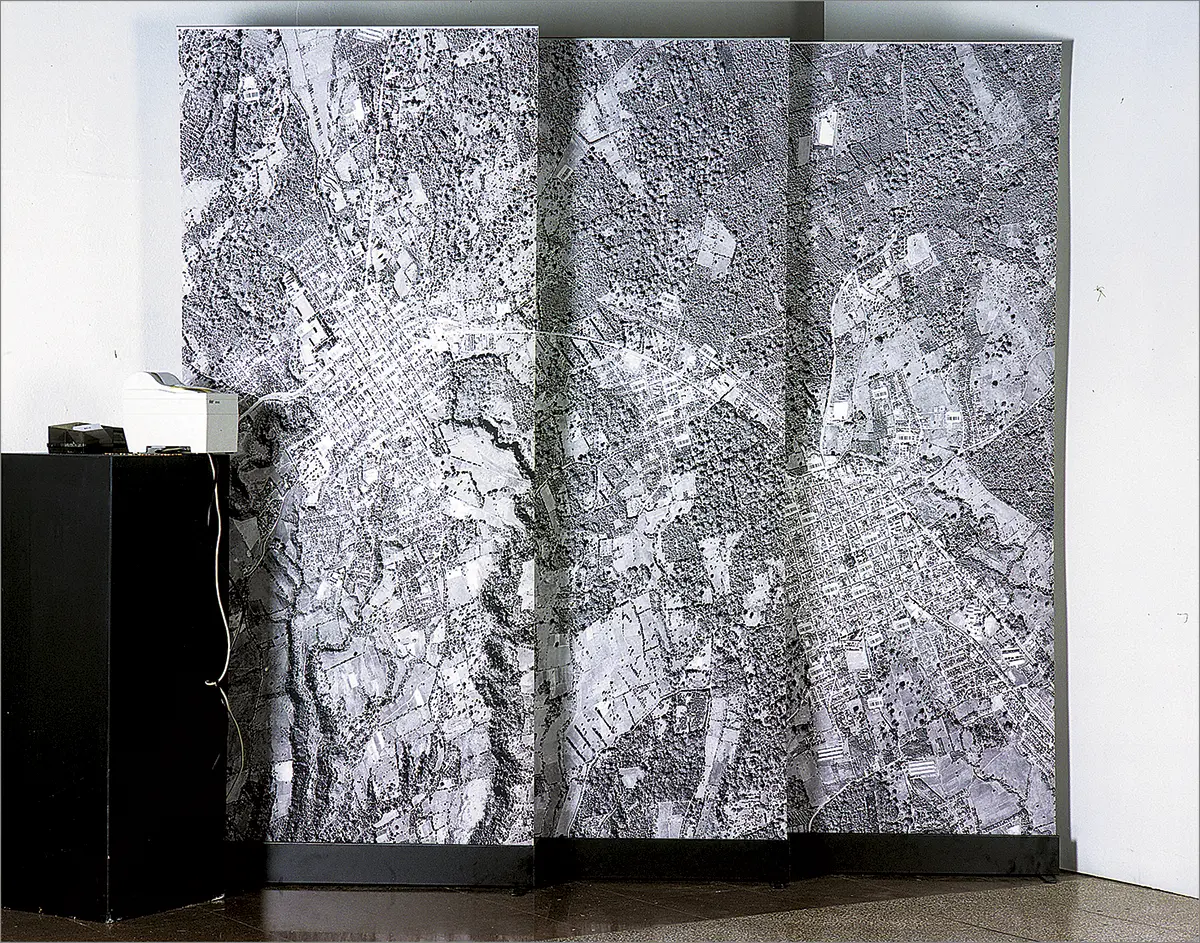
Oscar Rivas showed two works related to the theme of the over-extended cities, so timely in current Latin American art. In the interactive installation entitled Cit for sites, he presented a large black and white aerial photograph of a city that incorporates bar codes that the viewer is invited to decipher with an electronic scanner provided by the artist. The interactive process produces a printout on a piece of paper, rather like a cash register receipt, with the name and details of the person who occupies that particular spot on the world map. Cit for sites has far-reaching philosophical, social and political implications, particularly within the context of globalization.
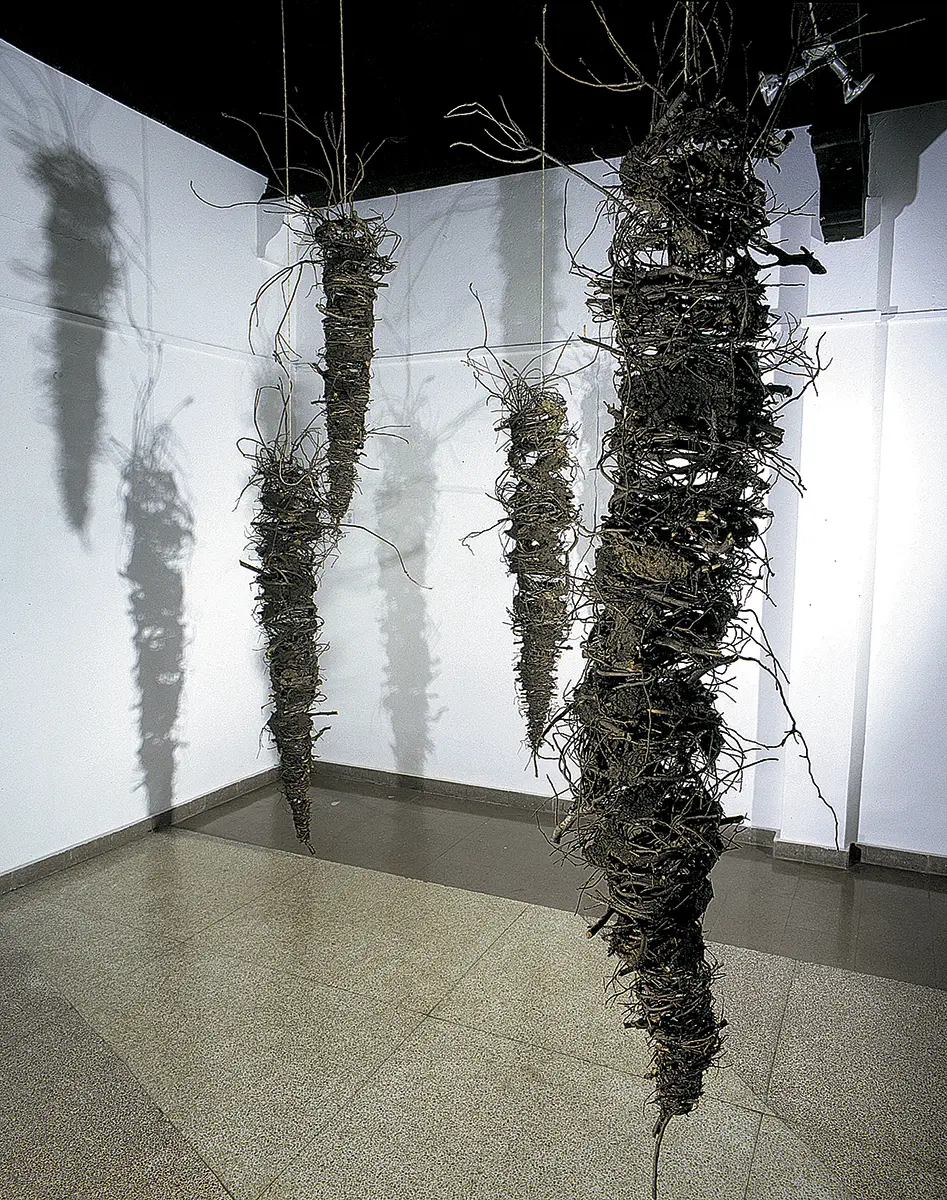
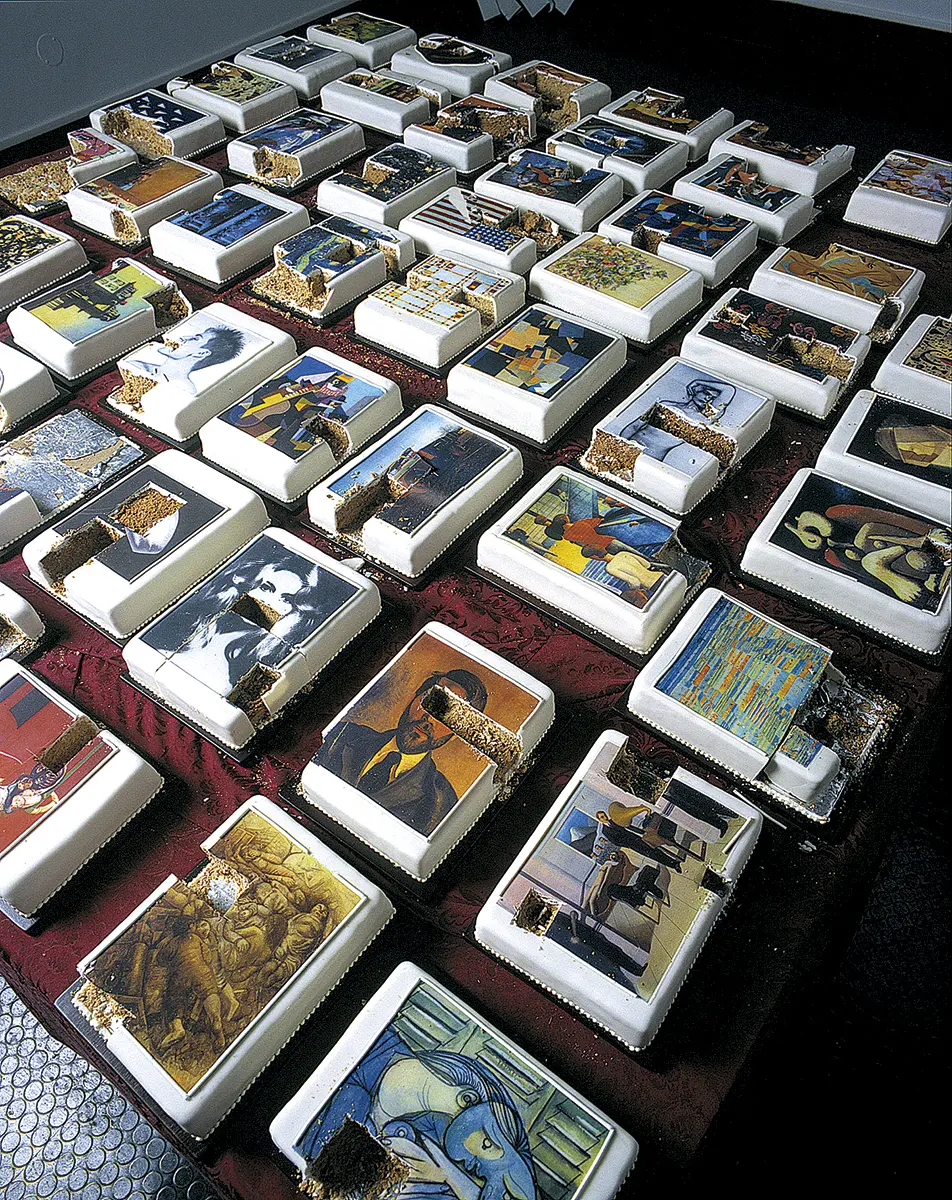
Outstanding among the Honorable Mentions was Guaridas (Lairs) by Veronica Vides, in which enormous structures of branches, earth, and manure formed unusual interpretations of nests, enormous cones of great pseudo-natural beauty. The artist recreates the splendor of nature in works that subtly manage both an ecological message and a reinterpretation of traditional sculpture. A radically different perspective characterized the interactive installation by the Argentine-Panamanian artist Mira Valencia whose Venga a disfrutar una obra de arte (Come and Enjoy a Work of Art) included a large table with a great number of iced cakes that displayed—in the place where a birthday child’s name might be—the reproductions in edible ink of works by a broad range of famous artists including Picasso, Mapplethorpe, and Panamanian painter Sinclair. Spectators were invited to cut the cake they liked most and to “consume” part of masterpiece. The installation attracted a large group of observers who willingly participated in a process that questioned the concept of art as a consumer product. Valencia also showed a series of four luxurious, white puffy pillows printed with the image of women in repose, a work of feminine connotations with a strong link to the language of design.
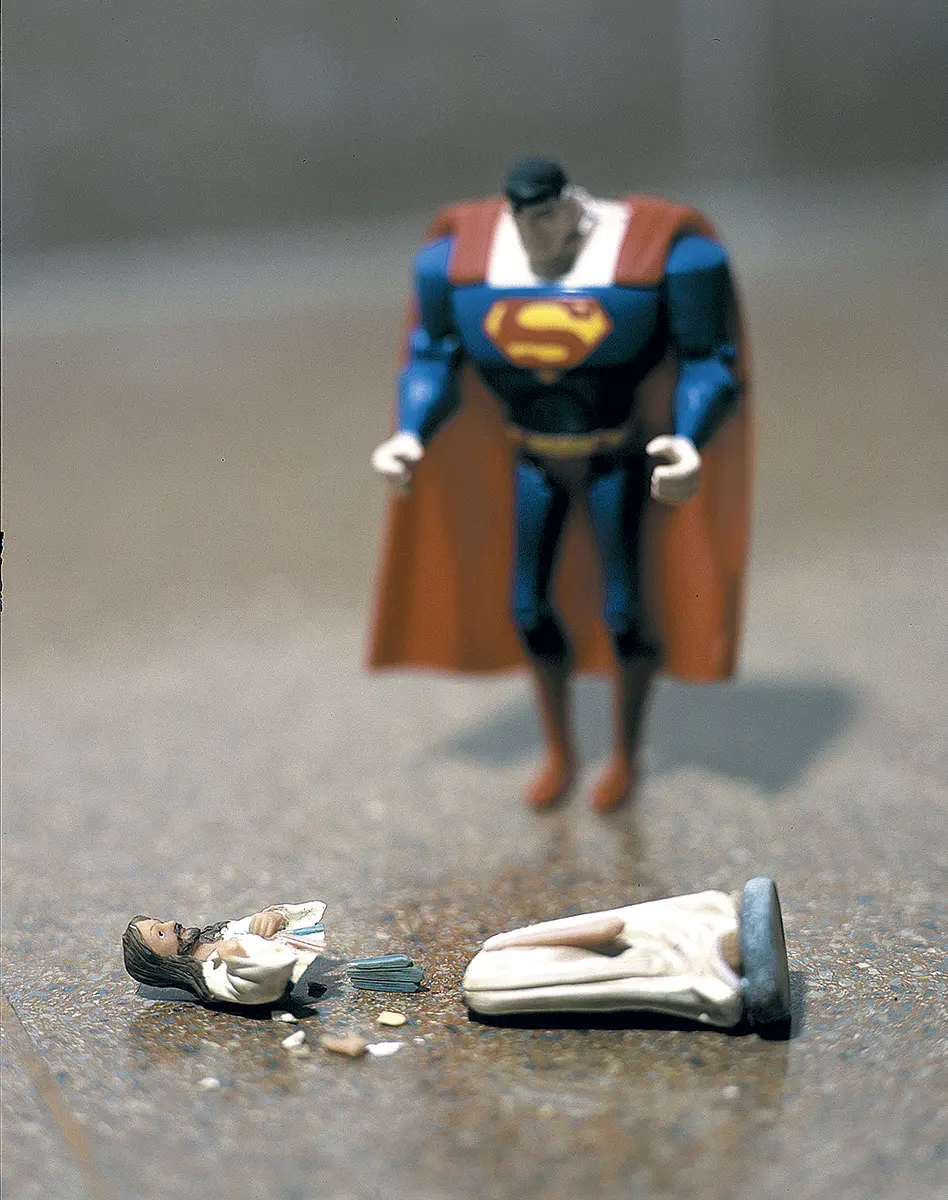
Equally remarkable among the Honorable Mentions were the Lecciones de vuelo 1 y 2 (Flight Lessons 1 and 2) by Walter Iraheta, conceptual works that combined straightforwardness and irony with a generous dose of humor. In an installation made up of miniature figures, Superman (adhered to the wall) flies over two rows of men who look like Jesus and stand in lines like school students. In the other “lesson,” two rows of little Jesus images—minus one—appear on a mini-platform attached to the wall. The missing “savior” lies broken on the floor. In a message that requires no explanation, Superman observes the broken body of Jesus who could not ascend. Closer to everyday life are the strongly interrelated prize-winning videos by Hugo Ochoa entitled Barroco (Baroque) and Tercer Mundo (Third World) where, by employing split screens, bright colors, and classical music, the artist explores the position of human beings within underdevelopment. Images of children, adults and old people appear against bright but corroded walls in an existentialist statement enhanced by the projection, at intervals, of the words “READY-AIM-FIRE.”
The piece that triggered most public reaction during the exhibition’s opening was the performance Lo que tú quieras (Whatever you want) by Panamanian artist Abner Benaím. With no introduction or explanation, visitors entered a darkened cubicle where they found the artist sitting before a video screen next to a metal tray with a pair of scissors, which could be used to do “whatever you want.” The artist’s very long hair enticed people to snip some off, a process that was recorded in a video that was then projected as long as the Biennial lasted, leaving entertaining and revealing visual proof of the many different reactions people had to Benaím’s invitation. His second piece, Tal como eres (Just as You Are) consisted of an interview with a distinguished older gentleman—with film cuts to traditional barber shops, veteran barbers, and the long-haired artista—who offered the young man counsel on cutting and combing his hair in a socially acceptable manner, revealing what sounded like moral precepts in relation to something as banal as a haircut.
The tongue-in-cheek work of art entitled Vender bienestar (To Sell Well-Being) by Wilbert Carmona of Nicaragua documented a performance in which the artist tried—unsuccessfully—to sell a series of small, pretty landscape oil paintings for ridiculously low prices on buses in Panama City. In Carmona’s installation Mano dura (Hard Hand), the artist presented several large oil portraits with gilded baroque frames that displayed members of street gangs in menacing poses rather than showing society figures. Social commentary and humor also abound in the very short video entitled Planta baja (Ground Floor) by Panamanian artist Ramón Zafrani, a 42-second piece that reveals an understanding of the idiosyncrasies of his countrymen and speaks volumes about the way in which we have destroyed the historic and architectural heritage of our cities by superimposing ads for consumer goods onto graceful neoclassical buildings. The work speaks of environmental pollution in visual, auditory, social, and architectural terms.
Exploration into the drama of urban life also characterizes the installation Altar de santos pecadores (Altar for Holy Sinners) by Guatemalan artist Álvaro del Cid Mazariego, which included photos of prostitutes, images of the Virgin Mary, and signs with job offers, all within a shocking pink and turquoise structure with a kneeler upholstered in faux-tiger fabric. This artist also focused on the grotesque in the everyday in Existencialismo abordo (Existentialism Aboard), an installation composed of nocturnal images of city dwellers traveling in taxis: a couple necking, a woman eating a hamburger, and a wrinkled, old lady coming out of church. Salvadorian artist Simón Vega offers a different perspective on humanity: he does not analyze but rather bluntly rejects relationships in his installation of a lighted sign that clearly states: GUARDE SU DISTANCIA (Keep Your Distance).
Far from the bustle of urban activity were the artworks presented in the Biennial by Nicaraguan artist Patricia Belli and her Costa Rican counterparts Vanesa Biasetti, Adela Marín and Roxana Nagygeller, whose compositions dwelled in the realm of domestic life and human intimacy. In her installations Diván (Sofa) and Cama (Bed), Belli deconstructs the idea of the couch and the marital bed, although not with the magical touch she has displayed in earlier works. The small sofa has a wonderful eye sewn into the backrest, a detail that in and of itself would have rounded off the work (with a respectful wink at Dada Art). The “bed” consisted of a thin cloth suspended from the ceiling by strings that would yield immediately if anyone were to even think of seeking repose—or a bedmate—on that surface.
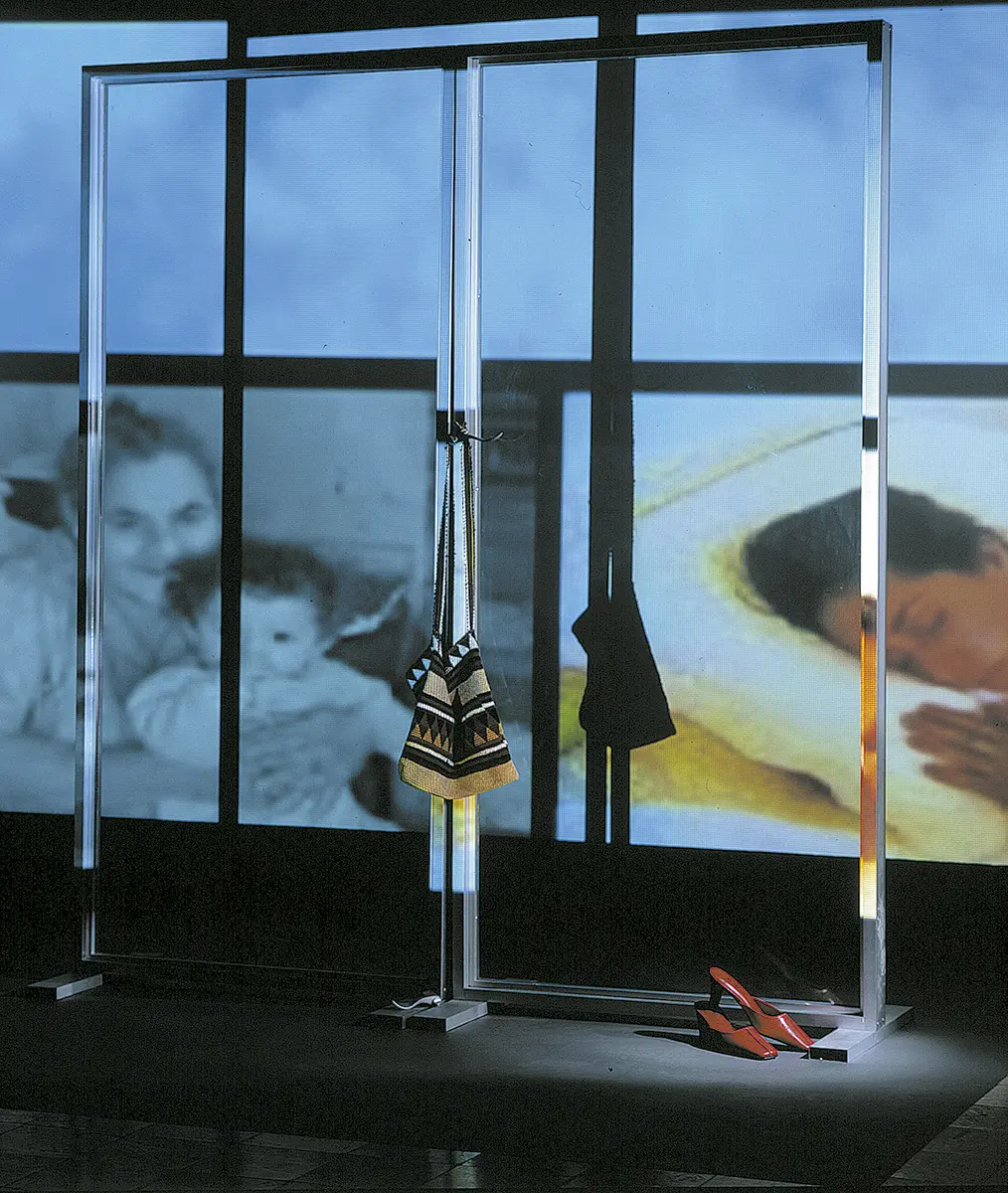
Biasetti delved into another facet of intimacy with some exceptional pieces of feminine lingerie created from natural seeds with very fine membranes that the artist painstakingly glued together to create a natural “fabric.” These objects generate ambiguous sensations for several reasons: their beautiful appearance, the way they are reminiscent of ads that offer sexy clothing for women, and their enormous fragility and absolute uselessness as dress items. Hanging from extremely delicate, spiny branches, Biasetti’s pieces make reference to the social role of women as well as their connection to primal nature, to seeds and to our origins. Adela Marín also explores female reality in two installations from the series entitled El aspecto femenino de Dios (The Feminine Aspect of God) with photographs printed on lengths of fabric that hang from the ceiling in a circular or spiral shape, with interior illumination. In one of them she reviews, with great sensitivity, the development of woman from pregnancy to maternity to old age, making allusions to menstruation, reproduction, and menopause. In her second piece, Trabajadoras inmigrantes del Restaurante Charles (Immigrant Workers of the Charles Restaurant), we see portraits, in parts, of several women with halos made of knives and forks, like the figures of saints martyred for the greater good of family or society. Finally, within the exploration of female issues, we must mention the work in photography and video by Nagygeller, who contrasts a static and smiling image of one young woman with another, in video, in which the figure undergoes several transformations from “normal” to bald to masculine.
Although installations and videos predominated, two-dimensional art was also present in the Fourth Central American Biennial. Salvadorian artist Antonio Cañas produced a striking yet subtle composition in mixed media with references to the issue of colonization: he used the typeface of the Coca-Cola logo to write his own name, echoing the famous “Colombia” by Antonio Caro. The walls of the Museum also displayed the work of Guatemalan artists Marco Tulio Roquel, who made allusions to violence with acrylic paint and collage on metal, and Jorge Mazariegos, whose large paintings focused on images of dogs as expressionist metaphors for, and witnesses of, urban violence. Reinaldo Fernández of Nicaragua presented a new interpretation of “paintings” with two large, delicate canvases of transparent cloth with applications of striped or flowered fabrics in a subtle and delightful visual scheme. Equally delicate was the large-format drawing of two male figures presented by Jorge Palomo of El Salvador.
Although this Biennial proved that contemporary art in the Central American region is progressing well, the exhibition also reflected a general lack of discernment in the use of the different artistic media, a situation that events such as this one will surely help to improve. Several works showed too close a connection with the field of graphic design and the use of computer programs like Photoshop. The familiarity most people have today with photography, video, and computers does not free artistic production from the creative process, with all its implications. That tempting lack of exploration and depth was obvious in the works of Byron Mejía and Guillermo Mahchi of Honduras and Roberto Guerrero of Costa Rica, and yet was well managed in the case of Guatemalan artist Lourdes de Menéndez, who successfully employed a computer to enlarge a fingerprint and transformed it into a beautiful, almost abstract landscape of blacks and whites. On the other hand, Panamanian artists Humberto Vélez and Eric Fajardo, generally respected for the originality and subtlety of their oeuvre as well as their conceptual talent, fell short on this occasion. Vélez presented a piece produced in Manchester and a performance that took place in the Old Quarter of Panama City, both displayed through videos that only worked at times during the exhibition, and Fajardo showed two digital photographs that lacked his usual ironic edge. In other cases, one could sense too much imitation -or a lack of identity- in the reinterpretation of almost classic models, such as those in the work of Honduran artist Lester Rodriguez, whose displacement of earth and its photographic record reminds us of, but in no way competes with, the great Cuban artist Ana Mendieta.
The Fourth Visual Arts Biennial of the Central American Isthmus was an exhibition of considerable size and importance and revealed much about the artistic, social, and political situation of the region. Unfortunately, it had limited press coverage and denied the local audience the possibility of considering analytical information about an exhibition with avant-garde artworks that the common visitor may have considered incomprehensible and, in some cases, even shocking. Nevertheless, it is truly admirable that six countries—through the efforts of dedicated individuals and creative artists—have managed to join efforts in order to offer the public this valuable and up-to-date view of contemporary art in Central America.
NOTES
1. In Spanish, “Arma-desarma” means to arm and disarm, but also to build and take down, a play on words that is relevant to the theme and the medium in this work of art.
*All images illustrating this article are courtesy of Galería Arteconsult, Panama.
MÓNICA E. KUPFER
Ph.D. in Art History, art critic, and curator. President of the Art & Culture Foundation, and Founding Director of the Panama Art Biennials.