
Trazando recorridos is the title of Andrea Di Castro’s most recent show. Di Castro, who was born in Rome in 1953 and has lived in Mexico since 1966, has since 1988 integrated the computer as a tool in her photographic and video work —and not just the computer: the artist uses technology in general as a support, structure, and result.
Pablo Goebel Fine Arts gallery, in Polanco, presented a very complete exhibition of Di Castro’s work, comprising photography, electrography, drawings, video, and robotics.
This show is an excellent illustration of the close relationship between art and technology, a relationship that has intensified steadily in recent times. An example of this is the series of electrographs and drawings created on the basis of a Global Positioning System, or GPS, a small instrument that pinpoints the precise location of an object anywhere in the world, using signals sent from a computer to a satellite.
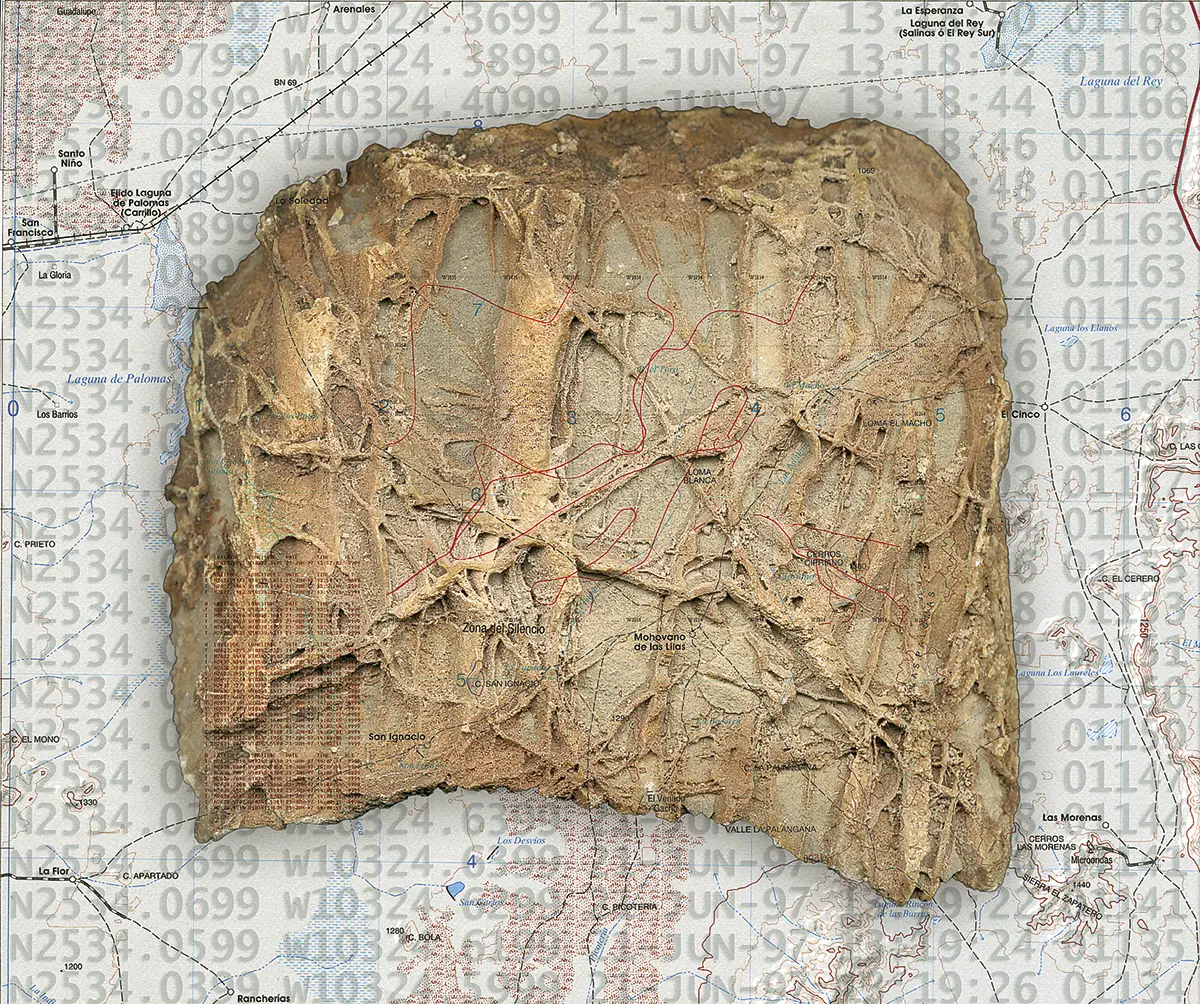
Starting from his own given location, precisely recorded in a cartographic map, the artist creates an electrograph and adds to it the image of a rock picked up in the area; the piece is completed by a small box, with the map on its cover and the image of the rock inside. This idea of the objectual, of picking up something that indicates where one was, perhaps as a fetish, perhaps simply as a record, makes the work an interest based not only in its visual aspect and its technological proposition, but also in a broader concept in which the artist wants to make his viewers participants in the moment of the recording, as a faithful testimony of the satellite images of Europe, Asia, or any other place where the artist has been.
This gives an idea of belonging to a global concept, of the need for precise location, in the sense of re-creating the moment, a chosen point in a map that becomes an event in a spatio-temporal plane. The evolution of the images and of narrative itself becomes manifest in the incorporation of technology as a tool for the production of art.
In this way, the structure of Andre Di Castro’s work questions the conventional idea of photography and its relationship to electronic media. The idea of transforming maps into works with matteric texture makes for a unique work in a creative sense of visual experimentation where all expressive resources contribute to the creation of an oeuvre that is rich in expressiveness, formal, and narrative elements.
On the other hand, the videos that accompany the show are narrated by the artist himself, who speaks about the creative process, of the various regions he has visited to complete his pieces, and, in general, of his work as a whole.
The opening was a unique event. The artist, wittily, created a painting robot that created piece after piece and astonished all present.
Another series shown in this exhibition was L.A. Project, which brings together a photographic record of the sewer system of the city of Los Angeles and satellite electrographs that display the location of each drain. In 2002, Andrea Di Castro told an interviewer that he’s been creating this type of work since 1997, based on the idea that recorded movement becomes a trace. For the artist, this system is an inexhaustible field that relates to registers, to memory; he says that, as in literature, the dream of movement is to keep a record.
Thus, digital resources change the role of the viewer, making it less a position of contemplation and more one of interaction, by making us participants in a precise moment, in a process of collecting a great amount of visual, technical, geographic data that will result in the event of seeing in a new, more integral way, beyond a mere presence, as part of the action itself.
In this new relationship, the work involves the viewer with technology as a platform to interact with the environment and discover that a location is not just a set of coordinates on a map, but a place rich in textures and evocations.
ISAURA RUIZ