
If anything has consistently interested Galería Alternativa, it has been the new languages and the most experimental contributions of young Venezuelan and Latin American artists. In that sense, it has filled an important space in their promotion, assuming a difficult responsibility in terms of the art market by directing its efforts more in the direction of art in itself, rather than in the direction of obtaining profits. One of its most recent exhibitions was of works by Ani Villanueva (Venezuela, 1954), a multifaceted artist who, from the starting point of her training in modern dance, began her career in the 1980s as a performance artist, made videos, and explored the theater. In the 1990s, she started experimenting with painting, in a figurative vein as she puts it, almost fauve, pop, and abstract, only to move forward in a different direction, more in the realm of what could be defined as conceptual and spatial, a line of work that experiments, analyzes, and reflect on itself, for the last three years. We could say that her interest focuses not only on the expressive potential of a given material (plastic) but also on its capacity to conduct and project light towards changes in color and in its stability in space; in that sense, we are talking about a new proposal in kinetic art.
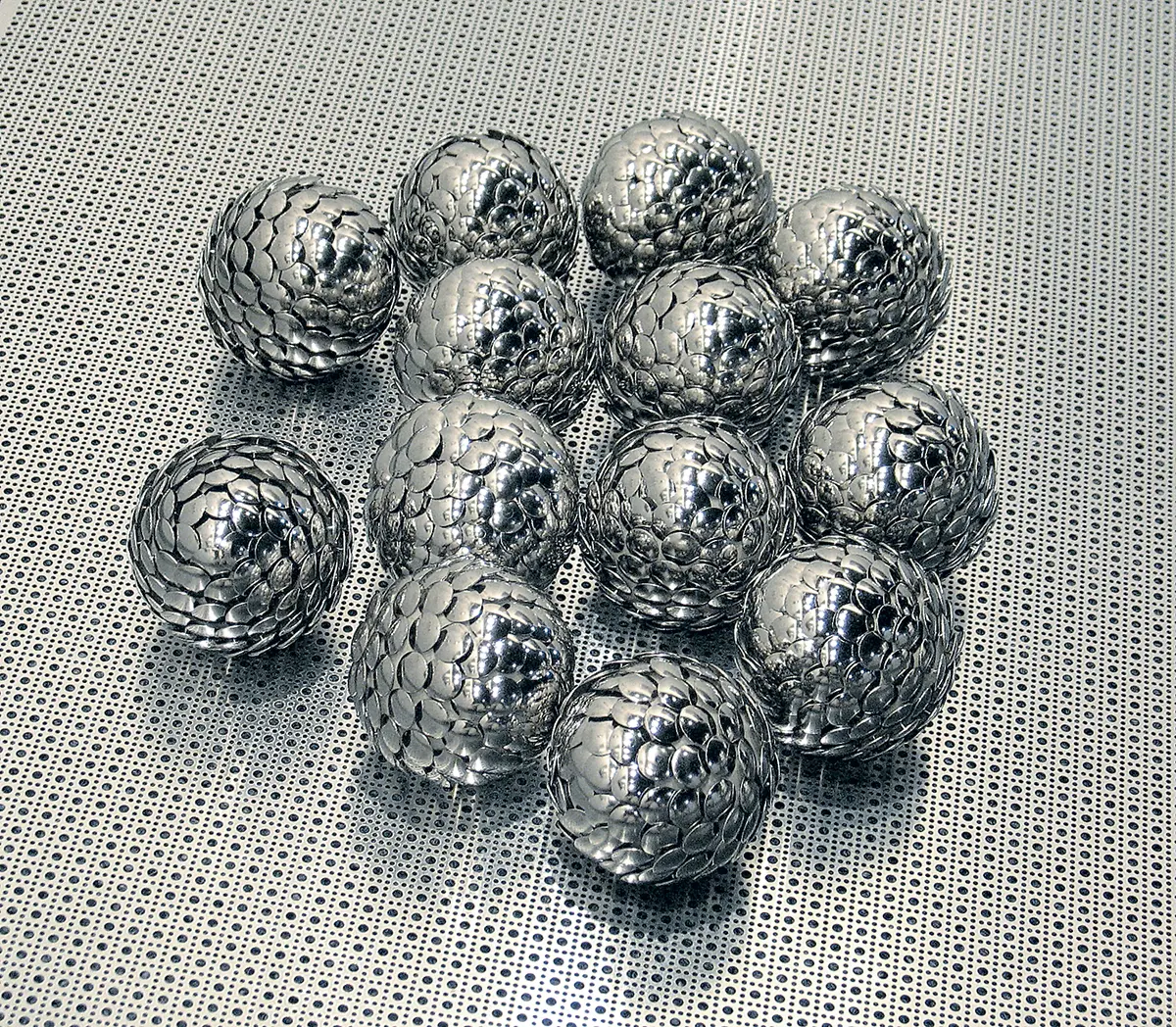
From many different experiences, Ani Villanueva has arrived at her latest explorations in the sensible field of the most “insignificant” of everyday objects. Plates, glasses, cups, security seals, sponges, objects from piñatas, balls, everything in plastic; with them she built the “works” of her show Caos de cosas, presented in late 2004 at Galería Alternativa. A cumulus of experiences has nestled since childhood. The granddaughter and daughter of artists, Villanueva regards her environment and her everyday life with a sensible eye, locating “new harmonies” that allow her to find “creative periods in which to enjoy and grow,” as well as to afford herself “the chance to transgress convention.” It is precisely the latter that she does in the works presented in Casos de cosas. But her appropriation of the “junk” of mass consumption does not bring to mind a new Pop Art, since the artist transforms the “objects” in such a way as to build a reality inscribed in an absolutely formalist language. For instance, her silver-colored plastic plate curtain becomes a kinetic surface where what matters is the spatial interplay of light and shadow. Despite being “objects: that occupy a portion of space in their three-dimensional condition, their “pictorial” character can not be obviated; they project color, shadows, perspective, and movement. It is, then, in the ambivalence between the three and the two-dimensional where we can find the contributions of the Venezuelan artist’s new creative period, a period in which the element of playfulness has an important role.
In Villanueva’s hands, the appropriation of a readymade object, so conventional in the past and now, becomes the exploration of an ethical and aesthetic approach to the contemporary context of Being: wrapped and lined in plastic materials, Being must appropriate plastic and transform it into an “spiritual object” capable of bringing Being closer to its essence and away from the banality and frivolity of the present. It is not a matter of consumerism. It is more of an existential problem. It is life that must be preserved despite plastic. This is why it is important to promote the transformation of our banal everyday life into a historically human reality. When Ani Villanueva elevates the “ordinariness” of the plastic object material to an artistic condition, any one of her works (Unnatural anemonies 1, Manimals series, Casos series) comes to the viewer in an ebullient simplicity, while at the same time motivating a reflection about the reality that surrounds them. That surrounding reality, and Being, are what matter in this work that, without rhetorical pretensions but deeply allegorical with respect to the historical present, offers a pause to reflect about the then and the now.
BÉLGICA RODRÍGUEZ