
The way our childhood determines who we are in the present is the underlying concern of Elba Damast’s interactive, video-based installation, Memories of Things to Come at Lehman College Art Gallery of the City University of New York in the Bronx.
The piece consists of eight vintage wooden school desks from the Bronx, each with a heart—cast in bronze or brass—mounted on top of it. The hearts are based on the anatomical shape of the human heart. The viewer is invited to look inside the chambers through the arteries and veins protruding from each heart. Inside each chamber, there is a video projection filmed in Damast’s native Venezuela—of children during lunch time at school, children at recess in the playground, and their empty classrooms. There is also a video of an old woman sitting in her home surrounded by photographs with a voiceover talking about love. In yet another video, the Venezuelan countryside is shown, grounding the remembered past in nature.
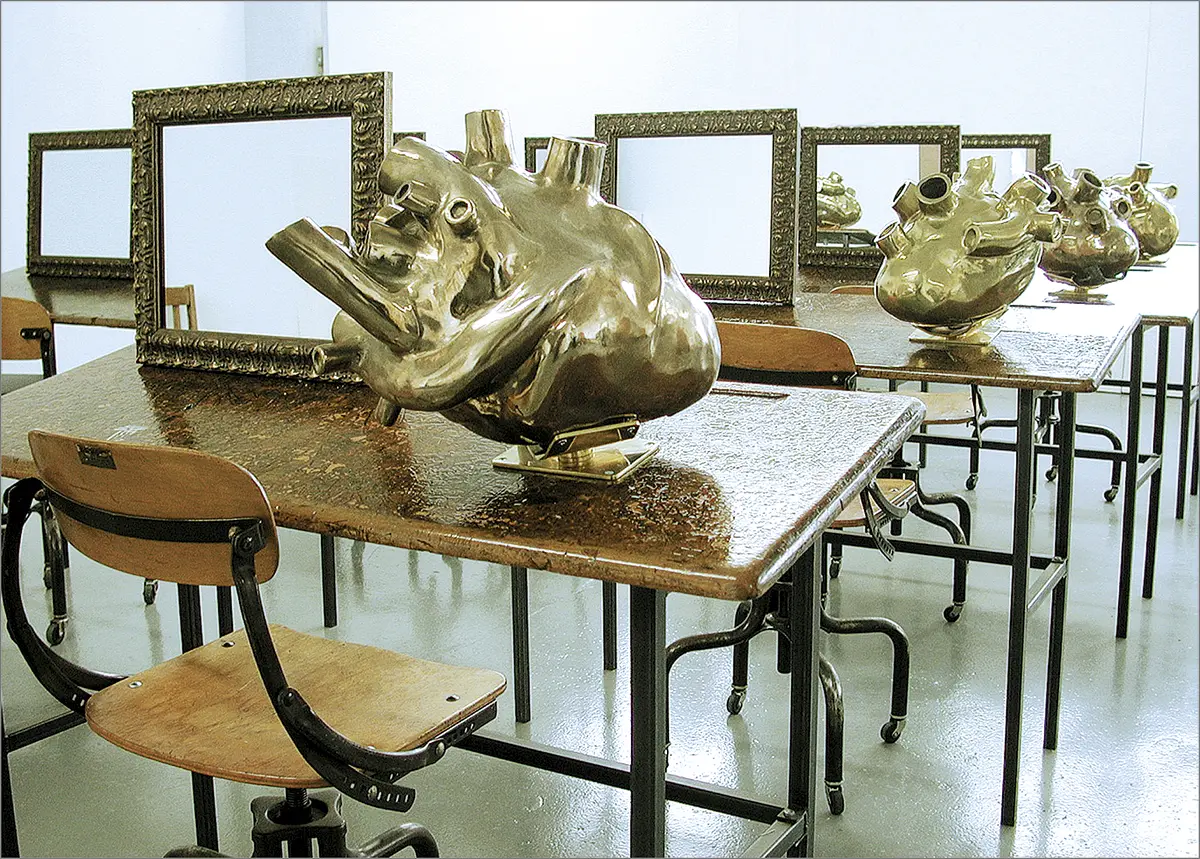
The most affecting image of all comes from a live video feed in the gallery, bringing the visitor’s own image inside the heart’s chamber. This is when the work comes to life, and one realizes that the whole experience is not about the artist’s Venezuelan childhood or the kids who studied at those desks, but instead about the present, in which the spectator has become part of the installation, both through his video likeness inside the sculpted heart and from the image reflected in the gilded mirror mounted on the top of each desk. The effect is to bring us back to our own time as kids, in the playground, at lunch time, and in classrooms.
The vintage 1940s desks are richly marked by age and their use by a number of students who wrote and carved their names all over them. It becomes obvious, however, that these desks are no longer meant to be used by school children, since the newly fabricated metal legs added to them are tall enough to allow an adult to sit comfortably on them. As the visitor sits in front of the desk, it is his image that is seen reflected on the square gilded mirrors that are mounted on top of it. It is as if Damast invites you to look into the past, to reflect on what became of you in the present.
Damast, who has lived in New York for the past 30 years, obtained the desktops from the storerooms of schools in the Bronx. The anatomical human heart remains a strong reference throughout Damast’s work. There is a naïve sentimentality attached to it, as the artist suggests that, no matter how much we learn intellectually from our schooling, it is the heart -and the lesson learned there- that determines who we are throughout our passage in life. The heart image reappears throughout the artist’s work—in her drawings, paintings, and sculptures. Also included in this exhibition were sketchbooks, drawings, and two small sculptures designed to fit in the palm of one’s hand.
CLAUDIA CALIRMAN