
It would be simple to say that the work of Ruth Vollmer and Gego, German artists who were almost unknown in their lifetimes (and quite possibly unknown to each other) was about the exercise and study of projections of geometric volumes in space. The exercise and study of geometry is the province of mathematicians; the work of artists is to translate those disciplines into another language.
Thinking the line helps understand the extraordinary latent force that seems to oppose one another, these two artists, whose work was exhibited at the Miami Art Center (MAC), headed by Rina Carvajal, under the curatorship of Nadja Rotter. As a viewer confronted with their works, one enters into a process that demands a very sharp level of appreciation. It is not easy to place oneself before the work of so special a pair of artists, given the fragility of their pieces but not of their ideas, which revolve around a new relationship with volume, space, and the transparency of light.)
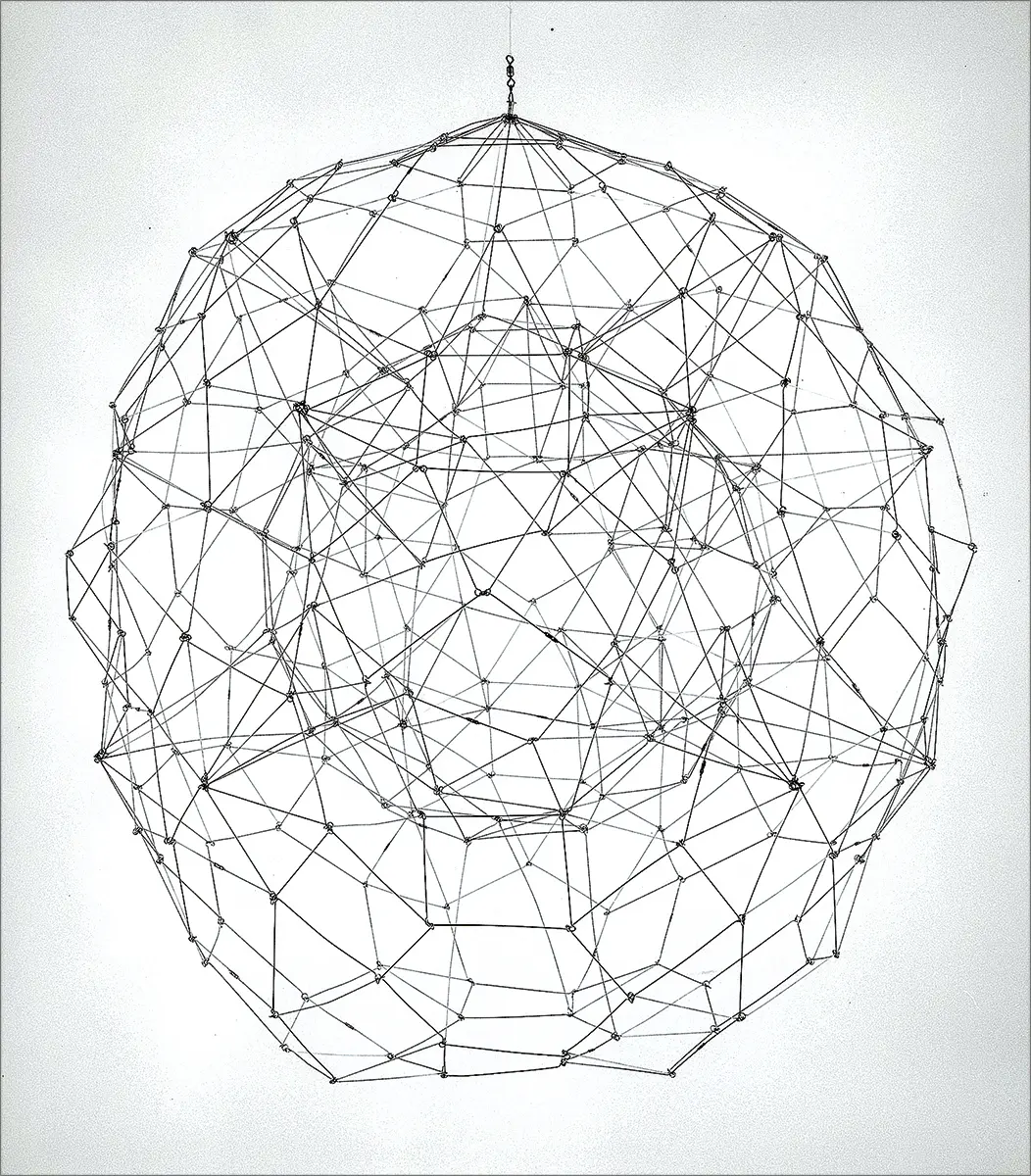
In this show, one may even end up experiencing the visions and doubts that the artists saw or confronted.
Most of Gego’s and Vollmer’s works were created between the 1960s and the 1990s. The case of Ruth Vollmer is special. In the catalog, Nadja Rotter and Rhea Anastas leave it very clear their association with the first generation of minimalist artists in New York, like Sol Lewitt, Richard Tuttle, Eva Hesse, Dan Graham, Mel Bochner, Jo Baer, and especially Robert Smithson, who was already a student of rock formation. Probably, Smithson identified in some way with Ruth Vollmer's studies in conceiving his Jetty spiral, as the spiral is a constant in Vollmer’s work. It is interesting to note that her name does not appear in the large bibliography around minimalist art.
When geometric form is discovered as artistic expression, it can reveal an as-yet unknown potential.
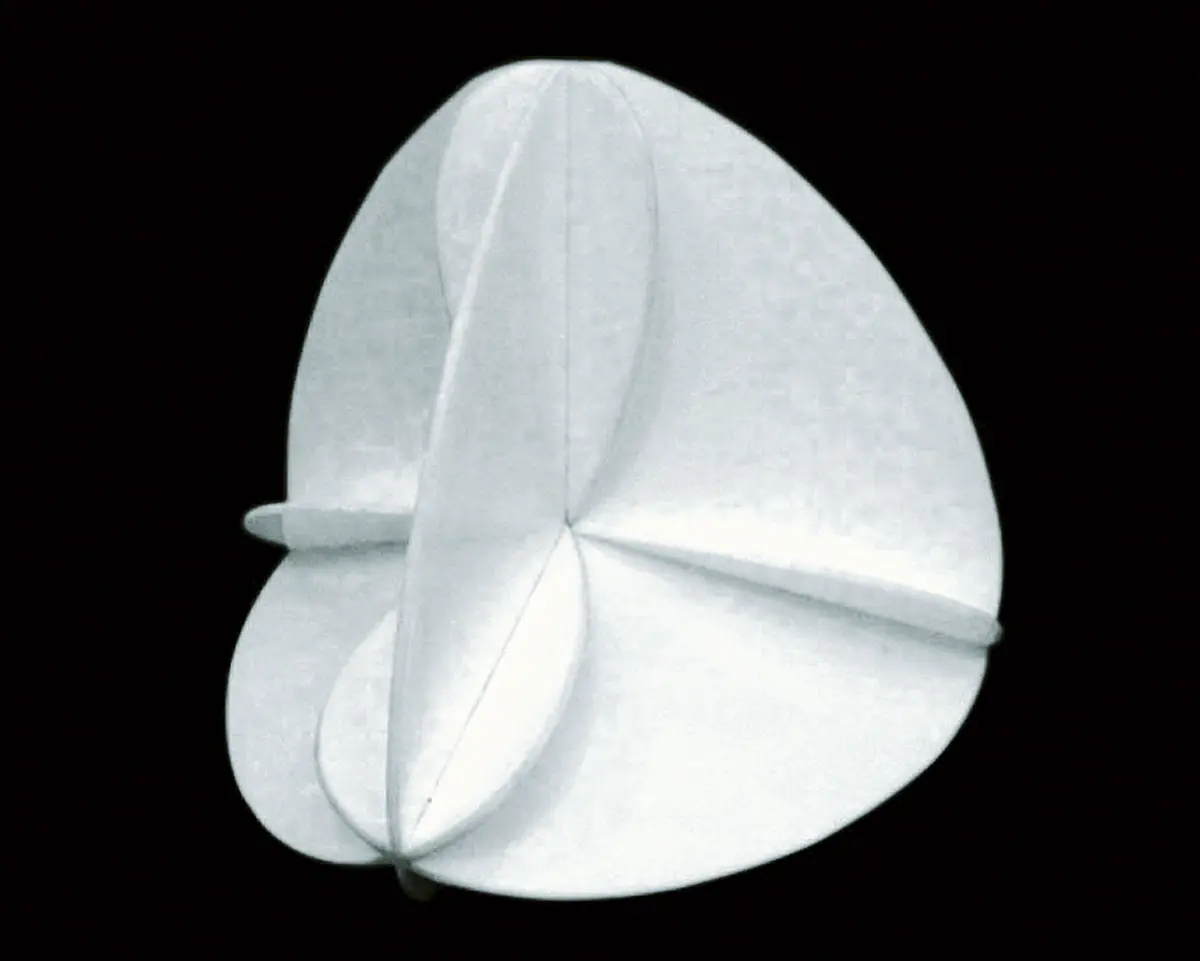
That was perhaps the impact of Ruth Vollmer’s work on her minimalist friends, starting in the 1960s. The time was ripe, as a new generation of younger New York artists sought to break with Abstract Expressionism and Pop Art, and attempted the discovery of a language more closely related to interdisciplinary evolution methods.
Ruth Vollmer’s interest in geometry related to the formation and nature of minerals, geology, and crystallography. Her spheres or volumes, somewhat crystalline, through transparent plastics like opaque volumes, built or welded in metal, reveal an energy that is contrary to expansion, that is to say, an energy that contracts in order to acquire solidity. However, in the late 1960s, these volumes became modules for sculptoric proposals, conceived to be placed on the floor in the manner of installations.
Ruth Vollmer and Gego are perceived as two very different artists, despite the fact that both of them were interested in geometry. There are differences, but there are also points of convergence.
The differences deserve study: Gego’s work is light, playful, mischievous, while Vollmer’s feels enigmatic and distant. Vollmer seems to have been interested in alchemy and the Gothic; interestingly, Mondrian had similar interests.
However, Ruth Vollmer’s work is only now starting to be known. There will soon be a specialist to analyze these issues more extensively.
In other latitudes, where culture has always had a different rhythm, Gego developed her oeuvre in a more spontaneous manner. Artists such as Lygia Clark, Hélio Oiticica, Alejandro Otero, and even Jesús Soto found in Latin American culture a different rhythm in the way of thinking and feeling the geometric tradition, and the result was the great dialectic of generosity, passion, and defeat.
In Latin America, Gego developed some of the most unexpected and interesting shifts in modern sculpture. In Caracas, her art had only one precedent, Reverón’s paintings, perhaps the first “scientific” experience in Venezuelan art before Soto’s and Cruz-Díez’s kinetic explorations and Gego’s “strange” creativity; the latter, whose relationship with kinetic art was never easy, was practically relegated in Caracas and internationally.
Locating Gego was always a headache, but now the headache goes in the opposite direction. In 1965, Gego was included in the Op-Art exhibition The Responsible Eye, at MoMA in New York. However, during her lifetime, her work did not conform to any single artistic movement.
Gego had a firm mastery of the language of engineering and architecture, but she was more interested in the liberation of architectural norms and the expansion of the expressiveness found in the precarious nature of her materials. The line is the element that brings together and sets apart these two artists. Gego saw the line as an independent, wily, irreverent element that, intelligently, occupied spaces and created its habitat. Her line did not come from the intellect; it came from an entirely different dimension, unrelated to the brain.
Gego always paid great attention to the dense vegetation of the tropics, and she traveled to the Amazon rainforest during her early years in Venezuela. This relationship with Nature’s “architecture” defies the unpredictable character of her line. Nevertheless, it can be said that Gego brought her line from Germany, only to free it and leave it to act on its own accord in a borderless, fertile place of her imagination.
Especially in the series Dibujando sin papel, Gego builds the line as a three-dimensional drawing through a great variety of wires and other metallic pieces. These lines form a Quixotic panorama of incredible and magisterial solutions, a product of the constant joy she found in inventing through her faith in the power of intuition.
Ruth Vollmer seems to use the line in order to move in and out of the labyrinths of mystery. The line is used with the discipline of an archaeologist to understand the origin of shapes. Her “Gothic” spheres and her studies on paper have a family resemblance to Leonardo da Vinci or Dürer.
Thinking the line not only connects us with a group of masterful works of art, but it also brings us into contact with one of the most important elements of art, which, since the Renaissance, has been one of the main interests among artists: the line.
EUGENIO ESPINOZA