
Thanks to its great conciseness, the title of this show is a precise indicator of what the viewer will find inside the São Paulo Museum of Modern Art. Não-cor cor is the first large retrospective devoted to Hércules Barsotti, who figures historically in the process of incorporating abstract geometric languages into Brazilian art.
Barsotti’s career has followed a singular trajectory. His artistic production develops in the terrain formulated by Concretismo in Brazil. Despite being a São Paulo native, he was able to cultivate his independence with respect to the Ruptura group, a collective of Concrete Art practitioners based in that city and centered on the catalytic figure of Waldemar Cordeiro. Starting in 1954, Barsotti was very active as a graphic designer, after founding, with his constant companion and interlocutor Willys de Castro, the Graphic Projects Studio. Barsotti and de Castro are widely acknowledged as pioneers in the renewal of the graphic language used in magazines and institutional brands, especially during the 1950s. In 1958, a European sojourn made possible Barsotti’s encounter with Max Bill, which was to influence the subsequent path followed by the latter’s work. Barsotti was back in Brazil by 1959, and at the invitation of Ferreira Gullar, he became a member of the Neo-Concrete group and took part in the two shows they held in Rio de Janeiro.
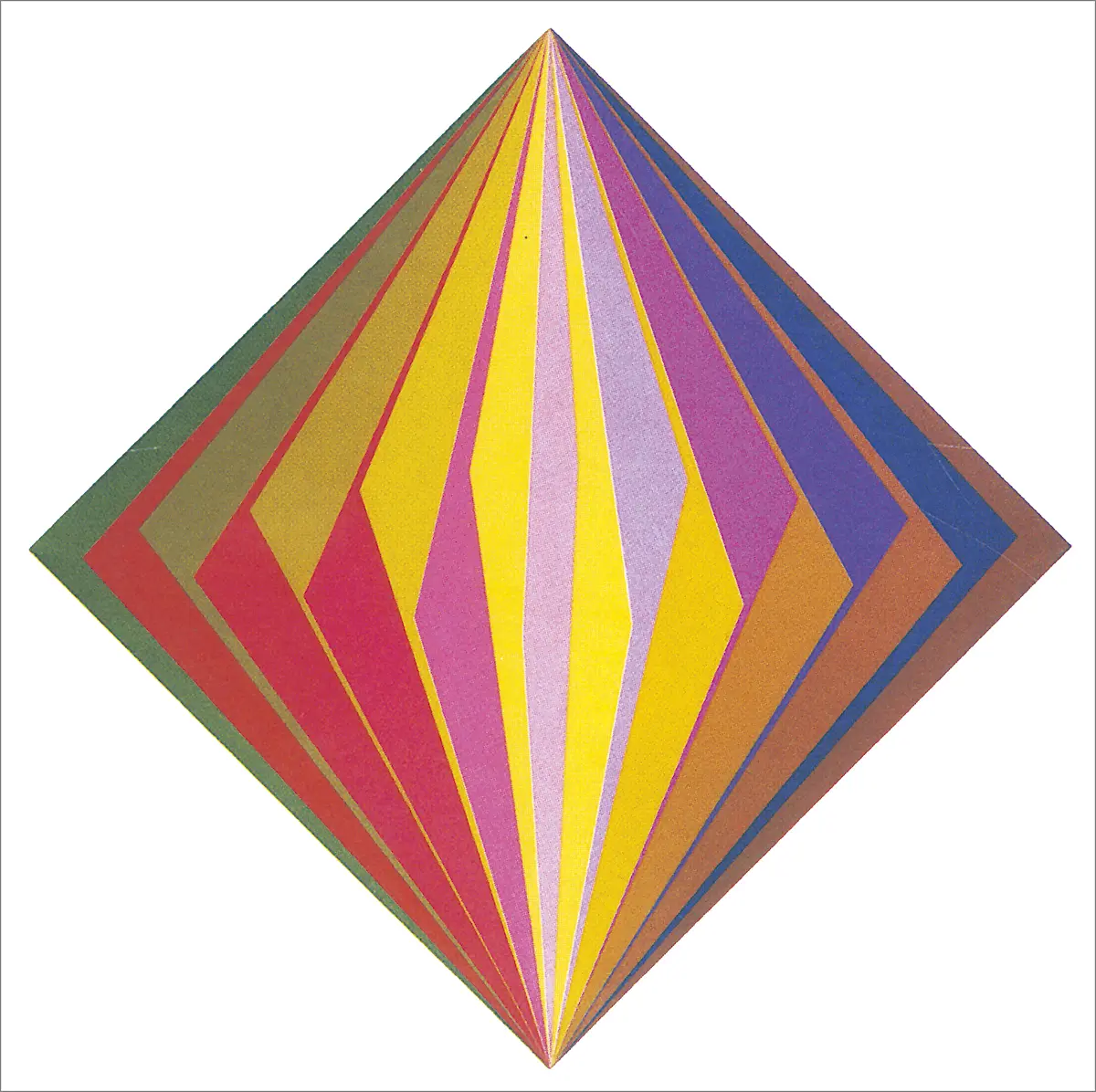
In fact, although the precise vocabulary that characterizes Barsotti’s work was derived from Concretismo, the way in which his pieces constantly invoke spatial notions and act upon the viewer’s sensitivity brought them closer to the Neo-Concrete experience. Based on Gestalt principles, the artist made discrete alterations on fields of highly contrasting black and white, provoking sensations of sliding planes or curves in the surface of the canvas. He destabilized regular formats, blurring the distinction between ground and figure. At a certain point, Barsotti began to hang his support—always a square—by a corner, turning it into a rhombus from the viewer’s perspective. The structural ratiocination that governs his work was thus made apparent in the emphasis placed on the painting’s internal balance. The square’s diagonals, now placed in a vertical and horizontal direction, recovered not only their common point of reference with the viewer, but also the orthogonal shape of the location’s architecture. At other times, Barsotti also paints the sides of the frame, in this way suggesting an expansion of painting beyond the two-dimensional level of the canvas. Like Willys de Castro, Hélio Oiticica, and Lygia Clark during the same period, Barsotti posed a debate between the two-dimensional nature of painting and the three-dimensional character of the painting-as-object.
The period of Barsotti’s closeness with Neo-Concrete art is presented in the exhibition’s first section, under the title Não-cor (“Without Color”). There, we find only works in black and white, whether they are gouaches on paper or oils on canvas. The correspondence between Barsotti’s paintings and his graphic works is at times so evident that the artist himself refers to some of his oil paintings as “design.” In this section, we also find some displays containing exercises and experiments using newspapers and folding techniques, following the teachings of the Bauhaus, many of which connect with the experiences developed in the same period by Clark and Amílcar de Castro. Two “active objects” by Willys de Castro were included in the show in order to make explicit the intense dialogue between the two artists during this period.
Color was to enter Barsotti’s work starting in 1963, when the artist started using acrylic paint, which at that time was an imported material that was hard to obtain in Brazil. Barsotti’s works from 1963 to the present are included in the second section, titled Cor (Color). The possibility of creating homogeneous color surfaces without a trace of the artist’s hand seems to have seduced Barsotti immediately and driven him to use acrylic paint. The construction of his color canvases begins with the physical compression of the effect of one color on another, as well as of all the colors on the eye of the observer. The artist never uses pure colors, nor does he attempt to combine hues by superimposing layers on the canvas. The whole range of colors is rehearsed and defined a priori; they correspond to a project. Significantly, the retrospective also includes some of Barsotti’s projects, carefully executed on paper. In them, we clearly perceive how the decision to use certain chromatic values is a decision made by the eye. The decision of placing them one next to the other —even if Barsotti approximates colors whose coexistence would seem improbable— makes them activate each other, producing a special vibration on the surface of the canvas.
Finally, Não-cor cor has not been built only upon a judicious and intelligent selection and articulation of Barsotti’s works. The exhibition’s arrangement and display deserves especial mention as well. This is an exhibition of paintings (most of the works are in that genre), yet there are no large continuous planes of panels, the usual structure in such shows. On the contrary, in this show, modular panels were placed to create small openings and separations that forced viewers to follow the exhibition in a diagonal direction. Similarly, two of the display cases holding dresses created in the 1960s using textile designs by Barsotti were boldly presented at an incline. In a way, we can say that the show transfers to real space some of the proposals the viewer encounters in Barsotti’s art. What was a rational exploration of spatial relationships in two-dimensional space begins to be experienced by the body as a spatial proposal in three dimensions.
VALERIA PICCOLI