
Acclaimed as one of Latin America’s most imaginative artists, Ignacio Iturria is recognized as the creator of a fascinating, toy-like world of tiny characters perched in cardboard condominiums or engaged in nonsensical tasks. With humor and irony, Iturria presents a view of the ordinary in the most extraordinary of ways. This exhibition presents more than 50 paintings and mixed media constructions from the 1990s to the present. Curated by Wayne Baerwaldt, Director of The Power Plant in Toronto, where it will travel in March 2005, the selection offers a surprisingly complete view of the artist’s incredibly prolific career, as well as clear evidence of the sophistication of his processes. A small complementary exhibition at Praxis International Art in Coral Gables brings the monumentality of the museum show to another, more personal and inviting level, and speaks to the artist’s residence in Miami for a few months (during hurricane season, which affected the exhibition’s opening events) and the effect of white-hot sunlight on his ordinarily monochromatic brown paintings. Between the two experiences, visitors may share in the enchantment of his works and become intimately involved with his characters.
Ignacio Iturria was born in Montevideo, Uruguay, in 1949 and has lived in the Basque region of his heritage and traveled extensively over the years, maintaining his residency in Montevideo. He says that his art is based on “previous experiences,” and there is no doubt that these experiences influence his creative process. In the carefully arranged spaces of the museum, one is immediately struck by the effectiveness of an installation that not only unites large-scale objects with “furniture” and paintings, most of which are beyond two-dimensional in format, but also includes the very unique and personal touches of the artist with drawings and other playful devices placed directly on the walls. At every glance, there is something to see, and the immediate response is to consider the works in a rather humorous context, like urban kitsch, until closer investigation reveals their complexities, both conceptually and technically.
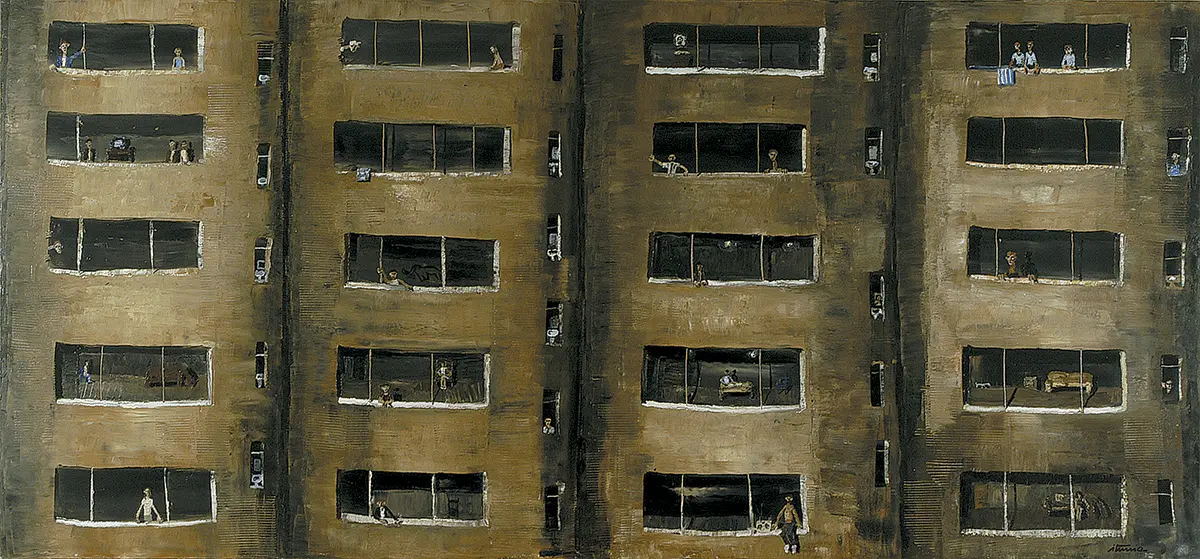
Iturria works primarily with cardboard and paper, and everything he does may be related to a constructive process. His familiar monochromatic paintings on cardboard are created by cutting (he considers the act of cutting as significant as the act of painting itself) and using paint in globs to make his strange little figures. The muddy waters and dry plains of the Rio de la Plata influence the brown tonalities, and cardboard houses are often a reality in the poorest barrios of Latin America, and contribute to the “brown-ness” of the city of Montevideo. The figures are toy-like puppets in paint, and their environment is like a stage from which to perform or appear. The arrangements of his characters are determined by some memory of time and place. He says painting is like hypnosis. It gives him the ability to fly back in time; a way to understand the past and the happy days of childhood with his brothers playing and sitting together around a table (they are often represented as forks and knives). Cutting adds a unique dimension to his work and is a way to work with light –light appears from behind and in his incredible tables (La mesa grande/The Large Table), light appears from above and below because of the cut flaps. The furniture is reminiscent of his home and modeled after actual pieces. Despite their large size and often-cumbersome appearance (Sillón Elefante/Elephant Sofa, 1993), they are actually quite fragile. Each piece is made of armatures and papier-mâché and painted. What he creates is a parallel universe to the past through the present.
In Nuestra Condominios/Our Condominiums, 2004, his oft-repeated theme of people contained in windows, grids, doorways, or other arrangements, speaks of the loneliness of the crowd, solitude, and shared human experiences. It is tempting to address matters of philosophical import and the socio-political references when contemplating Iturria’s crowds and their surroundings. However, after a lively discussion with the artist himself, I prefer to regard his works with the same sense of appreciation, humor and wisdom as he sees his world and imagine his family home in Montevideo, disputes over food and toys that come naturally in a house full of boys, fascinating travel experiences, an appreciation for the Pre-Columbian past, cityscapes of the imagination, and dreams for the future.
CAROL DAMIAN