
The Obra Invitada program at the Banco de la República Museum of Art seeks to generate a dialogue between the bank’s collections and contemporary Colombian art. The dynamic thus established, inviting young artists to interact with and interpret a given piece or theme in the collection, results in new and fascinating readings of the works.
As part of this program, from November 2004 through February 2005, Johanna Calle presented Ínsulas, a series of nine drawings that establishes a link with a not-so-evident segment of the Banco de la República collection. Unlike her predecessors, Johanna Calle moves somewhat away from the visual art items and looks instead at the bank’s book collection, housed in the same “cultural block,” at the Luis Ángel Arango library. Her most specific interest, and her starting point, was Antoine de Saint-Exupéry’s The Little Prince, a book that has been present throughout her artistic trajectory thanks to its ambivalent status as both children’s tale and grown-up fable.
According to the artist, Saint-Exupéry’s idea of referring to his childhood as his place of origin, “as if it were a country,” is fundamental to her own work in reference to the territory that marks the existence of each individual, and it is there that Calle’s acute interest in the topic resides.
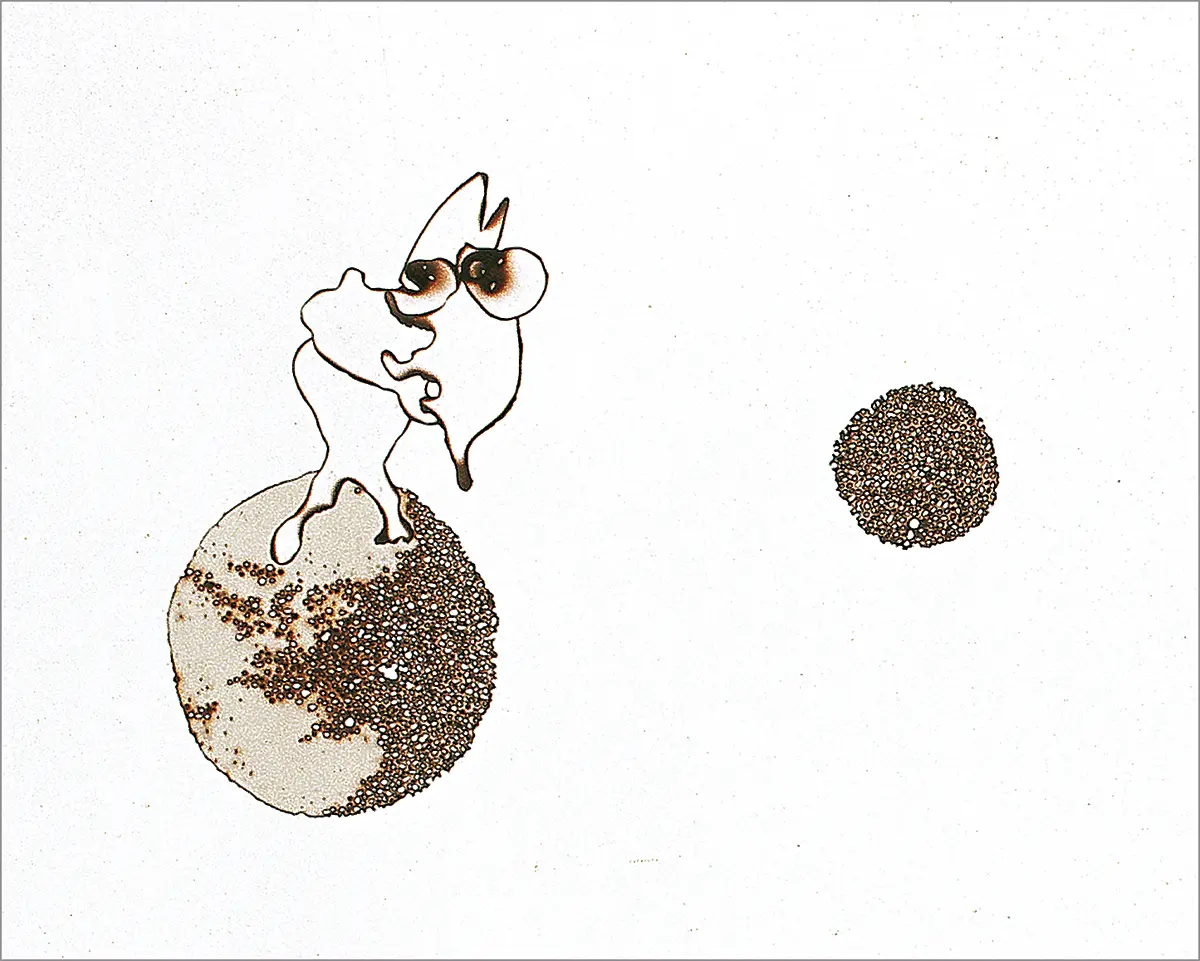
Continuing with an investigation that has been constant in her work, Johanna Calle blurs her technique. She proposes, once again, a transgression of the traditional drawing regime, as she has done in the past with works like Nombre propio, where she used needle and thread to draw the faces of abandoned children published by the Instituto de Bienestar Familiar (1997/1999,) or Las chicas de acero (1998,) in which she uses a pin to perforate on paper the faces of fifteen adolescent girls kidnapped by the ELN. This time around, using pyro-engraving on paper, Calle draws nine planets with their outsized inhabitants. In terms of technique, this experience represents a challenge for Calle, since her previous work has been characterized by precision and rigor. In this case, she needed to incorporate the haphazard nature of fire, which is often uncontrollable, to her painstaking way of working. While what we have here is, as in her previous work, the mantra-like repetition of a single gesture in order to reveal an image, in this case the gesture is often difficult to control, and fire brings up marvelous, frightening character that approximate Otto Dix’s or George Grosz’s political caricatures but also characters from Aesop’s fables, such as the turtle and the hare. Although there are references to the world of children’s fantasies, something that harks back to Calle’s beginnings in art, since she has spoken of her early fascination with the illustrations in volumes of tales by Kästner, Lindgren, and the brothers Grimm1, something here is, as in those stories, rather sinister.
The word Ínsula, which refers to a small territory or Estate, is the first point of contact between Calle’s drawings and the book, bringing to mind Planet B612, where Saint-Exupéry’s character lived. Beyond her pieces’ resemblance to the illustrations in The Little Prince, the artist is interested in exploring one of many possible readings of the book, one that focuses on power and the absurd. Calle’s ínsulas, like Saint-Exupéry’s planets, are inhabited by painfully human characters. Yet, the king without subjects, the vain man, the businessman, and the lamplighter are replaced by a series of hybrid human/animal characters that swing above planets that are usually drawn at a smaller scale, like jugglers on a circus ball.
The poignancy of these drawings resides then in the ambiguity of the territory they propose, between the “real” geographic place —they are allusive to a state in Latin American power relationships that is well known by all of us– and the mental states of fantasy and fright.
The technique used is not only an artistic means; it is at the same time a conceptual statement. This fire pencil destroys and erodes paper, leaving in its wake a texture of desolation similar to a moonscape. As always, Johanna Calle returns to the subtlety that transforms her work into something almost humble in terms of its presence, but powerful in its statements.
NOTE
1. Johanna Calle, in interview with Carmen María Jaramillo, in Otras miradas, catalog of traveling exhibition 2004.
MARÍA CLARA BERNAL