
Julio Larraz had an exhibition at Marlborough Gallery’s New York venue at the end of the year that was not only the most important exhibition that he has ever had in the city, but it also turned out to be a huge financial success for the artist: At the end of the exhibit, all the important paintings were sold.
Larraz has a well-known canon of figurative work that has been appreciated for years amongst Latin American as well as American collectors. As a matter of fact, I was able to inquire as to the background of most of the buyers, and it was interesting to note that from this particular exhibit, most of the works sold went into American collections, many of which do not own any other works by Latin American artists.
The theme of this Recent Paintings show was a series of large-format paintings that are studies on power and status as seen on several strong, isolated figures placed within settings that are as much a reflection of their environment as they are extensions of the power the figures are emanating. Whether an open political statement such as the one on The Comedy of Power, which represents a typical Latin American first lady riding on an official government car, surrounded by generals very much in an Evita fashion, or the more subtle E Pluribus Unumun in which a very similar figure is also riding an official-looking vehicle, the black window of the car frames the face of the powerful lady with the same effect that a golden crown empowers a sacred image in an icon, her extravagant jeweled necklace, another obvious attribute of the ruling class.
There are also depictions of men that looked like retired dictators such as the ominous Omerta, which features an elderly gentleman with the aged features that resemble a shark, surrounded by a baroque fresco typical of Venetian palazzos, and grasping the edge of the armchair with a similar gesture of Velazquez’s famous portrait of Leo X that so fascinated the early works of Francis Bacon. For you, Anaxagoras also depicts an aging man of power, this time accompanied by a falcon that is poised on his right hand, and that maybe a commentary on the owner’s rapacious nature.
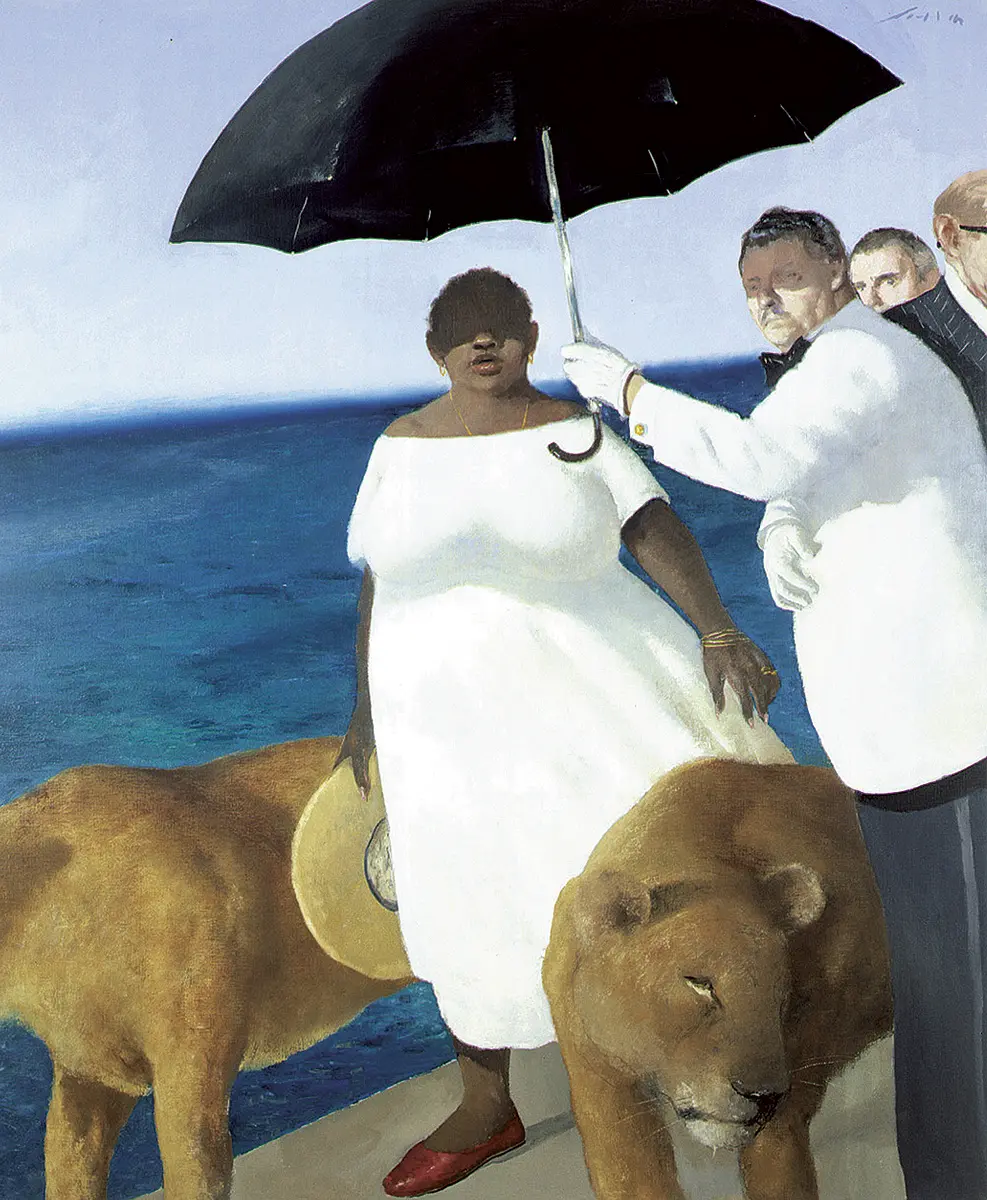
The catalogue, a very well illustrated work with an excellent essay by Edward Sullivan, a well known international authority on Latin American Art, had on the cover, perhaps the most effective image of absolute power, The Casabianca Compat, which depicts an African Queen or a Caribbean tyrant, surrounded by courtiers on a beach front, a white gloved servant that looks perfectly European, in an interesting play on reversal of fortune, holds a huge umbrella over her proud head, she is taking two huge lions for a walk on the water, and like an ancient goddess, is wrapped in a voluminous white dress and wears an excessive amount of gold jewelry. The painter has added his own portrait amongst the crowd of favor seekers, as if ironically commenting on the role of the artist in a world where there is still a strong dependency on the patronage of the powerful.
Other paintings in the exhibit showed Larraz’s technical abilities in Still Lives, landscapes, and nudes that are direct descendants of the classical tradition of Ingres, but it was the psychological analysis of the power figures that made the exhibition remarkable. The subtle quality of the details has placed these figures in the realm of the third world, where such totality of power is still the standard rather than the exception. Larraz manages to capture the setting through his use of light and shadow, the perfect costumes and accessories, the attendants, and the architectural grandeur, all configure a manifestation in painting of the same power figures that are so prevalent in the writings of García Márquez.
ALBERTO BARRAL