
Many of those who came to see Lihie Talmor’s recent show at the Blasini gallery ended up in tears; some cried so much that there was, in the exhibition space, a kind of emotional humidity loaded with pain, rage, and incomprehension towards certain human acts.
Let’s explain why so much crying around an aesthetic proposal: the show, titled Allí me encuentro, pero no me pueden ver, presented a group of 103 small-format color photographs that allowed viewers to reenact, frame by frame, a visit by a group of Muslims, Christians, and Jews to one of the world’s most beautiful and darkest forests: Auschwitz, the Polish location where some time ago, during World War II, nearly 4 million people were killed.
The initial images were of a group of 280 joyful travelers who didn’t seem to have yet registered, as they left for Poland, what it was they were going to see and feel as they stepped over every inch of terrain in the old Nazi concentration camp: a site that displayed the darkest hues in the chiaroscuro of life.
As they move forward, the story told by the photographs becomes sadder and more difficult to bear: details of barbed wire, shots of the barracks’ latrines, the image of tall trees that witnessed such irrational cruelty, the rails for the train that brought the millions condemned to a season in Hell; the inscription at the entrance to the camp (“Work will set you free”); and suitcases, many suitcases.
Talmor recorded every moment of the trip using a mini DV camera, and later printed selected shots in photographic paper. This technique allowed viewers to access the story of the journey on paper, but also in motion, since after finishing the tour through the 103 images, viewers entered a second room where a TV monitor offered, now in video, the experiences of this particular group of Muslims, Christians, and Jews.
Talmor was present during the whole trip to Auschwitz, but no one saw him at the show. Some think she adopted the position of an omniscient visual narrator in order to show the kind of beauty in which she believes: the beauty that is born of life’s hardest aspects. Others think that she simply didn’t want her artist’s face to be seen, so she covered in tears. Covered with so much salt.
Two moments are key in the imaginary presented by the artist through her photographs and video: the ironic statement made by Hana Tener, an elderly Holocaust survivor, who, standing before Talmor’s camera, declares that Dr. Mengele did not seem, physically, a devil. On the contrary, she remembered him as a handsome man (almost a Hollywood actor), well dressed in his impeccable nazi uniform and his unmistakable white gloves.
The second moment, much more emotional, is a view of the travelers inside one of the concentration camp barracks. Their faces are always downcast, on the verge of tears. Suddenly, the guide who is telling the camp’s macabre story of killings falls silent, and a unique scene —unique for this show with documentary elements— unfolds: an imam recites a verse from the Koran in the memory of the disappeared.
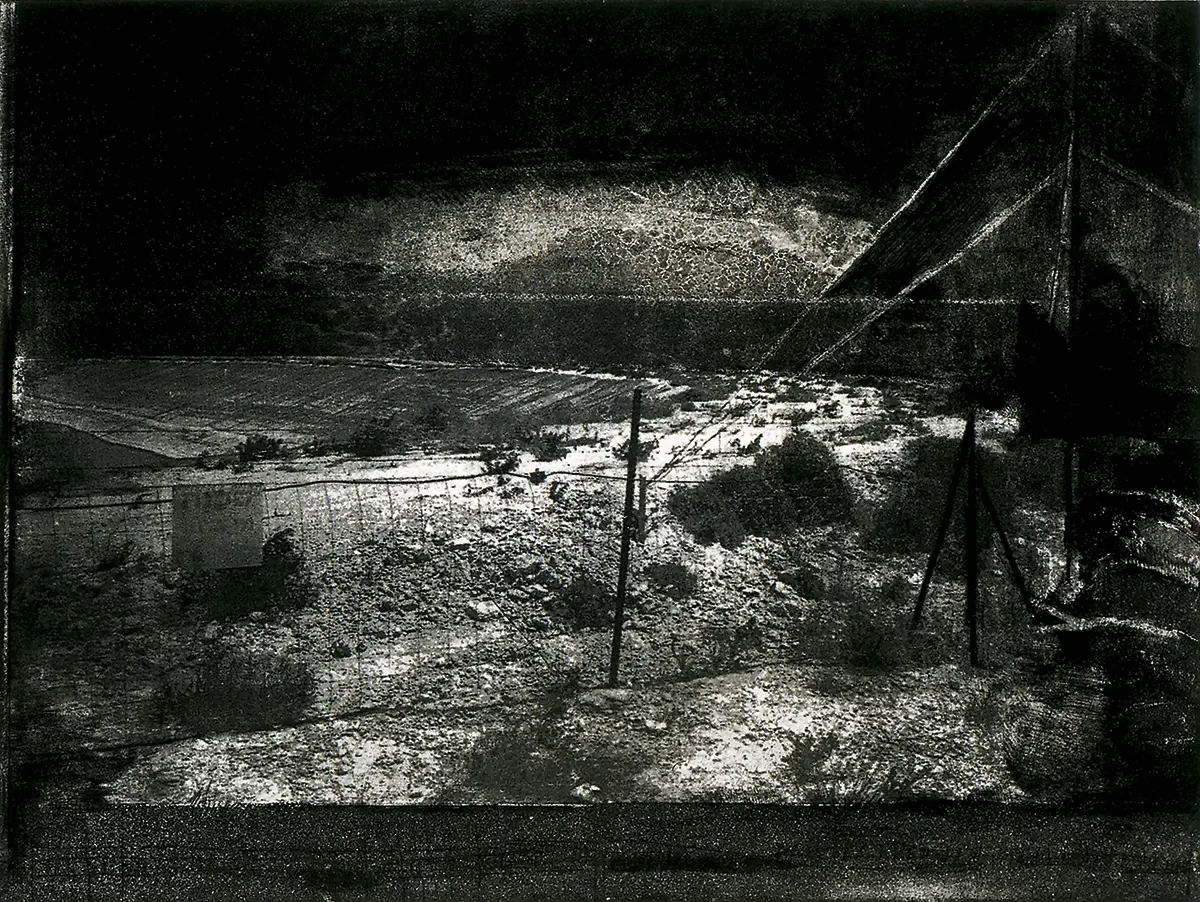
Allí me encuentro, pero no me pueden ver, which opened in October 2004, ends with two series of photoengravings: Contraseña (with images of the new border between Lebanon and Israel) and Separación-Unión (closed spaces with many protagonist objects in close-up.) Thus, the journey to Auschwitz ends.
Of Lihie Talmor’s biography, we need to mention that she was born in Tel-Aviv, Israel, in 1944, and studied architecture and Urban Planning in Haifa Technion, and Humanities and Theory at Tel-Aviv University. In 1980, she moved to Caracas, where she studied graphic arts and painting. Her work has been exhibited in many group and individual shows at, among others, Sextante gallery (Bogotá), Artist House (Jerusalem), the Caracas Museum of Contemporary Art, and the Ibiza Museum of Contemporary Art (Spain) Her previous show, in 2001 at Sala Mendoza, also centered around the topic of the Holocaust: a personal scar Talmor has been healing through the luminous tapestry of art.
PABLO VILLAMIZAR